Review
. 2021 Jan 4;20(1):2.
doi: 10.1186/s12943-020-01294-3.

Cytokine-chemokine network driven metastasis in esophageal cancer; promising avenue for targeted therapy

Affiliations
Review

Cytokine-chemokine network driven metastasis in esophageal cancer; promising avenue for targeted therapy

Ajaz A Bhat et al. Mol Cancer. .

Abstract

Esophageal cancer (EC) is a disease often marked by aggressive growth and poor prognosis. Lack of targeted therapies, resistance to chemoradiation therapy, and distant metastases among patients with advanced disease account for the high mortality rate. The tumor microenvironment (TME) contains several cell types, including fibroblasts, immune cells, adipocytes, stromal proteins, and growth factors, which play a significant role in supporting the growth and aggressive behavior of cancer cells. The complex and dynamic interactions of the secreted cytokines, chemokines, growth factors, and their receptors mediate chronic inflammation and immunosuppressive TME favoring tumor progression, metastasis, and decreased response to therapy. The molecular changes in the TME are used as biological markers for diagnosis, prognosis, and response to treatment in patients. This review highlighted the novel insights into the understanding and functional impact of deregulated cytokines and chemokines in imparting aggressive EC, stressing the nature and therapeutic consequences of the cytokine-chemokine network. We also discuss cytokine-chemokine oncogenic potential by contributing to the Epithelial-Mesenchymal Transition (EMT), angiogenesis, immunosuppression, metastatic niche, and therapeutic resistance development. In addition, it discusses the wide range of changes and intracellular signaling pathways that occur in the TME. Overall, this is a relatively unexplored field that could provide crucial insights into tumor immunology and encourage the effective application of modulatory cytokine-chemokine therapy to EC.

Keywords: Chemokines; Cytokines; Drug targets; Epithelial-Mesenchymal transition; Esophageal cancer; Immune evasion; Inflammation; Tumor microenvironment.


Conflict of interest statement

The authors declare that they have no competing interests.

Figures
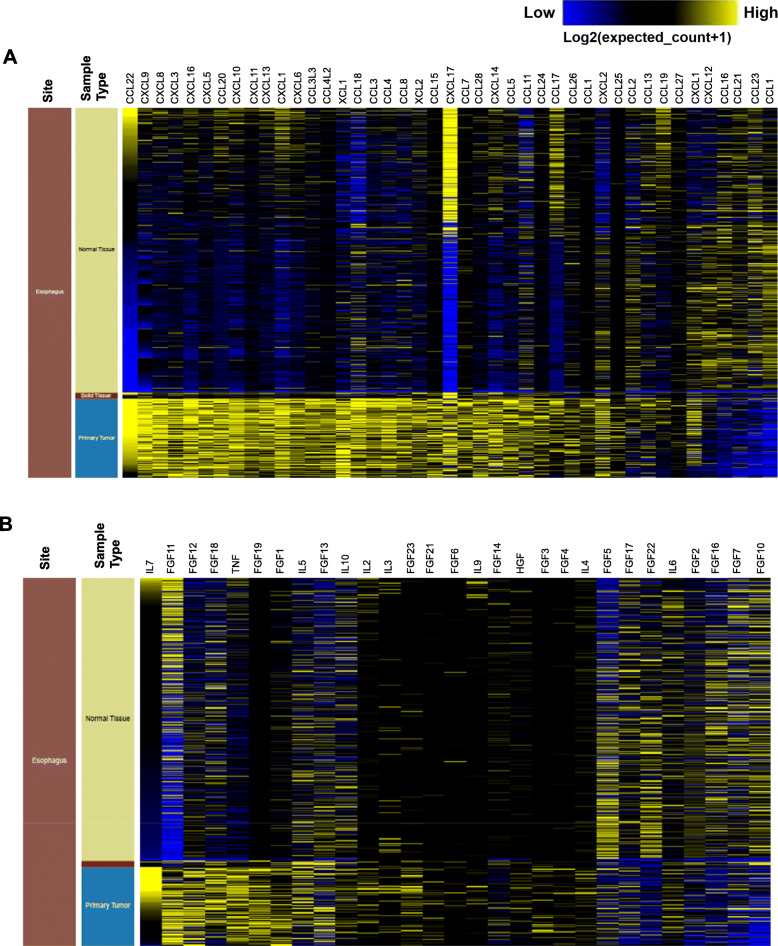
Fig. 1
Fig. 1
Cytokine/chemokine profile in esophageal tumor and normal tissues. Heat map showing cytokine/chemokine gene expression across normalized GTEX (Normal Tissue, n = 8000) and TCGA- ESCA (Tumor tissue, n = 10,431) data sets analyzed by using UCSC Xena (https://xenabrowser.net/datapages/)
Fig. 2
Fig. 2
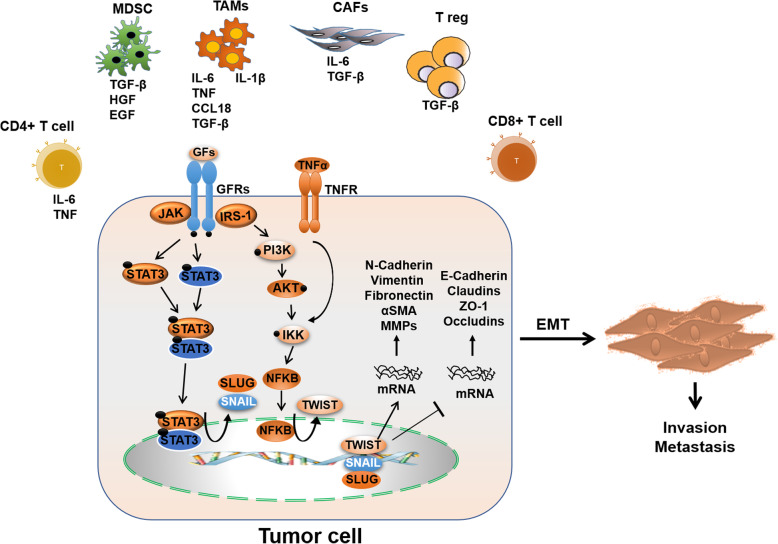
Complex network in TME orchestrating EMT. TME consists of TAMs, T cells, MDSCs, and CAFs. Through secretion of different cytokines and chemokines, it causes downregulation of epithelial marker, E-cadherin and upregulation of mesenchymal markers such as N-cadherin, vimentin, snail and ZEB1. In TME, these cells also upregulate cell signaling pathways such as STAT3, NF-kB and β-catenin, which all contribute to cell survival
Fig. 3
Fig. 3
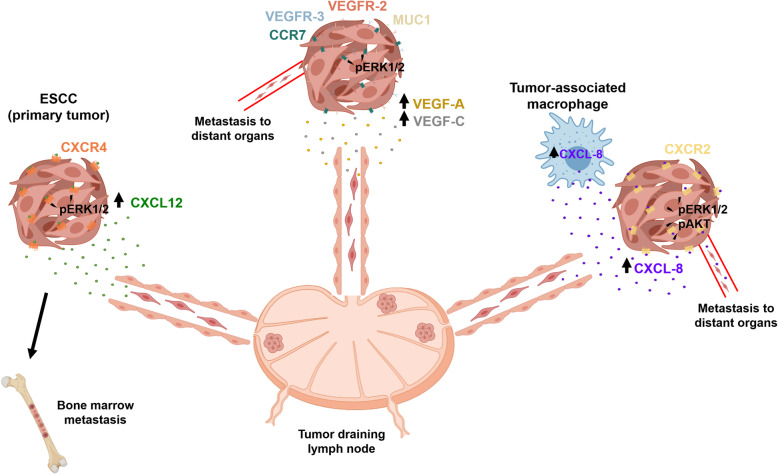
Role of cytokines/chemokines on tumor progression and dissemination. High expression of CXCL12/CXCR4 axis in primary tumor cells or/and ECSCs enhances the activation of p-ERK-1/2 and increases these cells’ ability to invade and metastasize to lymph node and bone marrow. Abundant expression of CCL21 in the endothelium of lymphatic vessels and lymph nodes attracts CCR-7-positive tumor cells. CCL21/CCR7 axis upregulates MUC-1 expression through p-ERK signaling and enhances the migration, invasion, and lymph node metastasis through the lymphatic system. High production of potent angiogenic (VEGF-A) and lymphangiogenic (VEGF-C) factors by primary tumor cells leads to a malignant process. Elevated levels of CXCL-8 secreted by primary tumor cells or TAMs induces the phosphorylation of AKT and ERK1/2 signaling pathway through the CXCR2 receptor expressed in primary tumor cells. These processes lead to further malignant progression to lymph nodes and distant organ metastasis through the lymphatic system and blood vessel. Also, circulating CXCL-8 contributes to the metastasis process
Fig. 4
Fig. 4
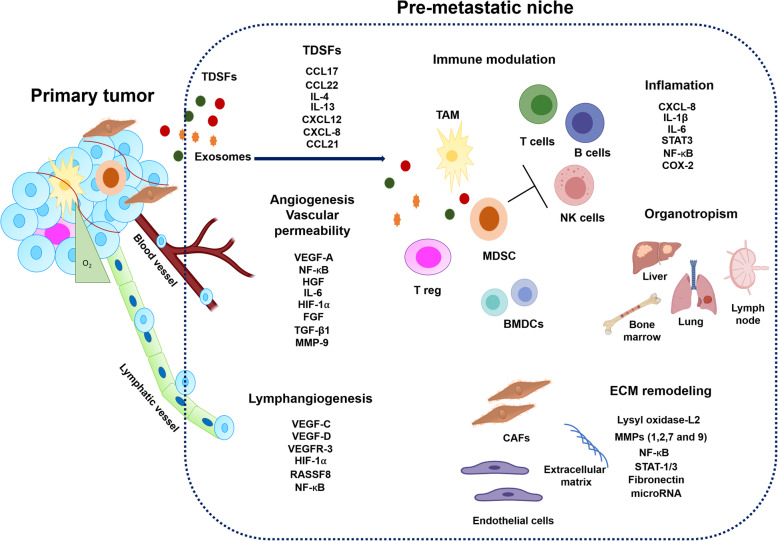
Role of Cytokines/chemokines in pre-metastatic niche formation Primary tumors establish a conducive microenvironment for eventual metastasis in secondary organs and tissue sites. A dynamic interplay between TDSFs, BMDCs, regulatory / suppressive immune cells, and stromal components in primary tumors provides an effective niche microenvironment for the tumor cells’ proliferation and metastasis. The specialized microenvironment dispels significant characteristic features that facilitate metastasis, such as inflammation, immunosuppression, ECM remodeling, angiogenesis, and lymphangiogenesis.
Fig. 5
Fig. 5
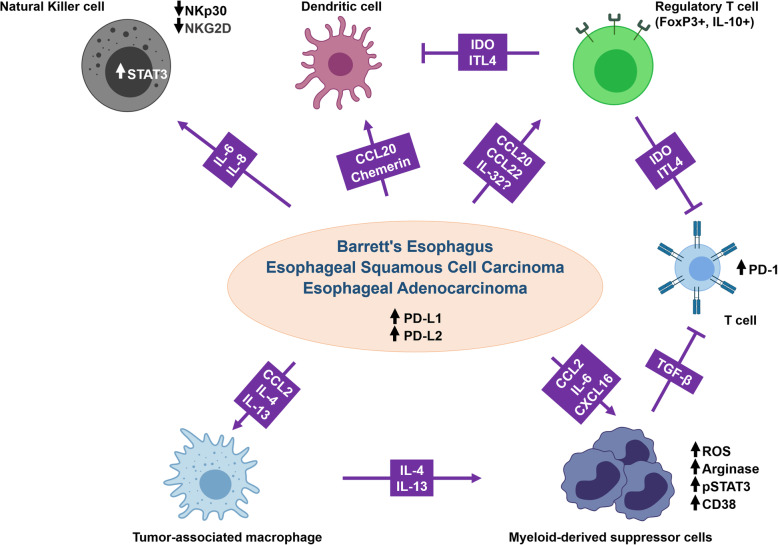
Tumor evasion from immune surveillance mediated by cytokines/chemokines in the TME. Cancer cells secrete several chemokines and cytokines that inhibit NK cells, DCs, and T cell functions and recruit TAMs. Tumor cells also induce MDSCs and Treg T cells that can further inhibit T cell function. TAMs and tumor cells both express PD-L1/2 to inhibit T-cell activation via the PD-1 receptor. Altogether, these cells suppress antitumor immunity while also promoting tumor growth and progression by various mechnisms

References

    1. Napier KJ, Scheerer M, Misra S. Esophageal cancer: a review of epidemiology, pathogenesis, staging workup and treatment modalities. World J Gastrointestinal Oncol. 2014;6(5):112–120. doi: 10.4251/wjgo.v6.i5.112. - DOI - PMC - PubMed
    1. Rustgi AK, El-Serag HB. Esophageal carcinoma. N Engl J Med. 2014;371(26):2499–2509. doi: 10.1056/NEJMra1314530. - DOI - PubMed
    1. Valverde CM, et al. Novel targets in gastric and esophageal cancer. Crit Rev Oncol Hematol. 2006;59(2):128–138. doi: 10.1016/j.critrevonc.2006.02.001. - DOI - PubMed
    1. Kuwano H, et al. Distinctive clinicopathological characteristics in esophageal squamous cell carcinoma. Ann Thoracic Cardiovasc Surg. 2003;9:6–13. - PubMed
    1. Kumagai Y, et al. Angiogenesis in superficial esophageal squamous cell carcinoma: magnifying endoscopic observation and molecular analysis. Dig Endosc. 2010;22(4):259–267. doi: 10.1111/j.1443-1661.2010.01010.x. - DOI - PubMed

Publication types