


The use of non-prescribed antibiotics; prevalence estimates in low-and-middle-income countries. A systematic review and meta-analysis
- PMID: 33390176
- PMCID: PMC7780654
- DOI: 10.1186/s13690-020-00517-9
The use of non-prescribed antibiotics; prevalence estimates in low-and-middle-income countries. A systematic review and meta-analysis
Abstract
Background: The global increase in the utilization of non - prescribed antibiotics (NPA), is concerning, with high persistence within the low and middle-income countries (LMICs). With a negative impact on the health of individuals and communities the use of NPA paves the way to the propagation of superbugs that potentially predisposes to changes in bacterial resistance patterns, antibiotic resistance (AR) and antimicrobial resistance (AMR). This study aimed at estimating through a systematic review and meta-analysis, the prevalence of NPA utilisation and describe its primary sources in LMICs.
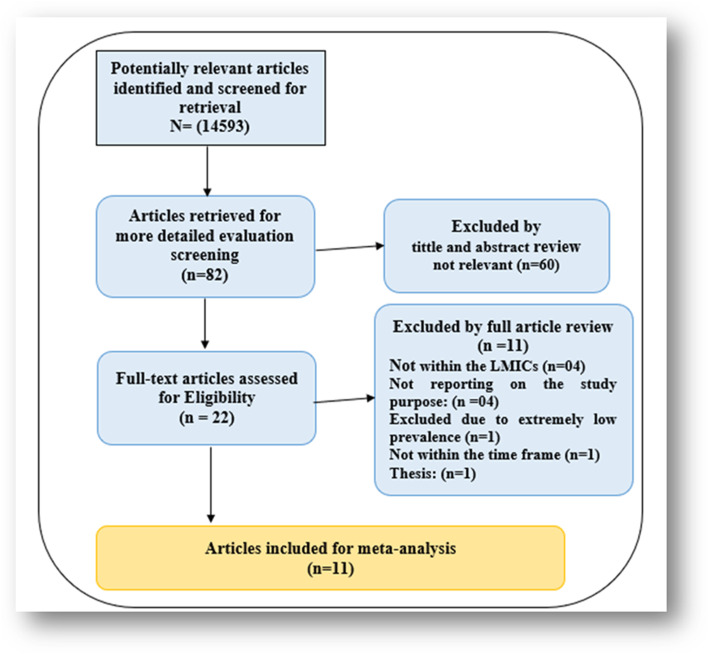
Methods: The study is a systematic review and meta-analysis which study protocol was registered in PROSPERO (CRD42017072954). The review used The Preferred Reporting Items for Systematic Review and Meta-Analysis (PRISMA) guidelines. The studies searched in databases were deemed eligible if reported evidence of practices of self-medication with antibiotics (SMA) and the prevalence of NPA utilisation within adult participants from LMICs, published between 2007 to 2017. The pooled analyses were carried out using Meta XL statistical software. The pooled prevalence was calculated with a 95% confidence interval (CI). The risk of bias of the included studies was assessed using the Quality in Prognosis Studies (QUIPS) tool.
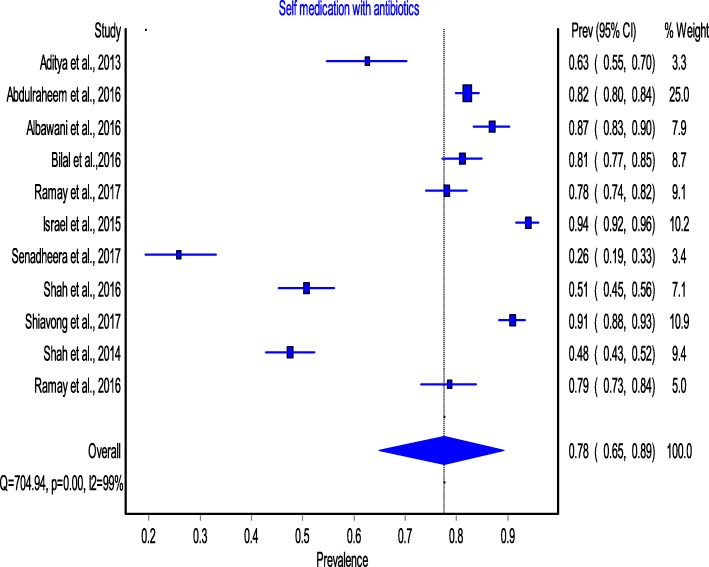
Results: The review included a total of 11 cross-sectional studies, involving 5080 participants and conducted in LMICs from Asia (India, Laos, Nepal, Pakistan, Sri Lanka and Yemen), Latin America (Guatemala), Africa (Nigeria). All studies reported existing practices of SMA, with reported prevalence ranging from 50% to 93,8%. The pooled prevalence of SMA was 78% (95% CI: 65-89%). The main sources of NPA were; pharmacies, family and friends, old prescriptions, home cabinet and leftover antibiotics.
Conclusion: This study revealed a high prevalence of utilisation of NPA in the studied LMICs, these were found to be twice as high in women than men and those participants aged between 18 and 40 years old. The review suggests f considering broader qualitative and comprehensive contextuallized research to better understand the nuances of NPA use. These would be benefitial to uncover uncover gray areas, inform decisions, support the (re) design and implementation of multifaceted interventions towards antibiotic stewardship and conservancy in LMICs.
Keywords: Antibiotic resistance; LMICs; Meta-analysis; Non-prescribed antibiotics; Prevalence; Self-medication; Sources.
Conflict of interest statement
The authors declare no competing interests.
Figures
References
-
- Alhomoud F, Aljamea Z, Almahasnah R, Alkhalifah K, Basalelah L, Alhomoud FK. Self-medication and self-prescription with antibiotics in the middle east—do they really happen? A systematic review of the prevalence, possible reasons, and outcomes. Int J Infect Dis. 2017;57:3–12. doi: 10.1016/j.ijid.2017.01.014. - DOI - PubMed
-
- Sigaúque BSE. Situations analysis and recomendations: Antibiotic use and resistance in mozambique; 2015. p.
-
- WHO. Antimicrobial resistance: Global report on surveilla.
Publication types
LinkOut - more resources
Full Text Sources
Other Literature Sources
Research Materials
