


The Human Takes It All: Humanlike Synthesized Voices Are Perceived as Less Eerie and More Likable. Evidence From a Subjective Ratings Study
- PMID: 33390923
- PMCID: PMC7772241
- DOI: 10.3389/fnbot.2020.593732
The Human Takes It All: Humanlike Synthesized Voices Are Perceived as Less Eerie and More Likable. Evidence From a Subjective Ratings Study
Abstract
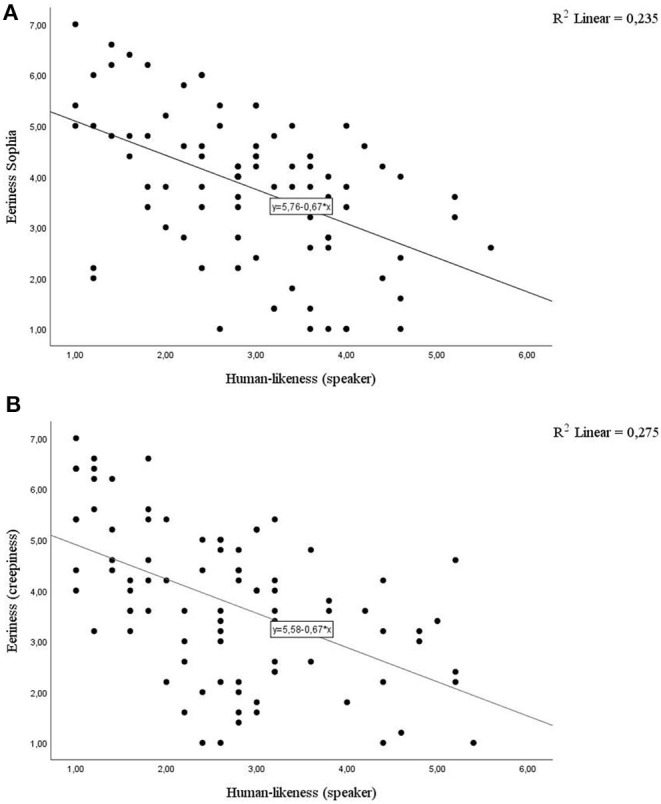
Background: The increasing involvement of social robots in human lives raises the question as to how humans perceive social robots. Little is known about human perception of synthesized voices. Aim: To investigate which synthesized voice parameters predict the speaker's eeriness and voice likability; to determine if individual listener characteristics (e.g., personality, attitude toward robots, age) influence synthesized voice evaluations; and to explore which paralinguistic features subjectively distinguish humans from robots/artificial agents. Methods: 95 adults (62 females) listened to randomly presented audio-clips of three categories: synthesized (Watson, IBM), humanoid (robot Sophia, Hanson Robotics), and human voices (five clips/category). Voices were rated on intelligibility, prosody, trustworthiness, confidence, enthusiasm, pleasantness, human-likeness, likability, and naturalness. Speakers were rated on appeal, credibility, human-likeness, and eeriness. Participants' personality traits, attitudes to robots, and demographics were obtained. Results: The human voice and human speaker characteristics received reliably higher scores on all dimensions except for eeriness. Synthesized voice ratings were positively related to participants' agreeableness and neuroticism. Females rated synthesized voices more positively on most dimensions. Surprisingly, interest in social robots and attitudes toward robots played almost no role in voice evaluation. Contrary to the expectations of an uncanny valley, when the ratings of human-likeness for both the voice and the speaker characteristics were higher, they seemed less eerie to the participants. Moreover, when the speaker's voice was more humanlike, it was more liked by the participants. This latter point was only applicable to one of the synthesized voices. Finally, pleasantness and trustworthiness of the synthesized voice predicted the likability of the speaker's voice. Qualitative content analysis identified intonation, sound, emotion, and imageability/embodiment as diagnostic features. Discussion: Humans clearly prefer human voices, but manipulating diagnostic speech features might increase acceptance of synthesized voices and thereby support human-robot interaction. There is limited evidence that human-likeness of a voice is negatively linked to the perceived eeriness of the speaker.
Keywords: human-robot interaction; paralinguistic features; synthesized voice; text-to-speech; uncanny valley.
Copyright © 2020 Kühne, Fischer and Zhou.
Conflict of interest statement
The authors declare that the research was conducted in the absence of any commercial or financial relationships that could be construed as a potential conflict of interest.
Figures

References
-
- Antona M., Ioannidi D., Foukarakis M., Gerlowska J., Rejdak K., Abdelnour C., et al. (2019). My robot is happy today: how older people with mild cognitive impairments understand assistive robots' affective output, in Proceedings of the 12th ACM International Conference on Pervasive Technologies Related to Assistive Environments (Rhodes: ), 416–424. 10.1145/3316782.3322777 - DOI
-
- Aylett M. P., Sutton S. J., Vazquez-Alvarez Y. (2019). The right kind of unnatural: designing a robot voice, in Proceedings of the 1st International Conference on Conversational User Interfaces (Dublin: ), 1–2. 10.1145/3342775.3342806 - DOI
-
- Aylett M. P., Vazquez-Alvarez Y., Butkute S. (2020). Creating robot personality: effects of mixing speech and semantic free utterances, in Companion of the 2020 ACM/IEEE International Conference on Human-Robot Interaction (Cambridge: ), 110–112. 10.1145/3371382.3378330 - DOI
-
- Aylett M. P., Vinciarelli A., Wester M. (2017). Speech synthesis for the generation of artificial personality. IEEE Trans. Affect. Comput. 11, 361–372. 10.1109/TAFFC.2017.2763134 - DOI
-
- Baird A., Parada-Cabaleiro E., Hantke S., Burkhardt F., Cummins N., Schuller B. W. (2018). The perception and analysis of the likeability and human likeness of synthesized speech, in Interspeech (Hyderabad: ), 2863–2867. 10.21437/Interspeech.2018-1093 - DOI
LinkOut - more resources
Full Text Sources
