Review
. 2020 Dec 16:11:611982.
doi: 10.3389/fphys.2020.611982. eCollection 2020.

Synaptic Properties and Plasticity Mechanisms of Invertebrate Tonic and Phasic Neurons

Affiliations
Review

Synaptic Properties and Plasticity Mechanisms of Invertebrate Tonic and Phasic Neurons

Nicole A Aponte-Santiago et al. Front Physiol. .

Abstract

Defining neuronal cell types and their associated biophysical and synaptic diversity has become an important goal in neuroscience as a mechanism to create comprehensive brain cell atlases in the post-genomic age. Beyond broad classification such as neurotransmitter expression, interneuron vs. pyramidal, sensory or motor, the field is still in the early stages of understanding closely related cell types. In both vertebrate and invertebrate nervous systems, one well-described distinction related to firing characteristics and synaptic release properties are tonic and phasic neuronal subtypes. In vertebrates, these classes were defined based on sustained firing responses during stimulation (tonic) vs. transient responses that rapidly adapt (phasic). In crustaceans, the distinction expanded to include synaptic release properties, with tonic motoneurons displaying sustained firing and weaker synapses that undergo short-term facilitation to maintain muscle contraction and posture. In contrast, phasic motoneurons with stronger synapses showed rapid depression and were recruited for short bursts during fast locomotion. Tonic and phasic motoneurons with similarities to those in crustaceans have been characterized in Drosophila, allowing the genetic toolkit associated with this model to be used for dissecting the unique properties and plasticity mechanisms for these neuronal subtypes. This review outlines general properties of invertebrate tonic and phasic motoneurons and highlights recent advances that characterize distinct synaptic and plasticity pathways associated with two closely related glutamatergic neuronal cell types that drive invertebrate locomotion.

Keywords: Drosophila; neuromuscular junction; phasic; synapse; synaptic plasticity; synaptic transmission; tonic.


Conflict of interest statement

The authors declare that the research was conducted in the absence of any commercial or financial relationships that could be construed as a potential conflict of interest.

Figures

FIGURE 1
FIGURE 1
Structure of Drosophila tonic Ib and phasic Is motoneuron terminals. (A) Representative confocal image of a Drosophila 3rd instar larval muscle 6/7 NMJ. Immunolabeling for the PSD protein Dlg is shown in red. The phasic Is neuron is labeled green with a Is-GAL4 specific line driving UAS-GFP. Dlg is found throughout the muscle subsynaptic reticulum (SSR) and is more prevalent surrounding the bigger Ib boutons (red). (B) Diagram depicting muscle SSR invaginations around tonic Ib (teal) and phasic Is (orange) boutons. (C) Diagram of MN1-Ib motoneuron innervation of only muscle 1 in a larval abdominal hemi-segment. (D) Immunostaining for anti-GFP (green) to label MN1-Ib and HRP (magenta) to label all axons in a MN1-Ib GAL4; UAS-CD8-GFP 3rd instar larva. The location of muscles M1 and M2 are indicated. Scale bar = 20 μm. (E) Diagram of MNISN-Is and MNSNb/d-Is innervation of muscles in a larval abdominal hemi-segment. (F) Immunostaining for anti-GFP (green) to label MNIs and HRP (magenta) to label all axons in a MNIs GAL4; UAS-CD8-GFP 3rd instar larva. The location of muscles M1 and M2 are indicated. Panels (C–F) are modified from Aponte-Santiago et al. (2020).
FIGURE 2
FIGURE 2
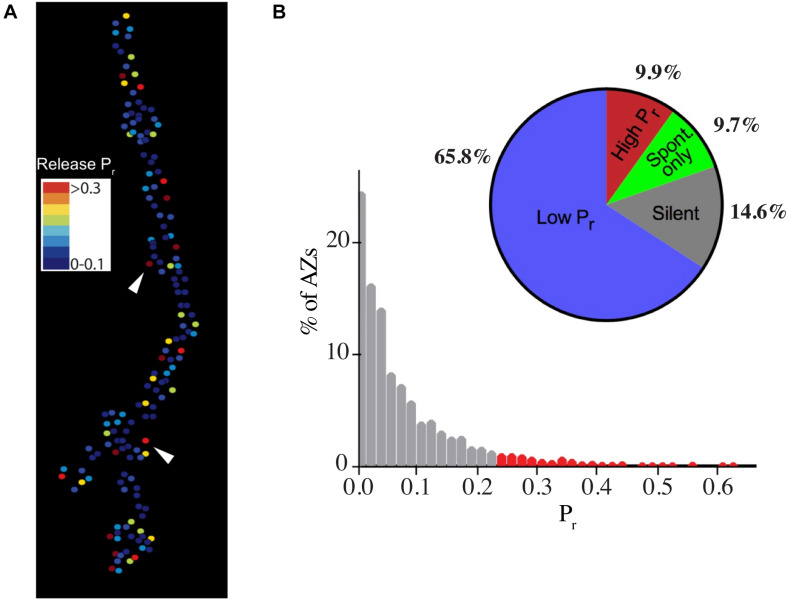
Heterogeneity in synaptic transmission strength of individual AZs at Ib motoneuron terminals. (A) Heat map for evoked AZ Pr at Ib NMJs at 3rd instar muscle 4 determined by optical quantal imaging with post-synaptic myristoylated GCaMP6s. Stronger AZs are shown in red with weaker AZs displayed in the colder blue colors. Arrowheads denote several high Pr AZs. (B) Histogram of AZ Pr distribution for 0.3 Hz stimulation for 5 min for Ib motoneurons. AZs classified as high Pr (>2 standard deviations above the mean) are shown in red. The pie chart shows the percentage of overall AZs from multiple NMJ optical imaging sessions that represent low Pr (65.8%), high Pr (9.9%), spontaneous-only (9.7%), or silent (14.6%) AZs for the Ib motoneuron population innervating muscle 4. Note the pie chart colors are unique and do not reflect the Pr heatmap. Panels (A,B) are modified from Akbergenova et al. (2018).
FIGURE 3
FIGURE 3
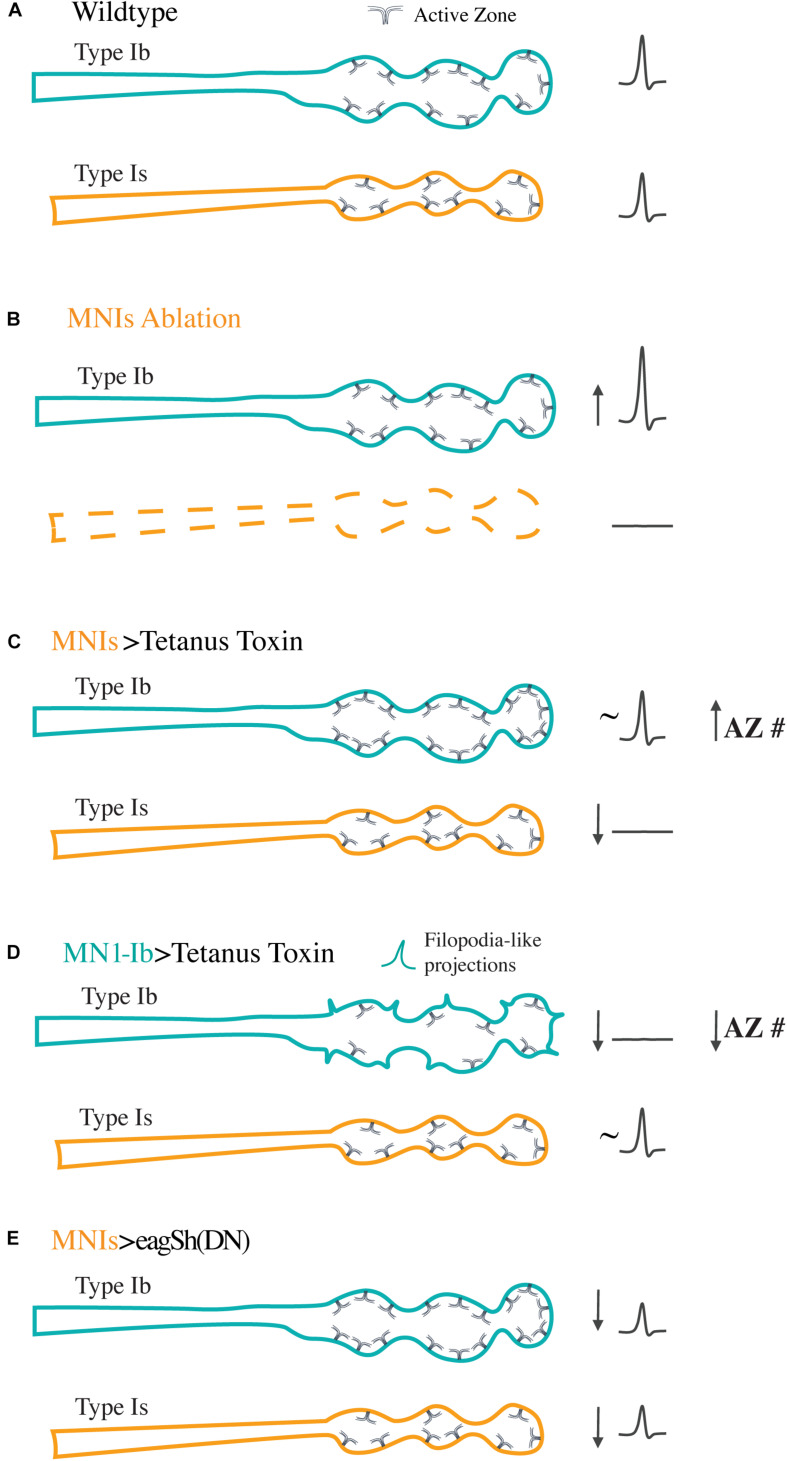
Synaptic plasticity following manipulation of the activity or presence of tonic Ib or phasic Is motoneurons. Diagrams represent the responses of Ib (teal) and Is (orange) motoneurons co-innervating the same muscle following the indicated manipulations. (A) For control Ib and Is terminals at muscle 1, the two inputs provide similar synaptic drive to the muscle as represented by the similar evoked excitatory junctional potentials (eEJPs) recorded from the muscle upon stimulation of either input (right). Ib NMJs contain more AZs than their Is counterparts, with an overall lower Pr per AZ. (B) Following ablation of the Is motoneuron with the Reaper cell death gene, the Ib motoneuron compensates by increasing the amount of neurotransmitter it releases without changes to AZ number. In contrast, ablation of the Ib motoneuron does not alter the structure or function of the co-innervating Is input. (C) Silencing the Is motoneuron with tetanus toxin results in a compensatory structural response in the co-innervating Ib input that arises from an in increase in AZ number. No structural changes are found in the silenced Is. (D) Silencing of the tonic Ib neuron results in reduced output, decreased AZ number, and increased filopodia-like projections in Ib with no compensatory response in the co-innervating Is input. (E) Increasing activity of the Is motoneuron by overexpressing dominant negative K+ channels to elevate overall firing rates results in uniform downscaling of evoked release in both the Ib and Is inputs as a compensation mechanism.

References

    1. Abbott L. F., Nelson S. B. (2000). Synaptic plasticity: taming the beast. Nat. Neurosci. 3(Suppl.), 1178–1183. 10.1038/81453 - DOI - PubMed
    1. Aberle H., Haghighi A. P., Fetter R. D., McCabe B. D., Magalhães T. R., Goodman C. S. (2002). wishful thinking encodes a BMP type II receptor that regulates synaptic growth in Drosophila. Neuron 33 545–558. 10.1016/s0896-6273(02)00589-5 - DOI - PubMed
    1. Akbergenova Y., Cunningham K. L., Zhang Y. V., Weiss S., Littleton J. T. (2018). Characterization of developmental and molecular factors underlying release heterogeneity at Drosophila synapses. Elife 7:e38268. 10.7554/eLife.38268 - DOI - PMC - PubMed
    1. Androschuk A., Al-Jabri B., Bolduc F. V. (2015). From learning to memory: what flies can tell us about intellectual disability treatment. Front. Psychiatry 6:85. 10.3389/fpsyt.2015.00085 - DOI - PMC - PubMed
    1. Aponte-Santiago N. A., Ormerod K. G., Akbergenova Y., Littleton J. T. (2020). Synaptic plasticity induced by differential manipulation of tonic and phasic motoneurons in drosophila. J. Neurosci. 40 6270–6288. 10.1523/JNEUROSCI.0925-20.2020 - DOI - PMC - PubMed

LinkOut - more resources