. 2020 Dec 18:11:540404.
doi: 10.3389/fmicb.2020.540404. eCollection 2020.

The Total and Active Bacterial Community of the Chlorolichen Cetraria islandica and Its Response to Long-Term Warming in Sub-Arctic Tundra

Affiliations

The Total and Active Bacterial Community of the Chlorolichen Cetraria islandica and Its Response to Long-Term Warming in Sub-Arctic Tundra

Ingeborg J Klarenberg et al. Front Microbiol. .

Abstract

Lichens are traditionally defined as a symbiosis between a fungus and a green alga and or a cyanobacterium. This idea has been challenged by the discovery of bacterial communities inhabiting the lichen thalli. These bacteria are thought to contribute to the survival of lichens under extreme and changing environmental conditions. How these changing environmental conditions affect the lichen-associated bacterial community composition remains unclear. We describe the total (rDNA-based) and potentially metabolically active (rRNA-based) bacterial community of the lichen Cetaria islandica and its response to long-term warming using a 20-year warming experiment in an Icelandic sub-Arctic tundra. 16S rRNA and rDNA amplicon sequencing showed that the orders Acetobacterales (of the class Alphaproteobacteria) and Acidobacteriales (of the phylum Acidobacteria) dominated the bacterial community. Numerous amplicon sequence variants (ASVs) could only be detected in the potentially active community but not in the total community. Long-term warming led to increases in relative abundance of bacterial taxa on class, order and ASV level. Warming altered the relative abundance of ASVs of the most common bacterial genera, such as Granulicella and Endobacter. The potentially metabolically active bacterial community was also more responsive to warming than the total community. Our results suggest that the bacterial community of the lichen C. islandica is dominated by acidophilic taxa and harbors disproportionally active rare taxa. We also show for the first time that climate warming can lead to shifts in lichen-associated bacterial community composition.

Keywords: climate change; host–microbiome; lichen; lichen microbiome; lichen-associated bacteria; long-term warming; tundra.


Conflict of interest statement

The authors declare that the research was conducted in the absence of any commercial or financial relationships that could be construed as a potential conflict of interest.

Figures
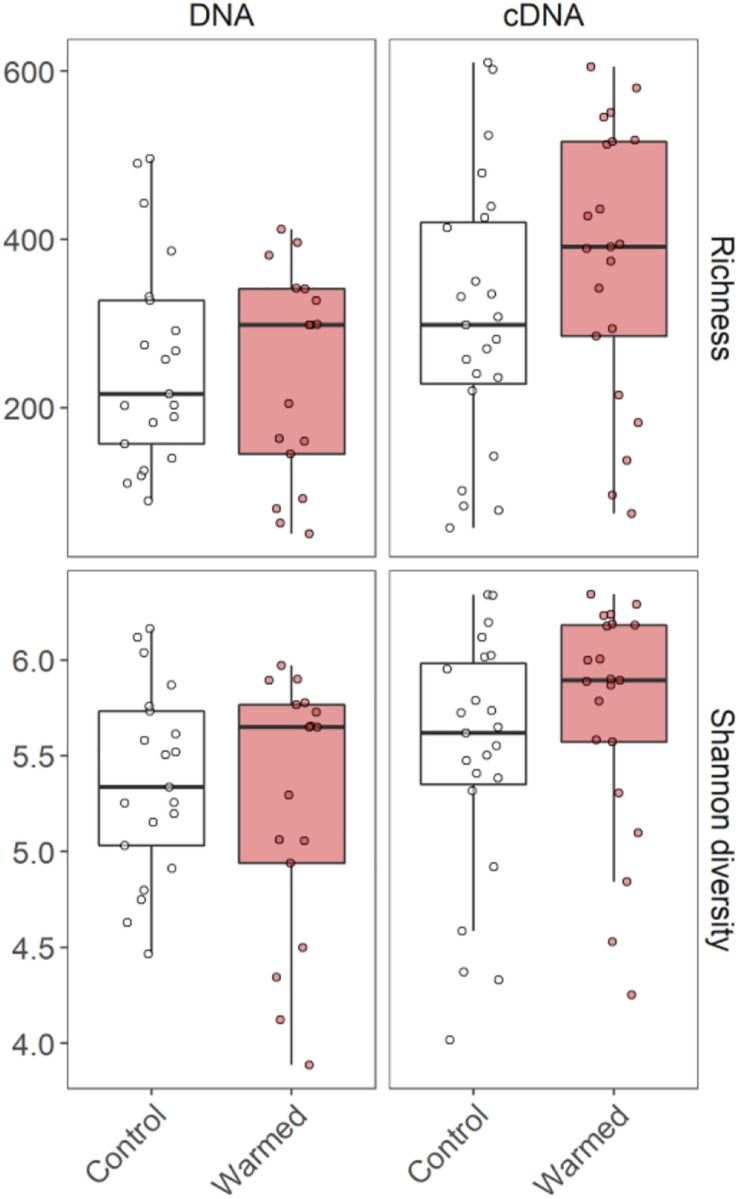
FIGURE 1
FIGURE 1
ASV richness and Shannon diversity of the DNA and cDNA-based bacterial communities associated with the lichen C. islandica in control and warmed samples. N = 82, n = 21 for DNA control, n = 17 for DNA warmed, n = 23 for cDNA control and n = 21 for cDNA warmed.
FIGURE 2
FIGURE 2
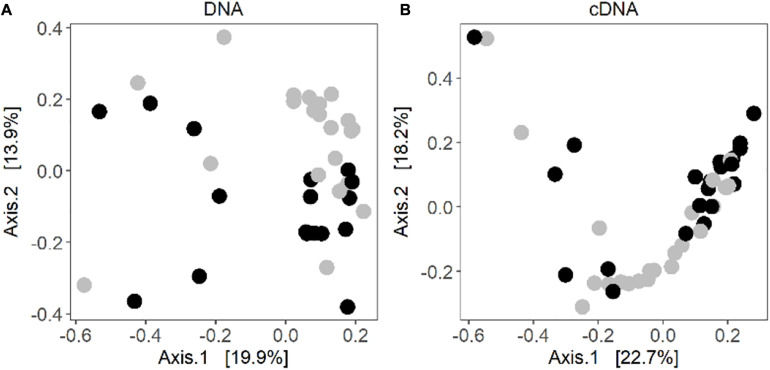
Principal coordinate analysis of Bray-Curtis distances of the (A) DNA-based community composition and (B) cDNA-based community composition of the lichen C. islandica. Warmed samples are represented as black circles and control samples as gray circles. N = 28, n = 21 for DNA control, n = 17 for DNA warmed, n = 23 for cDNA control and n = 21 for cDNA warmed.
FIGURE 3
FIGURE 3
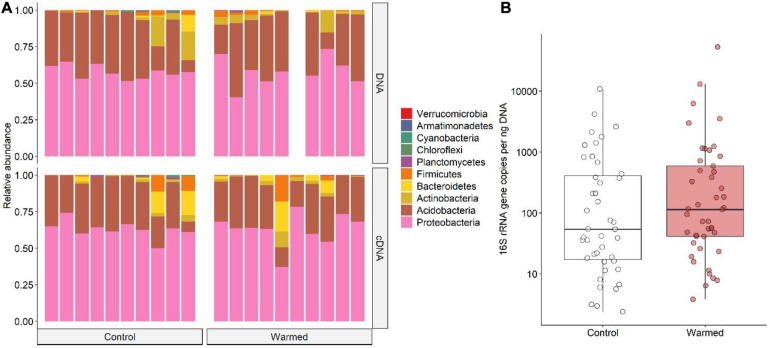
(A) Barplots of the bacterial community composition associated with the lichen C. islandica in the control and warmed plots. Data are presented at the phylum level for DNA and cDNA. Bars represent pooled samples from each separate plot. (B) 16S rRNA gene abundance per ng extracted DNA in control (white) and warmed (red) samples. N = 88, nwarmed = 45, ncontrol = 43.
FIGURE 4
FIGURE 4
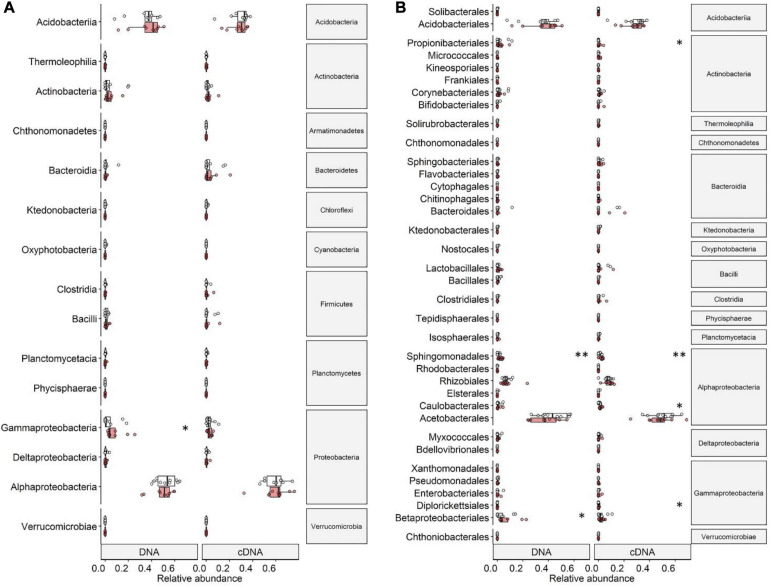
Relative abundances of (A) classes and (B) orders of DNA- and cDNA-based bacterial communities associated with the lichen C. islandica in control (white) and warmed (red) samples. Points indicate average relative abundance values per control or warmed plot. Boxplots represent minimum values, first quartiles, medians, third quartiles, and maximum values. Significance levels (p < 0.05 and ∗∗p < 0.01) are based on Wilcoxon rank-sum tests.
FIGURE 5
FIGURE 5
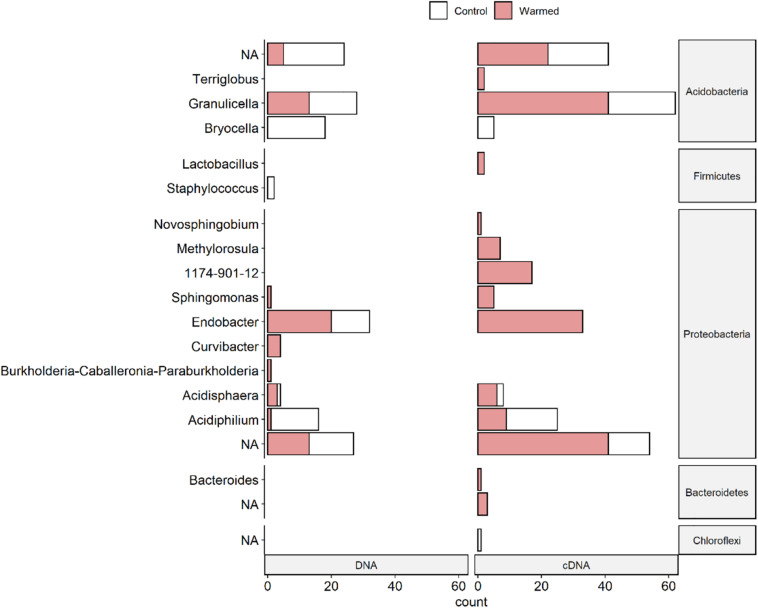
Number of ASVs (amplicon sequence variants) per genus sensitive to warming for DNA and cDNA-based bacterial communities associated with the lichen C. islandica. Sensitivity to warming was determined by differential abundance analysis (DESeq2) and indicator species analysis. ASVs not assigned to genus level are called “NA.” The number of ASVs indicative for the OTC (warmed) treatment is indicated in red and the number of ASVs indicative for the control treatment is indicated in white.

References

    1. Agler M. T., Ruhe J., Kroll S., Morhenn C., Kim S.-T., Weigel D., et al. (2016). Microbial hub taxa link host and abiotic factors to plant microbiome variation. PLoS Biol. 14:e1002352. 10.1371/journal.pbio.1002352 - DOI - PMC - PubMed
    1. Alatalo J. M., Jägerbrand A. K., Chen S., Molau U. (2017). Responses of lichen communities to 18 years of natural and experimental warming. Ann. Bot. 120 159–170. 10.1093/aob/mcx053 - DOI - PMC - PubMed
    1. Almendras K., García J., Carú M., Orlando J. (2018). Nitrogen-fixing bacteria associated with peltigera cyanolichens and cladonia chlorolichens. Molecules 23:3077. 10.3390/molecules23123077 - DOI - PMC - PubMed
    1. Anderson M. J. (2001). A new method for non-parametric multivariate analysis of variance. Austral. Ecol. 26 32–46. 10.1111/j.1442-9993.2001.01070.pp.x - DOI
    1. Aschenbrenner I. A., Cernava T., Berg G., Grube M. (2016). Understanding microbial multi-species symbioses. Front. Microbiol. 7:180. 10.3389/fmicb.2016.00180 - DOI - PMC - PubMed

LinkOut - more resources