Review
. 2020 Dec 16:8:575330.
doi: 10.3389/fpubh.2020.575330. eCollection 2020.

Air Pollution and Central Nervous System Disease: A Review of the Impact of Fine Particulate Matter on Neurological Disorders

Affiliations
Review

Air Pollution and Central Nervous System Disease: A Review of the Impact of Fine Particulate Matter on Neurological Disorders

Hyunyoung Kim et al. Front Public Health. .

Abstract

Background: It is widely known that the harmful effects of fine dust can cause various diseases. Research on the correlation between fine dust and health has been mainly focused on lung and cardiovascular diseases. By contrast, the effects of air pollution on the central nervous system (CNS) are not broadly recognized. Findings: Air pollution can cause diverse neurological disorders as the result of inflammation of the nervous system, oxidative stress, activation of microglial cells, protein condensation, and cerebral vascular-barrier disorders, but uncertainty remains concerning the biological mechanisms by which air pollution produces neurological disease. Neuronal cell damage caused by fine dust, especially in fetuses and infants, can cause permanent brain damage or lead to neurological disease in adulthood. Conclusion: It is necessary to study the air pollution-CNS disease connection with particular care and commitment. Moreover, the epidemiological and experimental study of the association between exposure to air pollution and CNS damage is critical to public health and quality of life. Here, we summarize the correlations between fine dust exposure and neurological disorders reported so far and make suggestions on the direction future research should take.

Keywords: epidemiological study; fine particulate matter; intervention; neurological disease; oxidative stress.


Conflict of interest statement

The authors declare that the research was conducted in the absence of any commercial or financial relationships that could be construed as a potential conflict of interest.

Figures
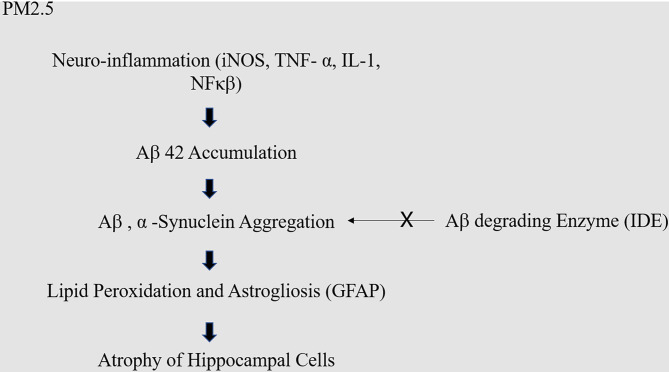
Figure 1
Figure 1
Molecular mechanism of PM2.5 in dementia. Fine dust causes neuro-inflammation, which causes excessive accumulation of amyloid. Excessively accumulated amyloid usually should be decomposed by amyloid decomposition enzyme like IDE, but the malfunction of IDE causes neuronal cell death.
Figure 2
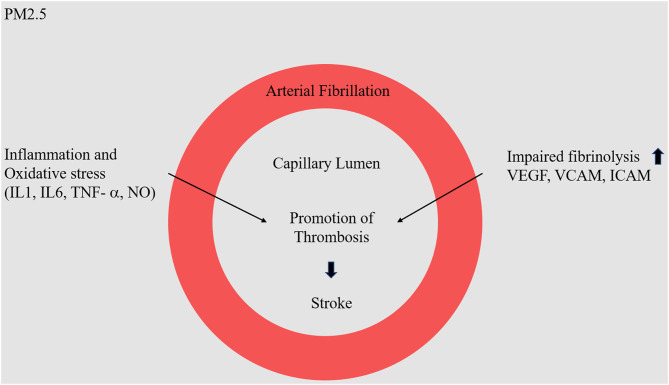
Figure 2
Molecular mechanism of PM2.5 in stroke. Fine dust (NO, O3) enters the blood vessel, it will cause inflammatory and oxidative stress reactions. In particular, as the expression of VEGF, VCAM, and ICAM protein increases, there is a high probability of causing problems in the physical barrier in blood vessels, causing arterial fibrillation.
Figure 3
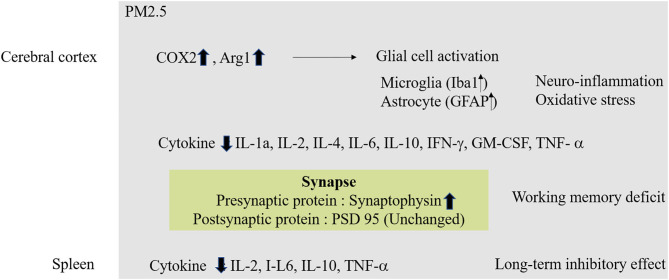
Figure 3
Molecular mechanism of PM2.5 in Neurodevelopment. In case of exposure to fine dust in fetal conditions, oxidative stress and inflammatory reactions occur in the cerebral cortex. Also, abnormal protein expression in synapses can affect working memory. Exposure to fine dust in fetal conditions also affects other organs, which can lead to long-term memory deficiencies.
Figure 4
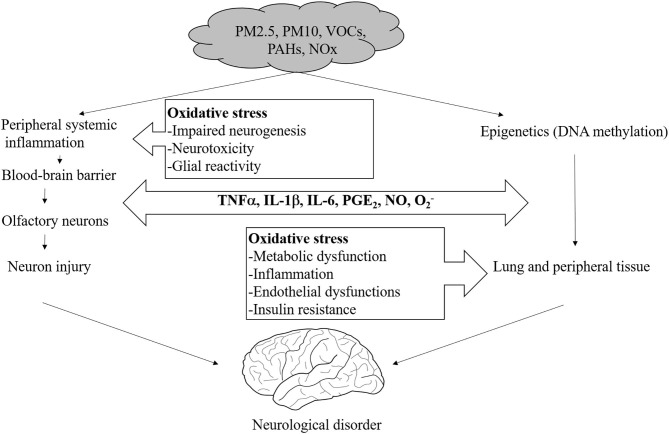
Figure 4
Proposed mechanisms of direct and systemic pollutant-induced oxidative stress in the brain.

References

    1. Nabizadeh R, Yousefian F, Moghadam VK, Hadei M. Characteristics of cohort studies of long-term exposure to PM2.5: a systematic review. Environ Sci Pollut Res Int. (2019) 26:30755–71. 10.1007/s11356-019-06382-6 - DOI - PubMed
    1. Calderon-Garciduenas L, Calderon-Garciduenas A, Torres-Jardon R, Avila-Ramirez J, Kulesza RJ, Angiulli AD. Air pollution and your brain: what do you need to know right now. Prim Health Care Res Dev. (2015) 16:329–45. 10.1017/S146342361400036X - DOI - PubMed
    1. Ajmani GS, Suh HH, Pinto JM. Effects of ambient air pollution exposure on olfaction: a review. Environ Health Perspect. (2016) 124:1683–93. 10.1289/EHP136 - DOI - PMC - PubMed
    1. Costa LG, Cole TB, Coburn J, Chang YC, Dao K, Roque PJ. Neurotoxicity of traffic-related air pollution. Neurotoxicology. (2017) 59:133–9. 10.1016/j.neuro.2015.11.008 - DOI - PMC - PubMed
    1. Andersen ZJ, Pedersen M, Weinmayr G, Stafoggia M, Galassi C, Jorgensen JT, et al. Long-term exposure to ambient air pollution and incidence of brain tumor: the European Study of Cohorts for Air Pollution Effects (ESCAPE). Neuro Oncol. (2018) 20:420–32. 10.1093/neuonc/nox163 - DOI - PMC - PubMed

Publication types

Substances