


Trends in the Epidemiology of Candidemia in Intensive Care Units From 2006 to 2017: Results From the Korean National Healthcare-Associated Infections Surveillance System
- PMID: 33392229
- PMCID: PMC7773785
- DOI: 10.3389/fmed.2020.606976
Trends in the Epidemiology of Candidemia in Intensive Care Units From 2006 to 2017: Results From the Korean National Healthcare-Associated Infections Surveillance System
Abstract
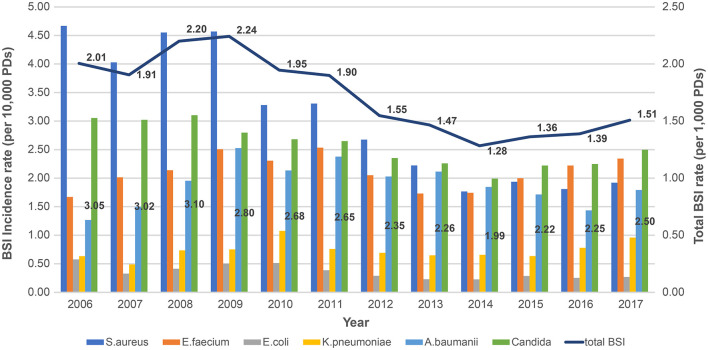
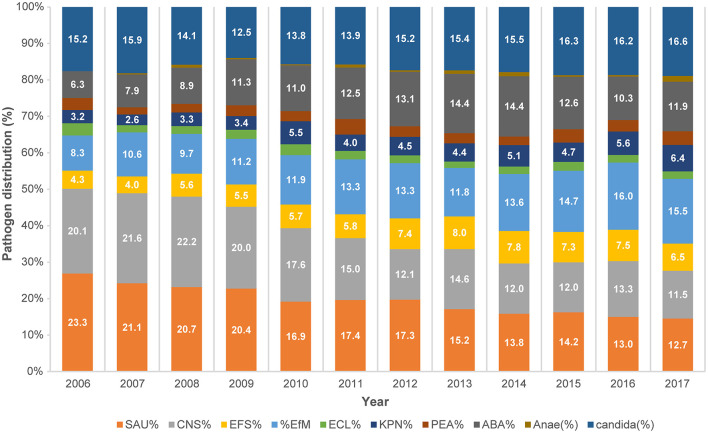
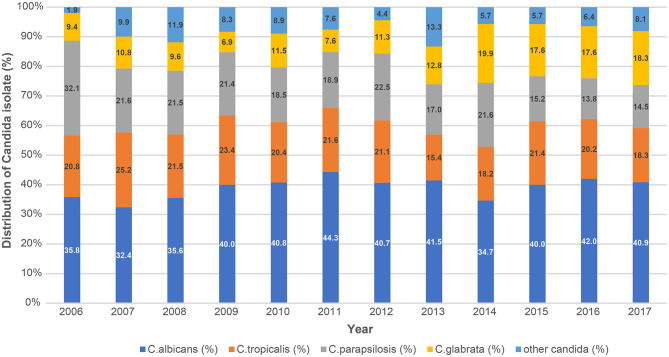
Candidemia is an important healthcare-associated infection (HAI) in intensive care units (ICUs). However, limited research has been conducted on candidemia in the Republic of Korea. We aimed to analyze the secular trends in the incidence and distribution of candidemia in ICUs over 12-years using data from the Korean National Healthcare-Associated Infections Surveillance System (KONIS). KONIS was established in 2006 and has performed prospective surveillance of HAIs including bloodstream infections (BSIs) in ICUs. We evaluated the trends in the distribution of causative pathogens and the incidence of candidemia. From 2006 to 2017, 2,248 candidemia cases occurred in 9,184,264 patient-days (PDs). The pooled mean incidence rates of candidemia significantly decreased from 3.05 cases/10,000 PDs in 2006 to 2.5 cases/10,000 PDs in 2017 (P = 0.001). Nevertheless, the proportion of candidemia gradually increased from 15.2% in 2006 to 16.6% in 2017 (P = 0.001). The most frequent causative pathogen of BSIs from 2006 to 2012 was Staphylococcus aureus; however, Candida spp. emerged as the most frequent causative pathogen since 2013. C. albicans (39.9%) was the most common among Candida spp. causing BSIs, followed by Candida tropicalis (20.2%) and Candida parapsilosis (18.2%). The proportion of candidemia caused by C. glabrata significantly increased from 8.9% in 2006 to 17.9% in 2017 (P < 0.001). There was no significant change in the distribution of Candida spp. by year (P = 0.285). The most common source of BSIs was central lines associated BSI (92.5%). There was a significant increase in the proportion of candidemia by year in hospitals with organ transplant wards (from 18.9% in 2006 to 21.1% in 2017, P = 0.003), hospitals with <500 beds (from 2.7% in 2006 to 13.6% in 2017, P < 0.001), and surgical ICUs (from 16.2% in 2006 to 21.7% in 2017, P = 0.003). The proportion of candidemia has increased in Korea, especially in hospitals with <500 beds and surgical ICUs. Thus, appropriate infection control programs are needed.
Keywords: Candidemia; Republic of Korea; bloodstream infections; intensive care units'; surveillance.
Copyright © 2020 Kim, Lee, Kwak, Yoo, Choi, Kim, Shin, Yoo, Cho and Choi.
Conflict of interest statement
The authors declare that the research was conducted in the absence of any commercial or financial relationships that could be construed as a potential conflict of interest.
Figures
References
LinkOut - more resources
Full Text Sources
Miscellaneous
