


Hijacking tRNAs From Translation: Regulatory Functions of tRNAs in Mammalian Cell Physiology
- PMID: 33392265
- PMCID: PMC7773854
- DOI: 10.3389/fmolb.2020.610617
Hijacking tRNAs From Translation: Regulatory Functions of tRNAs in Mammalian Cell Physiology
Abstract
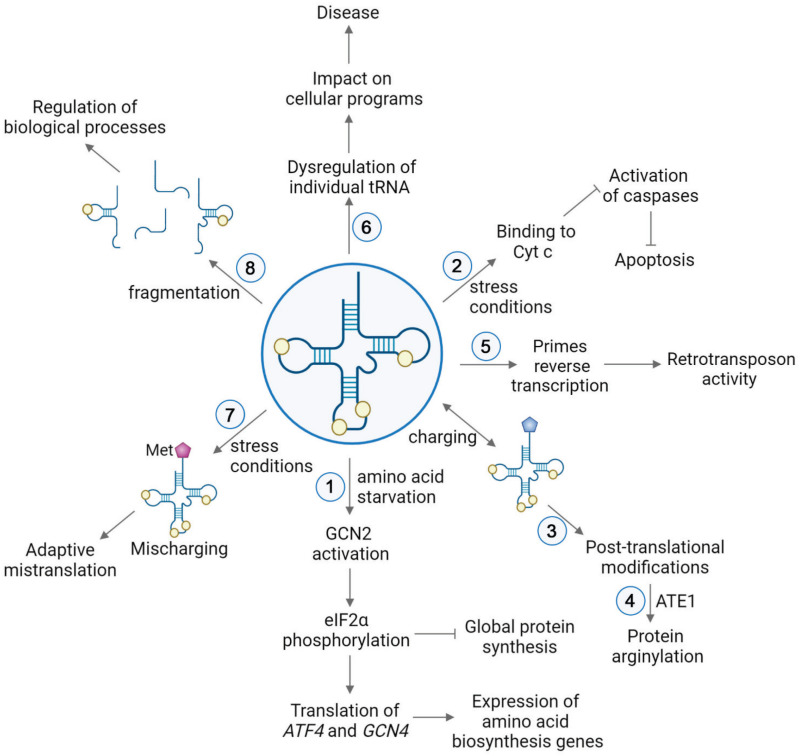
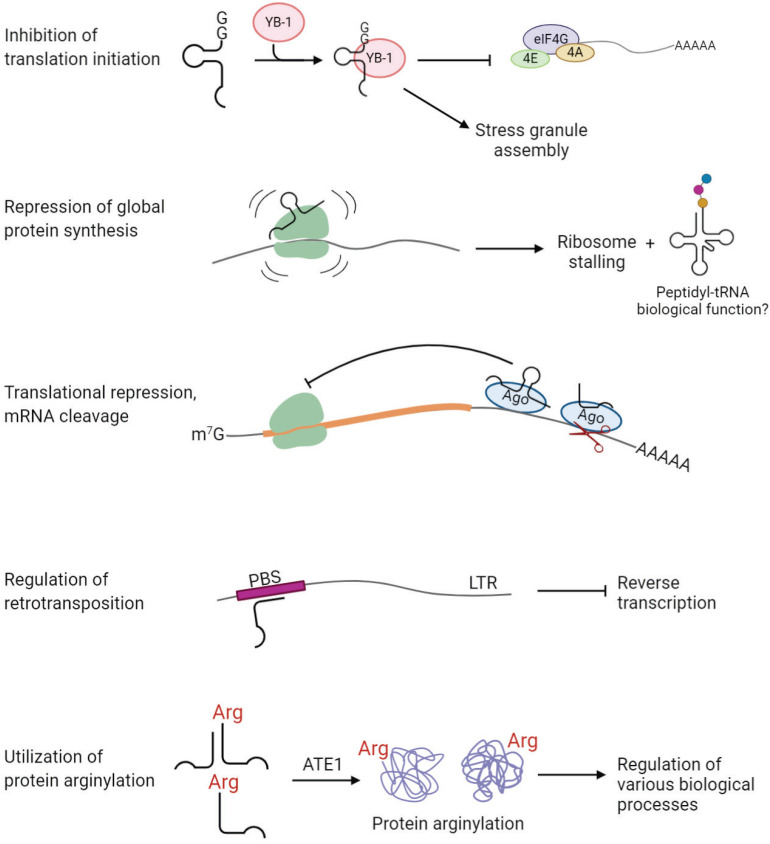
Transfer tRNAs (tRNAs) are small non-coding RNAs that are highly conserved in all kingdoms of life. Originally discovered as the molecules that deliver amino acids to the growing polypeptide chain during protein synthesis, tRNAs have been believed for a long time to play exclusive role in translation. However, recent studies have identified key roles for tRNAs and tRNA-derived small RNAs in multiple other processes, including regulation of transcription and translation, posttranslational modifications, stress response, and disease. These emerging roles suggest that tRNAs may be central players in the complex machinery of biological regulatory pathways. Here we overview these non-canonical roles of tRNA in normal physiology and disease, focusing largely on eukaryotic and mammalian systems.
Keywords: RNA-mediated signaling; arginylation; posttranslational modifications; tRNA; tsRNA.
Copyright © 2020 Avcilar-Kucukgoze and Kashina.
Conflict of interest statement
The authors declare that the research was conducted in the absence of any commercial or financial relationships that could be construed as a potential conflict of interest.
Figures



References
-
- Acehan D., Jiang X., Morgan D. G., Heuser J. E., Wang X., Akey C. W. (2002). Three-dimensional structure of the apoptosome: implications for assembly, procaspase-9 binding, and activation. Mol. Cell 9 423–432. - PubMed
Publication types
Grants and funding
LinkOut - more resources
Full Text Sources
