Review
. 2021 Jan 4;131(1):e142239.
doi: 10.1172/JCI142239.

The discovery of insulin revisited: lessons for the modern era

Review

The discovery of insulin revisited: lessons for the modern era

Gary F Lewis et al. J Clin Invest. .

Abstract

2021 to 2022 marks the one hundredth anniversary of ground-breaking research in Toronto that changed the course of what was, then, a universally fatal disease: type 1 diabetes. Some would argue that insulin's discovery by Banting, Best, Macleod, and Collip was the greatest scientific advance of the 20th century, being one of the first instances in which modern medical science was able to provide lifesaving therapy. As with all scientific discoveries, the work in Toronto built upon important advances of many researchers over the preceding decades. Furthermore, the Toronto work ushered in a century of discovery of the purification, isolation, structural characterization, and genetic sequencing of insulin, all of which influenced ongoing improvements in therapeutic insulin formulations. Here we discuss the body of knowledge prior to 1921 localizing insulin to the pancreas and establishing insulin's role in glucoregulation, and provide our views as to why researchers in Toronto ultimately achieved the purification of pancreatic extracts as a therapy. We discuss the pharmaceutical industry's role in the early days of insulin production and distribution and provide insights into why the discoverers chose not to profit financially from the discovery. This fascinating story of bench-to-beside discovery provides useful considerations for scientists now and in the future.


Conflict of interest statement

Conflict of interest: The authors have declared that no conflict of interest exists.

Figures

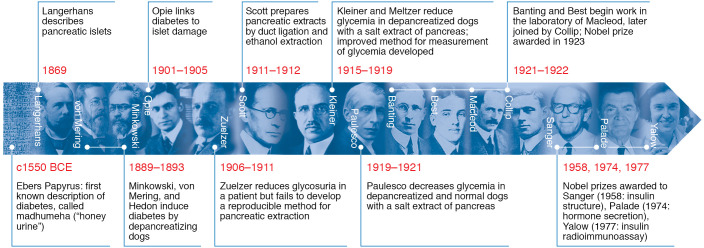
Figure 1
Figure 1. Timeline of notable advances in the discovery of insulin through history, showing some of the key players and their contributions.
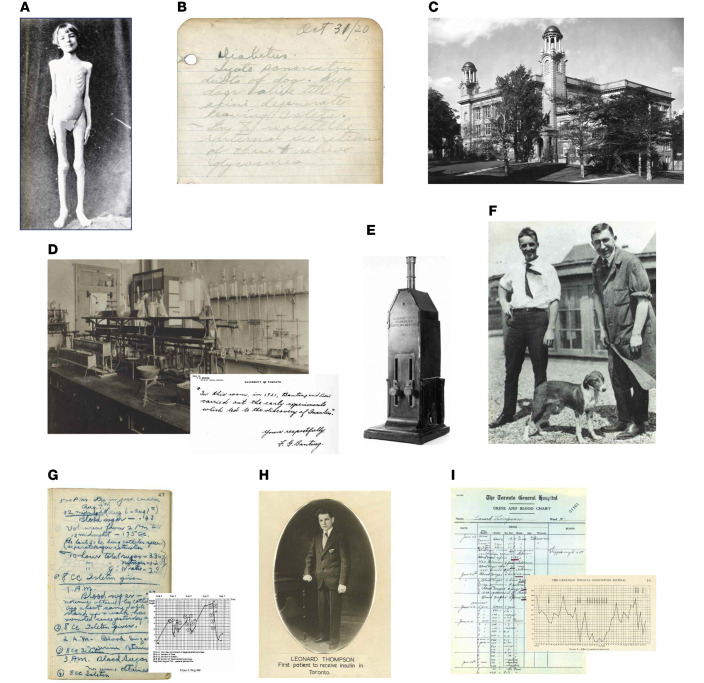
Figure 2
Figure 2. The discovery of insulin and the first human administration.
(A) Young girl with type 1 diabetes, which, before 1921, was a death sentence. (B) The Toronto insulin story began on October 31, 1920, when Dr. Frederick Banting noted an idea for an experiment to isolate an internal secretion from the pancreas. (C) The Medical Building, University of Toronto, stood at the center of a uniquely linked group of medical and scientific institutions including the Toronto General Hospital and the University’s public health biologicals producer, Connaught Laboratories. (D) Laboratory in which Banting and Best’s experiments were performed. (E) Colorimeter for analyzing blood and urine glucose levels. (F) Charles Best (left) and Dr. Frederick Banting (right) with a dog on the roof of the Medical Building, August 1921. After meeting Dr. J.J.R. Macleod, Head of Physiology at U of T, Banting was given a lab, experimental dogs, and the assistance of undergraduate student Charles Best. Over the summer of 1921, their notebooks reported encouraging results with “Isletin” controlling blood sugar levels in depancreatized dogs. (G) Banting’s notebook for August 7, 1921, and chart, showing first blood sugar reductions using “Isletin” in dog 408. (H) On January 11, 1922, a 14-year-old patient with type 1 diabetes, Leonard Thompson, was the first to receive an injection of the pancreatic extract, but with no effect. (I) On January 23, Thompson received a more purified extract with good results. This extract was developed by Dr. James Collip, a biochemist, who joined Banting and Best in December 1921. Images courtesy of The Thomas Fisher Rare Book Library, University of Toronto.
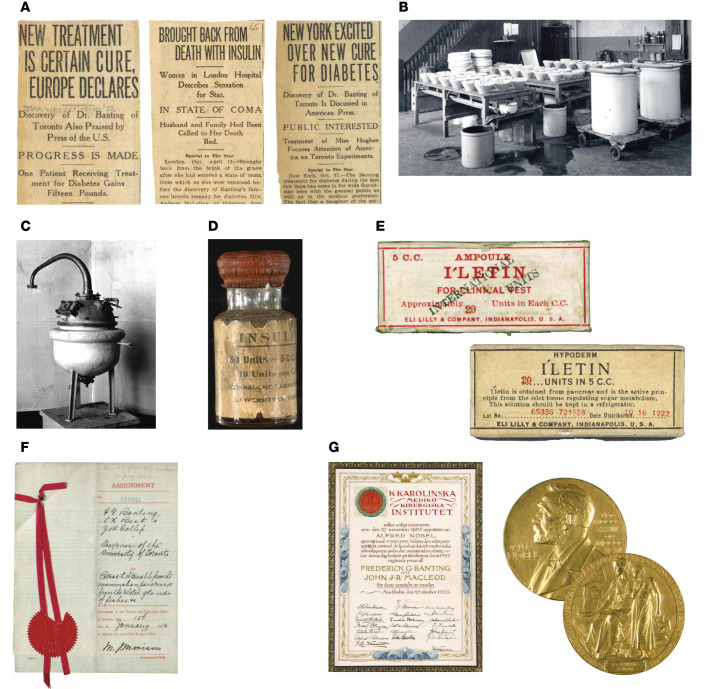
Figure 3
Figure 3. A Spreading Story: Excitement Grips the World!
(A) Reports of insulin’s first clinical trials in Toronto led to press coverage and a wave of requests for this diabetes “cure” from around the world. The severe insulin supply challenges during 1922 meant only a few critically ill patients could be treated. (B) Insulin production, Connaught Laboratories, University of Toronto, c. 1923. (C) Early vacuum still for insulin extraction. (D) Original vial of insulin produced by Connaught Laboratories, reproduced with permission from Sanofi Pasteur Canada (Connaught Campus) Archives. Connaught’s larger insulin facility in the former YMCA Building at the University of Toronto opened in May 1923, starting a period of steady declines in insulin prices that continued until 1942. (E) Making enough insulin at lower prices and scaling up production to meet a growing need — Eli Lilly’s Isletin insulin. Encouraged by Leonard Thompson’s successful treatments, commercial agreements were developed to initiate large-scale production of the extract. The University of Toronto Insulin Committee granted Eli Lilly exclusive US rights until 1924, when other firms were granted licenses. (F) On January 1, 1923, to protect the discovery from the unscrupulous, Banting, Best, and Collip assigned the insulin patent to the University of Toronto, with proceeds dedicated to supporting medical research. (G) In 1923, the Nobel Prize in Physiology or Medicine was awarded to Banting and Macleod, who immediately shared their awards with Best and Collip, respectively. While there were tensions between Banting and Macleod, the Nobel experience highlighted that in the insulin story, there indeed was “glory enough for all” (1). Images courtesy of The Thomas Fisher Rare Book Library, University of Toronto.

References

    1. Bliss M. The Discovery of Insulin. University of Toronto Press; 1982.
    1. Bliss M. Banting: A Biography. McLelland and Steward Ltd.; 1984.
    1. Jolles S. Paul Langerhans. J Clin Pathol. 2002;55(4):243. doi: 10.1136/jcp.55.4.243. - DOI - PMC - PubMed
    1. Minkowski O. Historical development of the theory of pancreatic diabetes by Oscar Minkowski, 1929: introduction and translation by Rachmiel Levine. Diabetes. 1989;38(1):1–6. doi: 10.2337/diab.38.1.1. - DOI - PubMed
    1. Keck FS, Pfeiffer EF. The first experimental diabetes mellitus. Acta Diabetol Lat. 1989;26(1):79–81. doi: 10.1007/BF02581200. - DOI - PubMed