Comment
. 2021 Jan 4;131(1):e144964.
doi: 10.1172/JCI144964.

Location is everything when it comes to megakaryocyte function

Affiliations
Comment

Location is everything when it comes to megakaryocyte function

Eric Boilard et al. J Clin Invest. .

Abstract

Megakaryocytes (MKs) give rise to platelets, which are blood cells that are essential to prevent hemorrhage. Although the majority of MKs localize to the bone marrow, there is a distinct population of lung-residing MKs (MKL). In this issue of the JCI, Pariser et al. examined gene expression patterns of MKs collected from murine and nonhuman primate bone marrow or lung. This Commentary explores the premise that environmental factors from the lung determine the genetic and phenotypic similarity of MKL to lung dendritic cells, distinguishing MKL from bone marrow MKs. Indeed, while MKL retain the ability to make platelets, they also process and present antigens that activate CD4+ lymphocytes. These data suggest that MKL may play an important role in immune processes beyond platelet production.


Conflict of interest statement

Conflict of interest: The authors have declared that no conflict of interest exists.

Figures

Figure 1
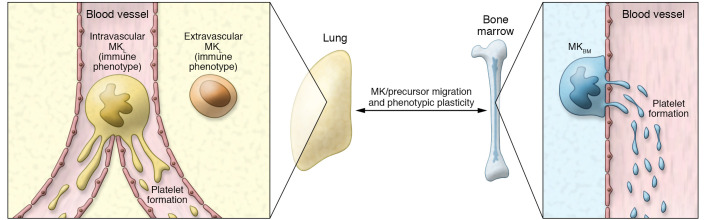
Figure 1. Model for MK plasticity.
The lung contains intravascular and extravascular populations of megakaryocytes (MKL). MKL that are large, polyploid (average of 16N), and intravascular are ideally positioned to release proplatelets into flowing blood. Extravascular diploid (2N) MKL resemble lung dendritic cells. The local environment modulates the phenotype of BM MKs (MKBM) and MKL. Notably, MKBM that are transferred into the lungs adopt an MKL-like phenotype (6). MKs or MK progenitors may continuously migrate between the BM and the lungs.

Comment on

  • Lung megakaryocytes are immune modulatory cells.
    Pariser DN, Hilt ZT, Ture SK, Blick-Nitko SK, Looney MR, Cleary SJ, Roman-Pagan E, Saunders J 2nd, Georas SN, Veazey J, Madere F, Santos LT, Arne A, Huynh NP, Livada AC, Guerrero-Martin SM, Lyons C, Metcalf-Pate KA, McGrath KE, Palis J, Morrell CN. Pariser DN, et al. J Clin Invest. 2021 Jan 4;131(1):e137377. doi: 10.1172/JCI137377. J Clin Invest. 2021. PMID: 33079726 Free PMC article.

References

    1. Machlus KR, et al. The incredible journey: From megakaryocyte development to platelet formation. J Cell Biol. 2013;201(6):785–796. doi: 10.1083/jcb.201304054. - DOI - PMC - PubMed
    1. Noetzli LJ, et al. New insights into the differentiation of megakaryocytes from hematopoietic progenitors. Arterioscler Thromb Vasc Biol. 2019;39(7):1288–1300. doi: 10.1161/ATVBAHA.119.312129. - DOI - PMC - PubMed
    1. Davis E, et al. Histologic studies of splenic megakaryocytes after bone marrow ablation with strontium 90. J Lab Clin Med. 1992;120(5):767–777. - PubMed
    1. Lefrancais E, et al. The lung is a site of platelet biogenesis and a reservoir for haematopoietic progenitors. Nature. 2017;544(7648):105–109. doi: 10.1038/nature21706. - DOI - PMC - PubMed
    1. Potts KS, et al. Membrane budding is a major mechanism of in vivo platelet biogenesis. J Exp Med. 2020;217(9):e20191206. doi: 10.1084/jem.20191206. - DOI - PMC - PubMed