


The Relationship Between Symptoms of Depression and Anxiety and Disease Activity in IBD Over Time
- PMID: 33393632
- PMCID: PMC8314114
- DOI: 10.1093/ibd/izaa349
The Relationship Between Symptoms of Depression and Anxiety and Disease Activity in IBD Over Time
Abstract
Brackground: We aimed to examine associations between elevated symptoms of depression and anxiety and disease activity in inflammatory bowel disease (IBD). Previous findings have been inconsistent and have not accounted for variability in the courses of these conditions over time.
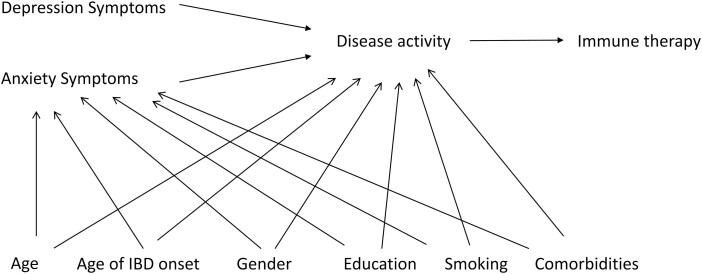
Methods: We followed 247 participants with IBD (153 Crohn's disease [CD], 94 ulcerative colitis [UC]) for 3 years. Annually, participants underwent an abdominal examination, reported therapies used for IBD, and completed the Hospital Anxiety and Depression Scale (HADS) questionnaire. We evaluated associations of elevated symptoms (scores ≥11) of anxiety (HADS-A) and depression (HADS-D) with the presence of active IBD as measured using the Powell Tuck Index for UC and the Harvey-Bradshaw Disease Activity Index for CD. We employed logistic regression with generalized estimating equations, simultaneously estimating between-person and within-person effects.
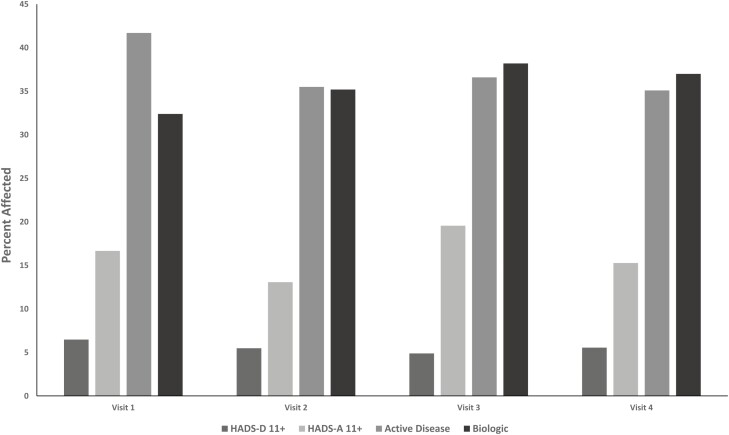
Results: Of 247 participants, 15 (6.1%) had elevated symptoms of depression (HADS-D ≥11) at enrollment, 41 (16.6%) had elevated symptoms of anxiety (HADS-A ≥11), and 101 (40.9%) had active IBD. On average, individuals with elevated symptoms of depression (odds ratio [OR], 6.27; 95% CI, 1.39-28.2) and anxiety (OR, 2.17; 95% CI, 1.01-4.66) had increased odds of active IBD. Within individuals, elevations in symptoms of depression over time were associated with increased odds of active IBD (OR, 2.70; 95% CI, 1.15-6.34), but elevated symptoms of anxiety were not. After adjustment for covariates (including disease activity), elevated symptoms of depression were also associated with increased odds of biologic therapy use (OR, 2.02; 95% CI, 1.02-4.00).
Conclusion: Symptoms of depression and anxiety are associated with disease activity in IBD over time. Reducing these symptoms should be incorporated into the management of IBD.
Keywords: IBD; anxiety; depression; mood disorders; self-reported outcomes; symptoms.
© 2021 Crohn’s & Colitis Foundation. Published by Oxford University Press. All rights reserved. For permissions, please e-mail: journals.permissions@oup.com.
Figures
Comment in
-
Risk of Depression During the Natural History of Inflammatory Bowel Disease: The Phantom Menace.Inflamm Bowel Dis. 2021 Aug 19;27(9):e99-e100. doi: 10.1093/ibd/izab067. Inflamm Bowel Dis. 2021. PMID: 33900409 No abstract available.
References
-
- Marrie RA, Walld R, Bolton JM, et al. ; CIHR Team in Defining the Burden and Managing the Effects of Psychiatric Comorbidity in Chronic Immunoinflammatory Disease . Increased incidence of psychiatric disorders in immune-mediated inflammatory disease. J Psychosom Res. 2017;101:17–23. - PubMed
-
- Szigethy EM, Allen JI, Reiss M, et al. White paper AGA: the impact of mental and psychosocial factors on the care of patients with inflammatory bowel disease. Clin Gastroenterol Hepatol. 2017;15:986–997. - PubMed
-
- Alexakis C, Kumar S, Saxena S, et al. Systematic review with meta-analysis: the impact of a depressive state on disease course in adult inflammatory bowel disease. Aliment Pharmacol Ther. 2017;46:225–235. - PubMed
Publication types
MeSH terms
LinkOut - more resources
Full Text Sources
Other Literature Sources
Medical
