


Thirty-day suicidal thoughts and behaviors among hospital workers during the first wave of the Spain COVID-19 outbreak
- PMID: 33393724
- PMCID: PMC8246904
- DOI: 10.1002/da.23129
Thirty-day suicidal thoughts and behaviors among hospital workers during the first wave of the Spain COVID-19 outbreak
Abstract
Background: Healthcare workers are a key occupational group at risk for suicidal thoughts and behaviors (STB). We investigated the prevalence and correlates of STB among hospital workers during the first wave of the Spain COVID-19 outbreak (March-July 2020).
Methods: Data come from the baseline assessment of a cohort of Spanish hospital workers (n = 5450), recruited from 10 hospitals just after the height of the coronavirus disease 2019 (COVID-19) outbreak (May 5-July 23, 2020). Web-based self-report surveys assessed 30-day STB, individual characteristics, and potentially modifiable contextual factors related to hospital workers' work and financial situation.
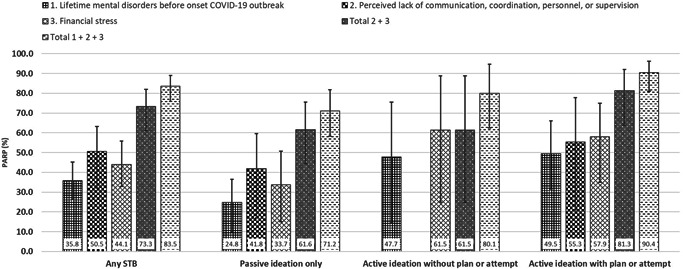
Results: Thirty-day STB prevalence was estimated at 8.4% (4.9% passive ideation only, 3.5% active ideation with or without a plan or attempt). A total of n = 6 professionals attempted suicide in the past 30 days. In adjusted models, 30-day STB remained significantly associated with pre-pandemic lifetime mood (odds ratio [OR] = 2.92) and anxiety disorder (OR = 1.90). Significant modifiable factors included a perceived lack of coordination, communication, personnel, or supervision at work (population-attributable risk proportion [PARP] = 50.5%), and financial stress (PARP = 44.1%).
Conclusions and relevance: Thirty-day STB among hospital workers during the first wave of the Spain COVID-19 outbreak was high. Hospital preparedness for virus outbreaks should be increased, and strong governmental policy response is needed to increase financial security among hospital workers.
Keywords: COVID-19 outbreak; hospital workers; suicidal thoughts and behaviors.
© 2020 The Authors. Depression and Anxiety Published by Wiley Periodicals LLC.
Conflict of interest statement
Eduard Vieta reports personal fees from Abbott, personal fees from Allergan, personal fees from Angelini, grants from Novartis, grants from Ferrer, grants and personal fees from Janssen, personal fees from Lundbeck, personal fees from Sage, personal fees from Sanofi, outside the submitted work. Juan D. Molina reports personal fees from Janssen, personal fees and nonfinancial support from Otsuka, personal fees and nonfinancial support from Lundbeck, personal fees from Angelini, personal fees and nonfinancial support from Accord, outside the submitted work. In the past 3 years, Ronald C. Kessler was a consultant for Datastat, Inc., Sage Pharmaceuticals, and Takeda. All other authors reported no conflict of interest.
Figures
References
-
- Amaya, A. , & Presser, S. (2016). Nonresponse bias for univariate and multivariate estimates of social activities and roles. Public Opinion Quarterly, 81(1), nfw037. 10.1093/poq/nfw037 - DOI
-
- Bernal, M. , Haro, J. M. , Bernert, S. , Brugha, T. , de Graaf, R. , Bruffaerts, R. , Lépine, J. P. , de Girolamo, G. , Vilagut, G. , Gasquet, I. , Torres, J. V. , Kovess, V. , Heider, D. , Neeleman, J. , Kessler, R. , & Alonso, J. (2007). Risk factors for suicidality in Europe: Results from the ESEMED study. Journal of Affective Disorders, 101(1–3), 27–34. 10.1016/j.jad.2006.09.018 - DOI - PubMed
Publication types
MeSH terms
Grants and funding
LinkOut - more resources
Full Text Sources
Other Literature Sources
Medical
Miscellaneous
