


Is it Safe to Be Transplanted From Living Donors Who Recovered From COVID-19? Experience of 31 Kidney Transplants in a Multicenter Cohort Study From India
- PMID: 33394992
- PMCID: PMC7993648
- DOI: 10.1097/TP.0000000000003609
Is it Safe to Be Transplanted From Living Donors Who Recovered From COVID-19? Experience of 31 Kidney Transplants in a Multicenter Cohort Study From India
Abstract
Background: There is lack of data on feasibility and safety of kidney transplants from living donors who recovered from COVID-19.
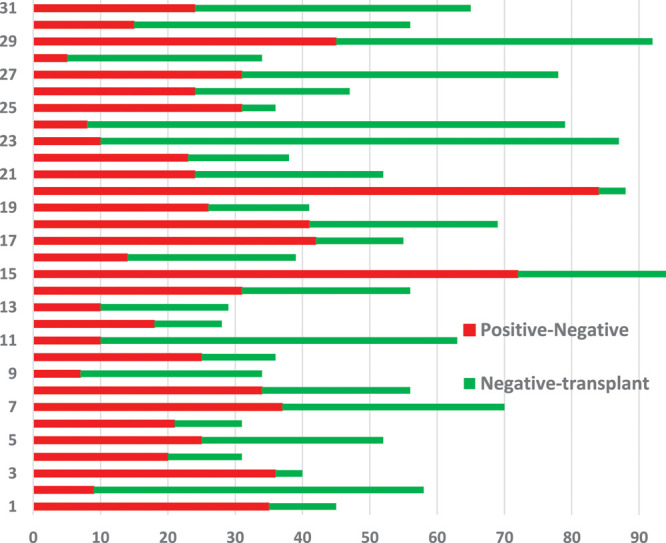
Methods: Here, we present a retrospective cohort study of 31 kidney transplant recipients (KTR) from living donors who recovered from polymerase chain reaction confirmed COVID-19 across 19 transplant centers in India from July 3, 2020, to December 5, 2020. We detailed demographics, clinical manifestations, immunosuppression regimen, treatment, and outcomes. Donors with a previous diagnosis of COVID-19 were accepted after documenting 2 negative polymerase chain reaction tests with complete symptom resolution for at least 28 days and significant social distancing for 14 days before surgery.
Results: COVID-19 clinical severity in donors ranged from completely asymptomatic (71%, n = 22) to mild infection (29%, n = 9). None progressed to moderate or severe stages of the disease in the entire clinical course of home treatment. Patient and graft survival was 100%, respectively, with acute cellular rejection being reported in 6.4% (n = 2) recipient. All recipients and donors were asymptomatic with normal creatinine at median follow-up of 44 days after surgery without any complications relating to surgery and COVID-19.
Conclusions: Our data support safety of proceeding with living donation for asymptomatic individuals with comprehensive donor, recipients screening before surgery, using a combination of clinical, radiologic, and laboratory criteria. It could provide new insights into the management of KTR from living donors who have recovered from COVID-19 in India. To the best of our knowledge, this remains the largest cohort of KTR from living donors who recovered from COVID-19.
Copyright © 2021 Wolters Kluwer Health, Inc. All rights reserved.
Conflict of interest statement
The authors declare no funding or conflicts of interest.
Figures
Comment in
-
Living Donor Hepatectomy After Proven SARS-CoV-2 Infection: First Report of 9 Cases From 3 Centers.Transplantation. 2021 Jul 1;105(7):e70-e71. doi: 10.1097/TP.0000000000003750. Transplantation. 2021. PMID: 33724249 No abstract available.
References
-
- Ministry of Health and Family Welfare. Ministry of Health and Family Welfare, Government of India. Available at https://www.mohfw.gov.in/. Accessed December 1, 2020.
-
- Summary. Global Observatory on Donation and Transplantation. Available at http://www.transplant-observatory.org/summary/. Accessed November 8, 2020.
-
- Kute V, Ramesh V, Shroff S, et al. . Deceased-donor organ transplantation in India: current status, challenges, and solution. Exp Clin Transplant. 2020;18(Suppl 2):31–42. - PubMed
-
- Kute V, Ramesh V, Shroff S, et al. . Benefit to few versus risk to many: an ethical dilemma during coronavirus disease 2019 pandemic for deceased-donor organ transplant in a resource-limited developing country. Exp Clin Transplant. 2021;19:1–7. - PubMed
-
- Government of India Ministry of Health and Family Welfare Directorate General of Health Services (EMR Division). Clinical Management Protocol: COVID-19. Available at https://www.mohfw.gov.in/pdf/ClinicalManagementProtocolforCOVID19.pdf. Accessed December 1, 2020.
Publication types
MeSH terms
LinkOut - more resources
Full Text Sources
Medical
