Review
. 2020 Dec 31;18(1):262.
doi: 10.3390/ijerph18010262.

Current Status of and Future Perspectives in Bacterial Degradation of Benzo[a]pyrene

Affiliations
Review

Current Status of and Future Perspectives in Bacterial Degradation of Benzo[a]pyrene

Alexis Nzila et al. Int J Environ Res Public Health. .

Abstract

Benzo[a]pyrene (BaP) is one the main pollutants belonging to the high-molecular-weight PAHs (HMW-PAHs) class and its degradation by microorganisms remains an important strategy for its removal from the environment. Extensive studies have been carried out on the isolation and characterisation of microorganisms that can actively degrade low-molecular-weight PAHs (LMW-PAHs), and to a certain extent, the HMW-PAH pyrene. However, so far, limited work has been carried out on BaP biodegradation. BaP consists of five fused aromatic rings, which confers this compound a high chemical stability, rendering it less amenable to biodegradation. The current review summarizes the emerging reports on BaP biodegradation. More specifically, work carried out on BaP bacterial degradation and current knowledge gaps that limit our understanding of BaP degradation are highlighted. Moreover, new avenues of research on BaP degradation are proposed, specifically in the context of the development of "omics" approaches.

Keywords: benzo[a]pyrene; bioaugmentation; biodegradation; catabolic pathways; co-metabolism; functional metagenomics; omics.


Conflict of interest statement

The authors declare no conflict of interest.

Figures
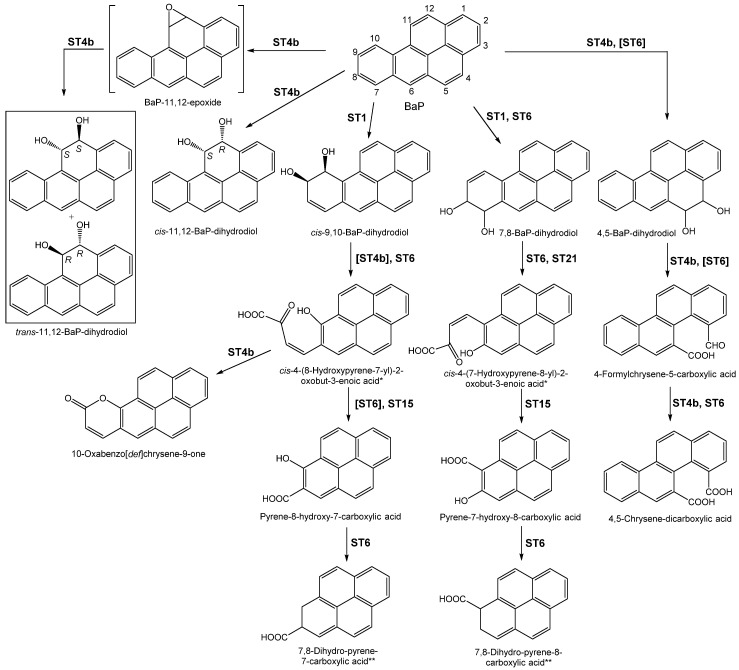
Scheme 1
Scheme 1
Biodegradation pathway of benzo[a]pyrene using various bacteria sprains under aerobic conditions. ST1: Beijerinckia B-836, ST4b: Mycobacterium sp. PYR-1, ST6: Mycobacterium RJGII-135, ST15: Sphingomonas yanoikuyae JAR02, ST21: Bacillus cereus and Bacillus vireti. *: The two compounds with their names followed by a * could not be distinguished from each other in degradation using ST6. **: same as the previous note. The compound in brackets is hypothetical. The two enantiomers in the box were formed in equal ratio. Strains in brackets indicate that the step was predicted, thus was hypothetical. Otherwise, except the structures in brackets, all compounds were identified in the afore-mentioned studies.
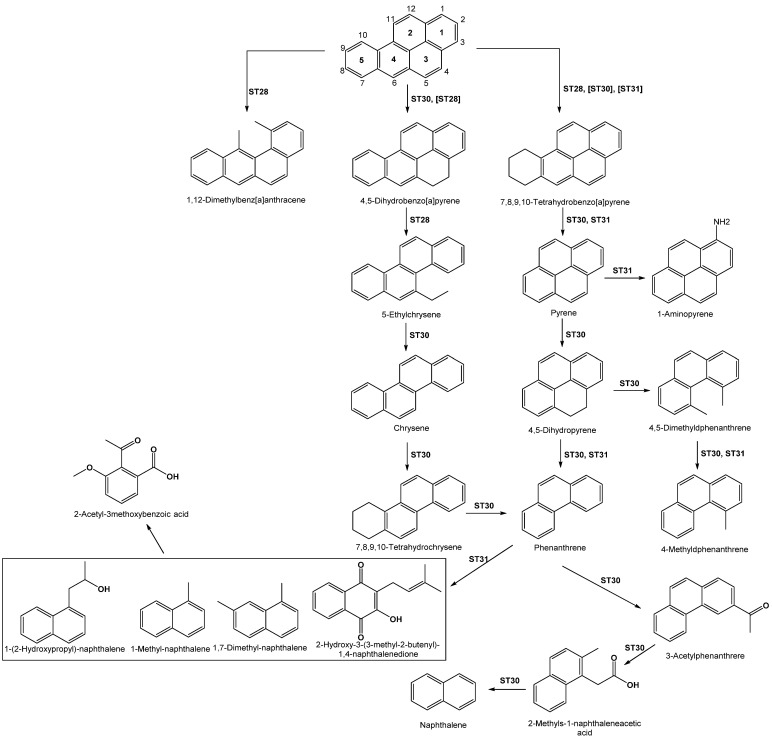
Scheme 2
Scheme 2
Anaerobic biodegradation pathways of benzo[a]pyrene using three bacteria sprains. ST28: Pseudomonas sp. JP1, ST30: Microbacterium sp. M.CSW3, ST31: Cellulosimicrobium cellulans CWS2. Strains in brackets indicate that this step was predicted, thus was hypothetical. Otherwise, all compounds were identified in the afore-mentioned studies.

References

    1. Stogiannidis E., Laane R. Source characterization of polycyclic aromatic hydrocarbons by using their molecular indices: An overview of possibilities. Rev. Environ. Contam. Toxicol. 2015;234:49–133. doi: 10.1007/978-3-319-10638-0_2. - DOI - PubMed
    1. Abdel-Shafy H.I., Mansour M.S.M. A review on polycyclic aromatic hydrocarbons: Source, environmental impact, effect on human health and remediation. Egypt. J. Pet. 2016;25:107–123. doi: 10.1016/j.ejpe.2015.03.011. - DOI
    1. Nzila A. Current status of the degradation of aliphatic and aromatic petroleum hydrocarbons by thermophilic microbes and future perspectives. Int. J. Environ. Res. Public Health. 2018;15:2782. doi: 10.3390/ijerph15122782. - DOI - PMC - PubMed
    1. Rentz J.A., Alvarez P.J., Schnoor J.L. Benzo[a]pyrene degradation by Sphingomonas yanoikuyae JAR02. Environ. Pollut. 2008;151:669–677. doi: 10.1016/j.envpol.2007.02.018. - DOI - PubMed
    1. Nisbet I.C.T., LaGoy P.K. Toxic equivalency factors (TEFs) for polycyclic aromatic hydrocarbons (PAHs) Regul. Toxicol. Pharmacol. 1992;16:290–300. doi: 10.1016/0273-2300(92)90009-X. - DOI - PubMed

Publication types

MeSH terms

LinkOut - more resources