. 2020 Dec 30;22(1):291.
doi: 10.3390/ijms22010291.

Trifostigmanoside I, an Active Compound from Sweet Potato, Restores the Activity of MUC2 and Protects the Tight Junctions through PKCα/β to Maintain Intestinal Barrier Function

Affiliations

Trifostigmanoside I, an Active Compound from Sweet Potato, Restores the Activity of MUC2 and Protects the Tight Junctions through PKCα/β to Maintain Intestinal Barrier Function

Amna Parveen et al. Int J Mol Sci. .

Abstract

Sweet potato (Ipomoea batata) is considered a superfood among vegetables and has been consumed for centuries. Traditionally, sweet potato is used to treat several illnesses, including diarrhea and stomach disorders. This study aimed to explore the protective effect of sweet potato on intestinal barrier function, and to identify the active compounds of sweet potato and their underlying mechanism of action. To this purpose, bioactivity-guided isolation, Western blotting, and immunostaining assays were applied. Interestingly, our bioactivity-guided approach enabled the first isolation and identification of trifostigmanoside I (TS I) from sweet potato. TS I induced mucin production and promoted the phosphorylation of PKCα/β in LS174T human colon cancer cells. In addition, it protected the function of tight junctions in the Caco-2 cell line. These findings suggest that TS I rescued the impaired abilities of MUC2, and protected the tight junctions through PKCα/β, to maintain intestinal barrier function.

Keywords: mucin; protein kinase C; sweet potato extract; tight junctions.


Conflict of interest statement

The authors declare no conflict of interest.

Figures
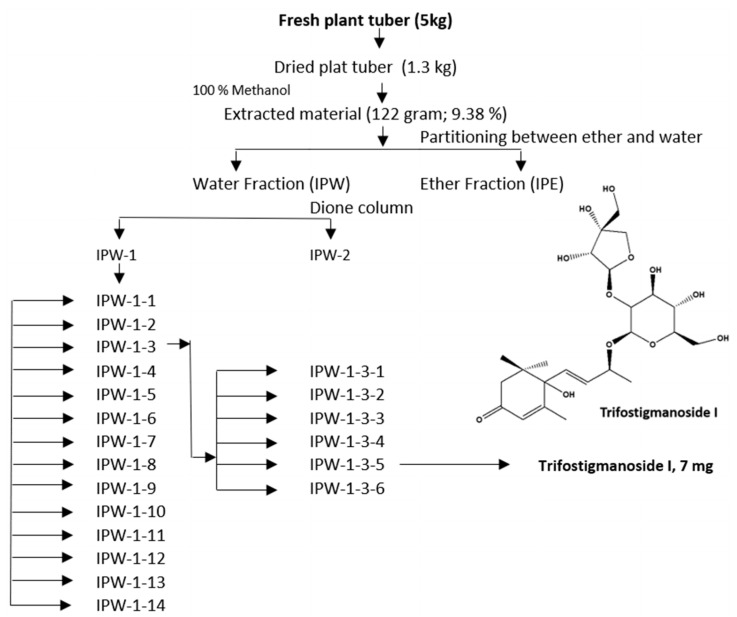
Figure 1
Figure 1
Isolation scheme of trifostigmanoside I from sweet potato extract.
Figure 2
Figure 2
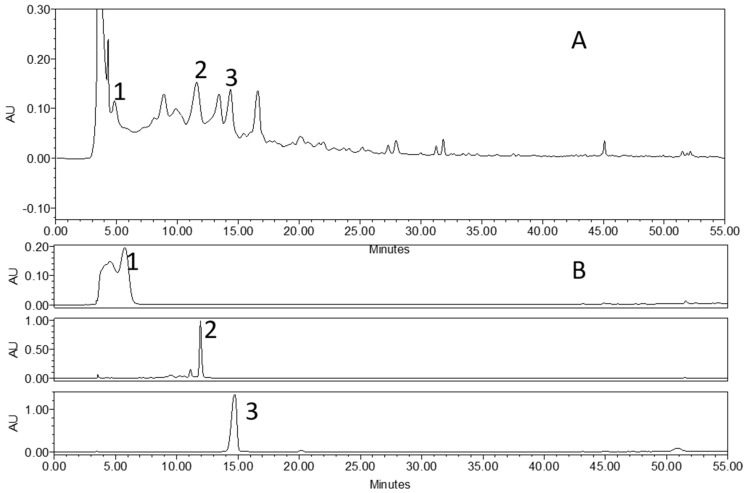
HPLC chromatograms of sweet potato extract and individual compounds: (A) Chromatogram of sweet potato extract; (B) chromatogram of standard compounds: (1) scopolin, (2) trifostigmanoside I, and (3) scopoletin.
Figure 3
Figure 3
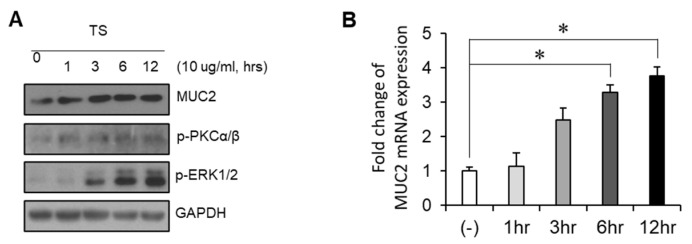
Identification of the signaling pathway involved in trifostigmanoside I-induced MUC2 expression. (A) LS174T cells were treated with trifostigmanoside I at different time points, and the expressions of MUC2, p-PKCα/β, p-ERK1/2, and GAPDH were assessed by Western blotting. (B) Semi-quantitative real-time PCR to assess the expression of MUC2 in LS174T cells after treatment with trifostigmanoside I at different time points. Data are presented as mean ± SEM of triplicate assays. All Western blot results were quantified by using Image J. * p < 0.05. TS, trifostigmanoside I.
Figure 4
Figure 4
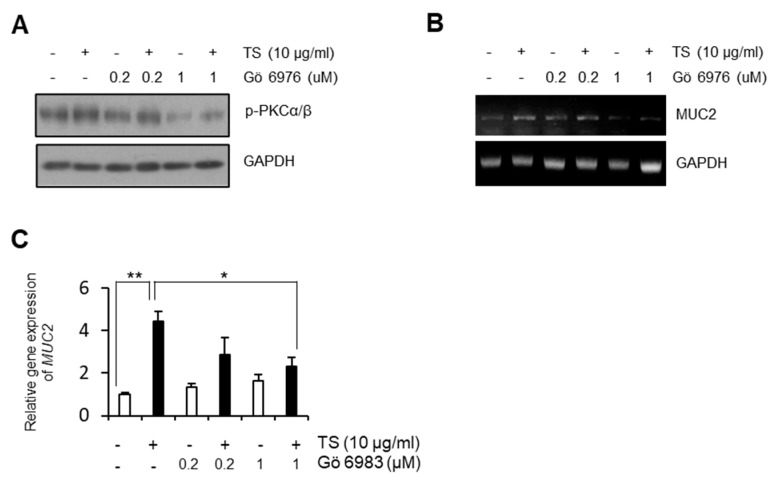
Effect of PKC inhibitors on the impact of trifostigmanoside I on LS174T cells. The PKC inhibitor suppressed TS-dependent MUC2 expression. (A) Expression of p-PKCα/β and GAPDH in LS174T cells after trifostigmanoside I treatment with or without Gö6976. (B) mRNA expression of MUC2 in LS174T cells after trifostigmanoside I treatment with or without Gö6976. (C) Semi-quantitative real-time PCR to assess the effect of pan-PKC inhibitor, Gö6983, on MUC2 expression. Data are presented as mean ± SEM of triplicate assays. All Western blot results were quantified by using Image J. * p < 0.05, ** p < 0.01. TS, trifostigmanoside I.
Figure 5
Figure 5
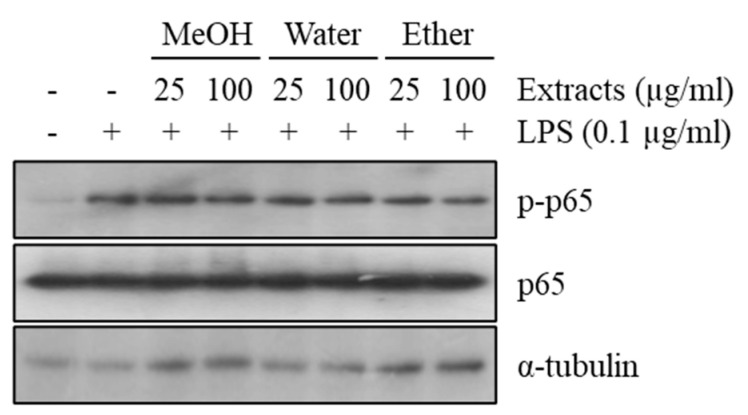
Effect of sweet potato extracts on p65 phosphorylation in the Raw264.7 mouse macrophage cell line. Raw264.7 cells were pre-treated with sweet potato MeOH, water, or ether extract and then treated with LPS. Phosphorylation of p65 was assessed by Western blotting. All Western blot results were quantified by using Image J.
Figure 6
Figure 6
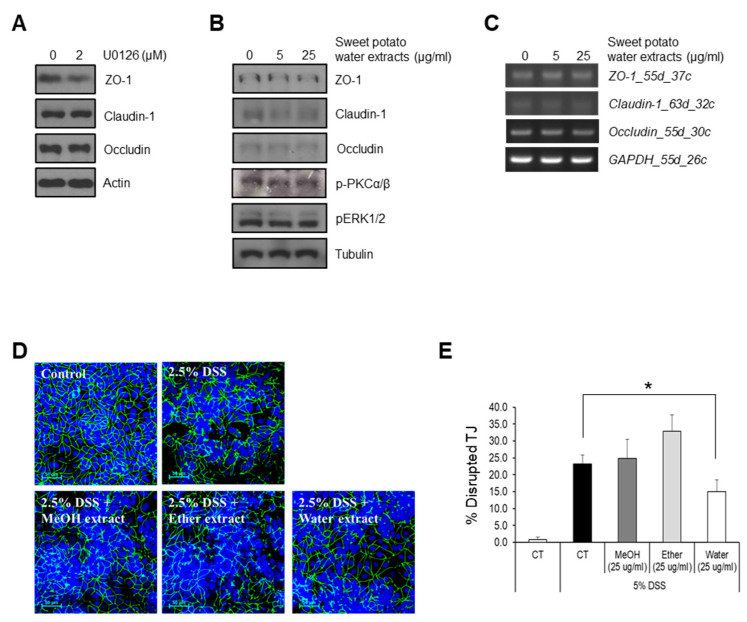
Effect of sweet potato extracts on tight junctions in Caco-2 cells. The effect of sweet potato water extract on tight junctions was assessed. (A) Caco-2 cells were treated with ERK inhibitor, U0126, and the expression of tight junction-related proteins was assessed by Western blotting. Caco-2 cells were treated with sweet potato water extract with the indicated concentrations, and the expression of tight junction-related proteins was assessed by Western blotting (B) and RT-PCR (C). (D) Caco-2 cells were treated with 2.5% DSS +/− MeOH, ether, or water extracts. Immunofluorescence assay for ZO-1 was performed to assess the orientation of tight junctions. Scale bar = 50 µm. (E) Quantification of immunofluorescence assay. Percent disrupted tight junctions was calculated by dividing the number of ZO-1-disrupted (wrinkled or discontinued) cells by the total number of cells in high-power fields. Data are presented as mean ± SEM of three independent experiments. All Western blot results were quantified by using Image J. * p < 0.05.

References

    1. Keller J., Bassotti G., Clarke J., Dinning P., Fox M., Grover M., Hellström P.M., Ke M., Layer P., Malagelada C. Expert consensus document: Advances in the diagnosis and classification of gastric and intestinal motility disorders. Nat. Rev. Gastroenterol. Hepatol. 2018;15:291–308. doi: 10.1038/nrgastro.2018.7. - DOI - PMC - PubMed
    1. König J., Wells J., Cani P.D., Garcia-Rodenas C.L., Macdonald T., Mercenier A., Whyte J., Troost F., Brummer R.-J. Human Intestinal Barrier Function in Health and Disease. Clin. Transl. Gastroenterol. 2016;7:e196. doi: 10.1038/ctg.2016.54. - DOI - PMC - PubMed
    1. Vancamelbeke M., Vermeire S. The intestinal barrier: A fundamental role in health and disease. Expert Rev. Gastroenterol. Hepatol. 2017;11:821–834. doi: 10.1080/17474124.2017.1343143. - DOI - PMC - PubMed
    1. Turner J.R. Intestinal mucosal barrier function in health and disease. Nat. Rev. Immunol. 2009;9:799–809. doi: 10.1038/nri2653. - DOI - PubMed
    1. Meira M., Da Silva E.P., David J.M., David J.P. Review of the genus Ipomoea: Traditional uses, chemistry and biological activities. Rev. Bras. Farm. 2012;22:682–713. doi: 10.1590/S0102-695X2012005000025. - DOI

MeSH terms

LinkOut - more resources