


Barriers and Facilitators to Promoting Oral Health Literacy and Patient Communication among Dental Providers in California
- PMID: 33396682
- PMCID: PMC7795206
- DOI: 10.3390/ijerph18010216
Barriers and Facilitators to Promoting Oral Health Literacy and Patient Communication among Dental Providers in California
Abstract
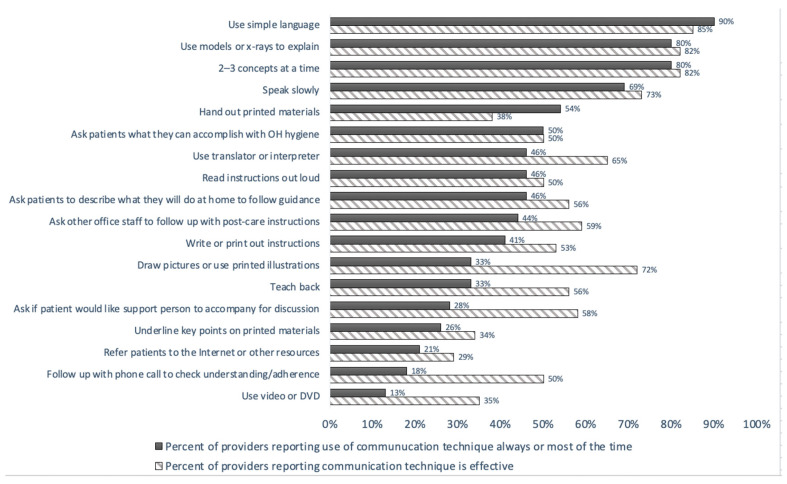
Studies demonstrate that dental providers value effective provider-patient communication but use few recommended communication techniques. This study explored perspectives of California dental providers and oral health literacy experts in the United States on use of communication techniques. We conducted a qualitative key informant interview study with 50 participants between November 2019 and March 2020, including 44 dental providers (dentists, hygienists, and assistants) in public or private practice in California and 6 oral health literacy (OHL) experts. We undertook thematic analysis of interview transcripts and descriptive statistics about interviewees from pre-surveys. Dental providers reported frequently speaking slowly, and using simple language and models/radiographs to communicate with patients, while infrequently using interpretation/translation, illustrations, teach-back, or motivational interviewing. Providers reported using only 6 of the 18 American Medical Association's (AMA) recommended communication techniques and only 3 of the 7 AMA's basic communication techniques. A majority of providers indicated using one of five oral health assessment and educational strategies. Key barriers to effective communication included limited time, financial incentives promoting treatment over prevention, lack of OHL training, limited plain-language patient education materials, and patients with low OHL knowledge. Dental organizations should prioritize supporting dental providers in effective patient communication practices. Standardizing OHL continuing education, creating an evidence-based OHL toolkit for dental teams, ensuring accessible interpretation/translation services, and incentivizing dental providers to deliver education could improve oral health literacy and outcomes.
Keywords: dental providers; health literacy; oral health; oral health literacy; provider-patient communication.
Conflict of interest statement
The authors declare no conflict of interest. The sponsor, J.K. and the CDPH Office of Oral Health, contributed to the conceptualization of the study, the recruitment of the provider interviews, and the review and edit of this manuscript.
Figures

References
-
- Center for Disease Control and Prevention Division of Oral Health at a Glance. [(accessed on 8 August 2019)]; Available online: https://www.cdc.gov/chronicdisease/resources/publications/aag/oral-healt....
-
- Fleming E., Afful J. Prevalence of Total and Untreated Dental Caries Among Youth: United States, 2015–2016. National Center for Health Statistics; Hyattsville, MD, USA: 2018. [(accessed on 10 August 2019)]. Available online: https://www.cdc.gov/nchs/data/databriefs/db307.pdf.
