


Intelligence and Creativity: Mapping Constructs on the Space-Time Continuum
- PMID: 33396809
- PMCID: PMC7838770
- DOI: 10.3390/jintelligence9010001
Intelligence and Creativity: Mapping Constructs on the Space-Time Continuum
Abstract
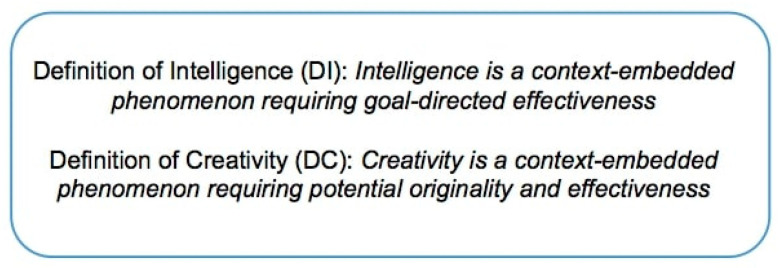
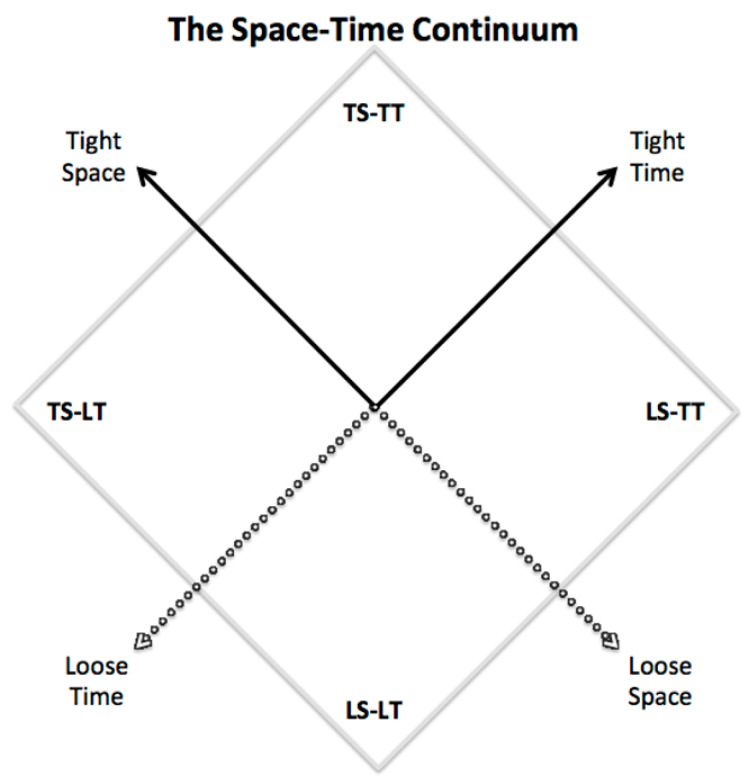
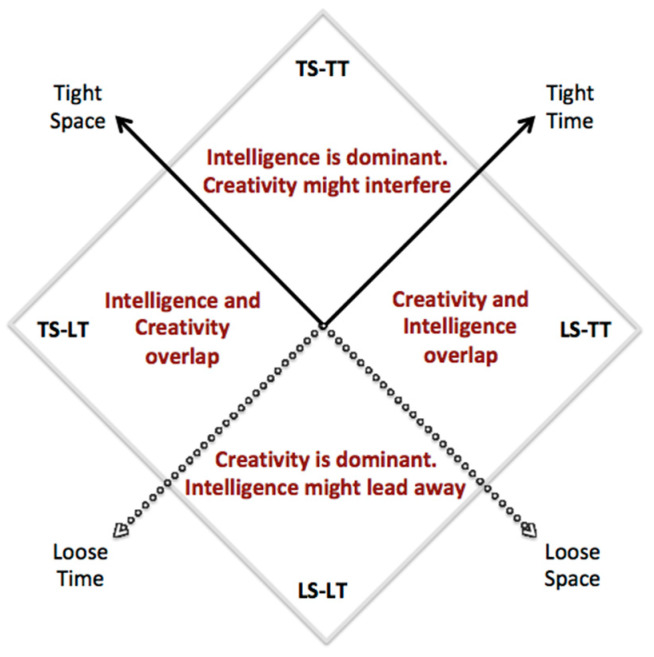
This theoretical article proposes a unified framework of analysis for the constructs of intelligence and creativity. General definitions for intelligence and creativity are provided, allowing fair comparisons between the two context-embedded constructs. A novel taxonomy is introduced to classify the contexts in which intelligent and/or creative behavior can be embedded, in terms of the tightness vs. looseness of the relevant conceptual space S and available time T. These two dimensions are used to form what is identified as the space-time continuum, containing four quadrants: tight space and tight time, loose space and tight time, tight space and loose time, loose space and loose time. The intelligence and creativity constructs can be mapped onto the four quadrants and found to overlap more or less, depending on the context characteristics. Measurement methodologies adapted to the four different quadrants are discussed. The article concludes with a discussion about future research directions based on the proposed theoretical framework, in terms of theories and hypotheses on intelligence and creativity, of eminent personalities and personality traits, as well as its consequences for developmental, educational, and professional environments.
Keywords: conceptual space; creativity; definition of creativity; definition of intelligence; intelligence; looseness; measurement of creativity; measurement of intelligence; relationship between intelligence and creativity; tightness.
Conflict of interest statement
The authors declare no conflict of interest.
Figures
References
-
- Abraham Anna. The Neuroscience of Creativity. Cambridge University Press; Cambridge: 2018.
-
- Acar Selcuk, Runco Mark. Latency predicts category switch in divergent thinking. Psychology of Aesthetics, Creativity, and the Arts. 2017;11:43–51. doi: 10.1037/aca0000091. - DOI
-
- Ackerman Phillip L. A theory of adult intellectual development: Process, personality, interests, and knowledge. Intelligence. 1996;22:227–57. doi: 10.1016/S0160-2896(96)90016-1. - DOI
-
- Agnoli Sergio, Franchin Laura, Rubaltelli Enrico, Corazza Giovanni Emanuele. The emotionally intelligent use of attention and affective arousal under creative frustration and creative success. Personality and Individual Differences. 2019;142:242–48. doi: 10.1016/j.paid.2018.04.041. - DOI
-
- Agnoli Sergio, Zanon Marco, Mastria Serena, Avenanti Alessio, Corazza Giovanni Emanuele. Predicting response originality through brain activity: An analysis of changes in EEG alpha power during the generation of alternative ideas. NeuroImage. 2020;207:116385. doi: 10.1016/j.neuroimage.2019.116385. - DOI - PubMed
LinkOut - more resources
Full Text Sources
