Review
. 2020 Dec 30;22(1):330.
doi: 10.3390/ijms22010330.

Monounsaturated Fatty Acids in Obesity-Related Inflammation

Affiliations
Review

Monounsaturated Fatty Acids in Obesity-Related Inflammation

Gaetan Ravaut et al. Int J Mol Sci. .

Abstract

Obesity is an important aspect of the metabolic syndrome and is often associated with chronic inflammation. In this context, inflammation of organs participating in energy homeostasis (such as liver, adipose tissue, muscle and pancreas) leads to the recruitment and activation of macrophages, which secrete pro-inflammatory cytokines. Interleukin-1β secretion, sustained C-reactive protein plasma levels and activation of the NLRP3 inflammasome characterize this inflammation. The Stearoyl-CoA desaturase-1 (SCD1) enzyme is a central regulator of lipid metabolism and fat storage. This enzyme catalyzes the generation of monounsaturated fatty acids (MUFAs)-major components of triglycerides stored in lipid droplets-from saturated fatty acid (SFA) substrates. In this review, we describe the molecular effects of specific classes of fatty acids (saturated and unsaturated) to better understand the impact of different diets (Western versus Mediterranean) on inflammation in a metabolic context. Given the beneficial effects of a MUFA-rich Mediterranean diet, we also present the most recent data on the role of SCD1 activity in the modulation of SFA-induced chronic inflammation.

Keywords: chronic inflammation; metabolic syndrome; monounsaturated fatty acids (MUFA); saturated fatty acid (SFA); stearoyl-CoA desaturase-1 (SCD1).


Conflict of interest statement

The authors declare no conflict of interest.

Figures
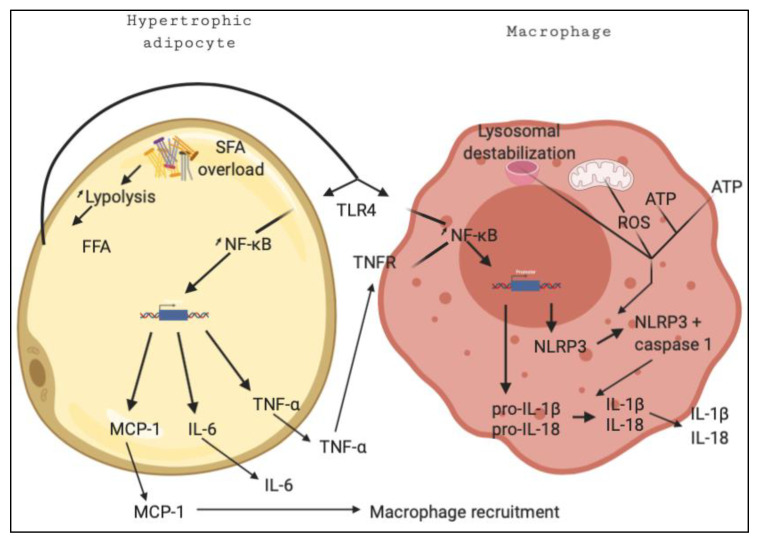
Figure 1
Figure 1
Crosstalk between adipocyte and macrophage leading to enhanced inflammation. FFAs (free fatty acids) produced as a consequence of SFA (saturated fatty acid) overload activate the TLR4 pathway, leading to MCP-1 (Monocyte chemoattracting protein-1), IL-6 (Interleukin-6) and TNF-α (Tumor necrosis factor alpha) secretion by adipocytes via NF-κB (Nuclear factor-kappa B) nuclear translocation. TNF-α activates TNFR (Tumor necrosis factor receptor) on recruited macrophages which, in combination with the TLR4 pathway, triggers NF-κB nuclear import and production of NLRP3 (NOD-like receptor family, pyrin domain containing 3), pro-IL-1β and pro-IL-18. Lysosomal disruption, as a consequence of ATP (adenosine triphosphate) and ROS (reactive oxygen species) accumulation, triggers NLRP3 activation and results in IL-1β/IL-18 maturation and secretion. This figure was generated with BioRender.
Figure 2
Figure 2
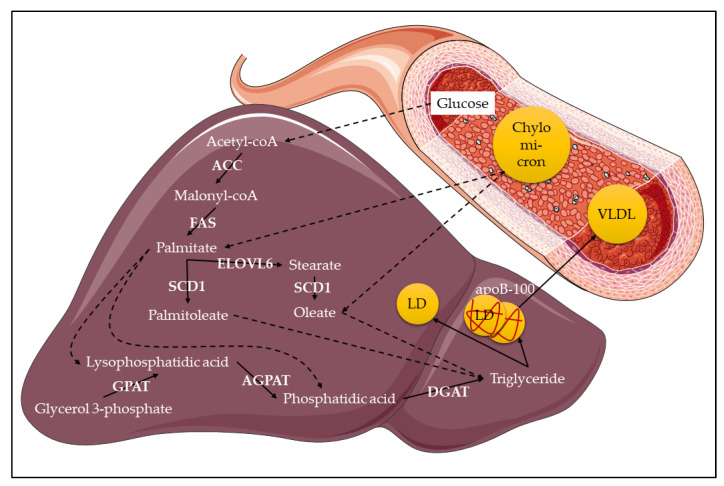
Triglyceride production in the liver. The chylomicrons bring fatty acids (mostly palmitate and oleate) to the liver, where they are used by GPAT (Glycerol-3-phosphate acyltransferase), AGPAT (1-Acylglycerol-3-phosphate-O-acyltransferase) and DGAT (Diacylglycerol-O-acyltransferase) enzymes to produce triglycerides. Alternatively, fatty acids can be synthesized de novo Figure 1. (Stearoyl-CoA desaturase-1) and ELOVL6 (Fatty acid elongase 6). Triglycerides are assembled into LDs (lipid droplets) and/or associated with apoB-100 (Apolipoprotein B-100) for secretion as VLDL (very low-density lipoproteins). This figure was generated with Servier Medical ART.
Figure 3
Figure 3
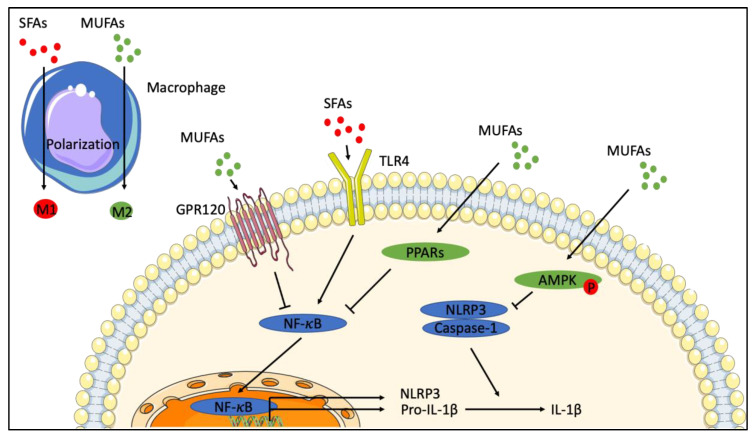
Monounsaturated fatty acids have anti-inflammatory effects. SFAs (saturated fatty acids) activate TLR4 (Toll-Like receptor 4) to induce NF-κB (Nuclear factor-kappaB) nuclear translocatable 3. (NOD-like receptor family, pyrin domain containing 3) and pro-IL-1β (pro-Interleukin-1beta) expression, leading to IL-1β secretion and macrophage M1 polarization. MUFAs (monounsaturated fatty acids) can inhibit NF-κB and NLRP3 activation, respectively, through direct binding to GPR120 (G-protein coupled receptor 120) or PPARs (Peroxysome proliferator activated receptors), and through AMPK (AMP-activated protein kinase) phosphorylation. By inhibiting macrophage M1 polarization, MUFAs potentiate M2 polarization. This figure was generated with Servier Medical ART.

References

    1. Goodpaster B.H., Krishnaswami S., Harris T.B., Katsiaras A., Kritchevsky S.B., Simonsick E.M., Nevitt M., Holvoet P., Newman A.B. Obesity, regional body fat distribution, and the metabolic syndrome in older men and women. Arch. Intern. Med. 2005;165:777–783. doi: 10.1001/archinte.165.7.777. - DOI - PubMed
    1. Sherling D.H., Perumareddi P., Hennekens C.H. Metabolic Syndrome. J. Cardiovasc. Pharm. 2017;22:365–367. doi: 10.1177/1074248416686187. - DOI - PubMed
    1. Saklayen M.G. The Global Epidemic of the Metabolic Syndrome. Curr. Hypertens. Rep. 2018;20:12. doi: 10.1007/s11906-018-0812-z. - DOI - PMC - PubMed
    1. Lee B.C., Lee J. Cellular and molecular players in adipose tissue inflammation in the development of obesity-induced insulin resistance. Biochim. Biophys. Acta. 2014;1842:446–462. doi: 10.1016/j.bbadis.2013.05.017. - DOI - PMC - PubMed
    1. Grandl G., Wolfrum C. Hemostasis, endothelial stress, inflammation, and the metabolic syndrome. Semin. Immunopathol. 2018;40:215–224. doi: 10.1007/s00281-017-0666-5. - DOI - PMC - PubMed

MeSH terms

Substances