. 2021 Jan 4;20(1):6.
doi: 10.1186/s12943-020-01299-y.

LncRNA CRNDE attenuates chemoresistance in gastric cancer via SRSF6-regulated alternative splicing of PICALM

Affiliations

LncRNA CRNDE attenuates chemoresistance in gastric cancer via SRSF6-regulated alternative splicing of PICALM

Feifei Zhang et al. Mol Cancer. .

Abstract

De novo and acquired resistance, which are mainly mediated by genetic alterations, are barriers to effective routine chemotherapy. However, the mechanisms underlying gastric cancer (GC) resistance to chemotherapy are still unclear. We showed that the long noncoding RNA CRNDE was related to the chemosensitivity of GC in clinical samples and a PDX model. CRNDE was decreased and inhibited autophagy flux in chemoresistant GC cells. CRNDE directly bound to splicing protein SRSF6 to reduce its protein stability and thus regulate alternative splicing (AS) events. We determined that SRSF6 regulated the PICALM exon 14 skip splice variant and triggered a significant S-to-L isoform switch, which contributed to the expression of the long isoform of PICALM (encoding PICALML). Collectively, our findings reveal the key role of CRNDE in autophagy regulation, highlighting the significance of CRNDE as a potential prognostic marker and therapeutic target against chemoresistance in GC.

Keywords: Autophagy; Chemoresistant; Gastric cancer; Long noncoding RNA CRNDE; Protein splicing.


Conflict of interest statement

The authors have declared that no conflicts of interest exist.

Figures
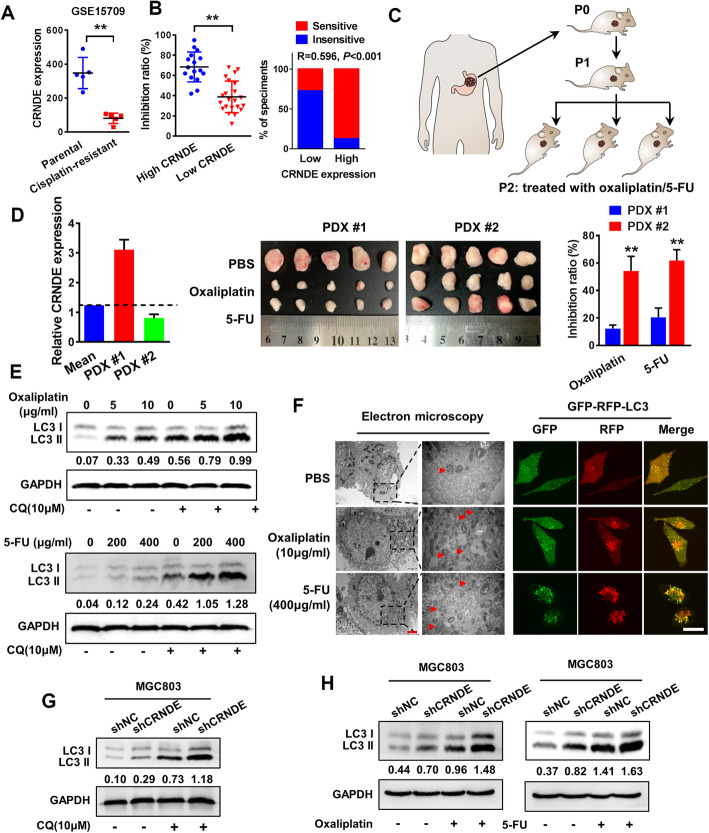
Fig. 1
Fig. 1
Low CRNDE suppresses the response to 5-FU/oxaliplatin-based chemotherapy via enhancing autophagy flux in GC patients and the PDX model. a The expression of CRNDE in cisplatin-resistant gastric cancer cell lines and their parental cells were analyzed by GSEA database. b CCK8 assay was used to evaluate the relationship between CRNDE expression and chemosensitivity in 38 cases of GC specimens. c Schematic diagram of PDX model of gastric cancer. d RT-PCR analysis of the expression level of CRNDE in two cases of PDX models. PDX #1 and #2 tumors were subcutaneously injected into the NOD/SCID mice. The mice were treated with oxaliplatin and 5-FU when the tumor volume reached 50 to 100 mm3. The dose of oxaliplatin was 10 mg / kg mice, and 5-FU 50 mg/kg mice were injected intraperitoneally every 3 days for 24 days. The tumor image and tumor inhibition rate (compared to PBS group) of each indicated group are shown (n=5). e Western blot was performed in MGC803 cells treated with different concentrations of oxaliplatin, 5-FU or CQ. f The autophagy and autophagy flow in MGC803 cells was observed by transmission electron microscopy and confocal microscopy when treated with 10 μg/ml oxaliplatin or 400 μg/ml 5-FU. Scale bars, 2 μm (TEM) and 10 μm (confocal microscopy). g Western blot of autophagy marker LC3II expression levels in MGC803 cells transfected with shCRNDE plasmid in the presence of CQ. h Western blot of autophagy marker LC3II expression levels in MGC803 cells transfected with shCRNDE plasmid in the presence of 10 μg/ml oxaliplatin or 400 μg/ml 5-FU. Student’s t-test; mean ± SD; the asterisk (**) indicates P < 0.01
Fig. 2
Fig. 2
CRNDE induces proteasome ubiquitination-dependent SRSF6 degradation and contributes to autophagy-induced chemoresistance in GC cells. a RNA pull-down assay was used to identify the proteins associated with CRNDE. Biotinylated CRNDE and antisense RNA were incubated with cell extracts, and the associated proteins were resolved by SDS-PAGE. The CRNDE-sense-special bands (arrows) were excised and analyzed by mass spectrometry. b SRSF6 was identified as CRNDE binding protein by mass spectrometry. c RIP assay showed that CRNDE and SRSF6 proteins interact with each other in MGC803 cells. d Western blot confirms the presence of SRSF6 in CRNDE pull-down products. e The effect of CRNDE on the stability of SRSF6. MG-132 eliminates the effect of CRNDE on the stability of SRSF6. (F) CRNDE affects the ubiquitination of SRSF6 in MGC803 cells. g Western blot analyzed the expression of LC3II in MGC803 cells transfected with shSRSF6 plasmid in the presence of CQ. h The chemotherapy resistance of MGC803 cells to oxaliplatin and 5-FU caused by interfering with the expression of CRNDE was counteracted after administration of shSFSF6 in vivo. The tumor volume of each group is shown (n=5). Representative figures are shown. The results are from three independent experiments. Student’s t-test and one-way ANOVA; mean ± SD; the asterisk (**) indicates P < 0.01
Fig. 3
Fig. 3
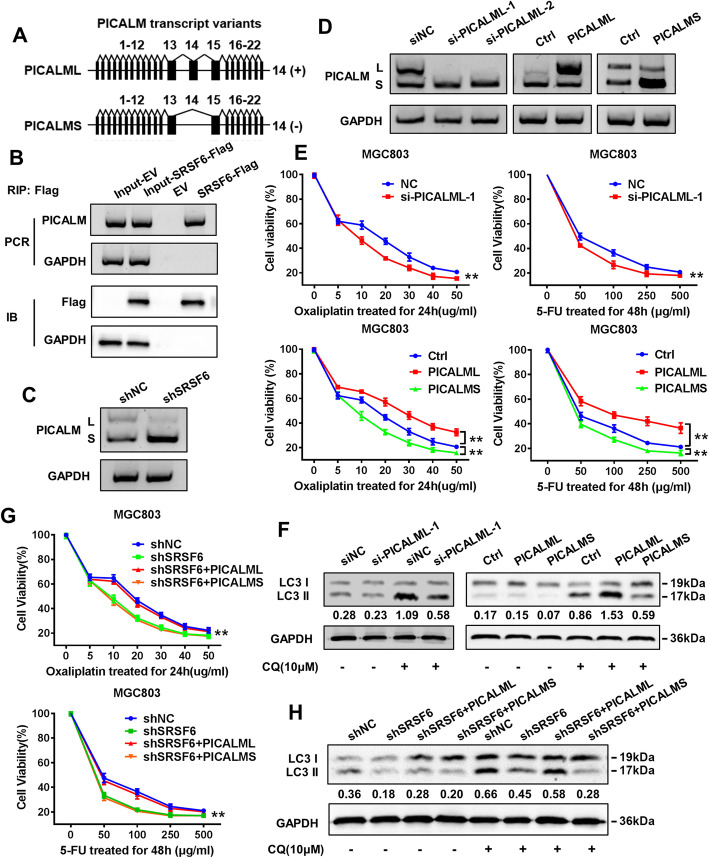
SRSF6 promotes autophagy activity through regulating alterative splicing of PICLAM. a Schematic diagram of PICALM splice variants. b RIP and RT-PCR for detecting the interaction between SRSF6 protein and PICALM mRNA (upper panels: RT-PCR for PICALM mRNA; lower panels: immunoblotting for SRSF6-flag protein). c Depletion of SRSF6 leads to a shift of PICALM splicing module in MGC803 cells. d The interference and overexpression of PICLAML and the overexpression efficiency of PICALMS were assessed by western blot. e CCK8 assays were used to evaluate the interference and overexpression of PICLAML and overexpression of PICALMS on the sensitivity of MGC803 cells to oxaliplatin and 5-FU. f The effect of PICALML and PICALMS on the expression of LC3II in MGC803 cells in the presence of CQ was detected by western blot. g PICLAML or PICLAMS were re-introduced into MGC803/shSRSF6 cells for drug sensitivity test. (H) PICLAML and PICLAMS were re-introduced into MGC803/shSRSF6 cells for western blot to detect the expression level of LC3II. Representative figures are shown. The results are from three independent experiments. One-way ANOVA; mean ± SD; the asterisk (**) indicates P < 0.01

References

    1. Bray F, Ferlay J, Soerjomataram I, Siegel RL, Torre LA, Jemal A. Global cancer statistics 2018: GLOBOCAN estimates of incidence and mortality worldwide for 36 cancers in 185 countries. CA Cancer J Clin. 2018;68:394–424. doi: 10.3322/caac.21492. - DOI - PubMed
    1. Smyth EC, Verheij M, Allum W, Cunningham D, Cervantes A, Arnold D. Gastric cancer: ESMO clinical practice guidelines for diagnosis, treatment and follow-up. Ann Oncol. 2016;27:v38–v49. doi: 10.1093/annonc/mdw350. - DOI - PubMed
    1. Charalampakis N, Economopoulou P, Kotsantis I, Tolia M, Schizas D, Liakakos T, Elimova E, Ajani JA, Psyrri A. Medical management of gastric cancer: a 2017 update. Cancer Med. 2018;7:123–133. doi: 10.1002/cam4.1274. - DOI - PMC - PubMed
    1. Ho CJ, Gorski SM. Molecular mechanisms underlying autophagy-mediated treatment resistance in Cancer. Cancers (Basel). 2019;11. - PMC - PubMed
    1. Levy JMM, Towers CG, Thorburn A. Targeting autophagy in cancer. Nat Rev Cancer. 2017;17:528–542. doi: 10.1038/nrc.2017.53. - DOI - PMC - PubMed

Publication types

MeSH terms