Review
. 2021 Jan 5;18(1):2.
doi: 10.1186/s12979-020-00213-w.

Gut microbiota as the key controllers of "healthy" aging of elderly people

Affiliations
Review

Gut microbiota as the key controllers of "healthy" aging of elderly people

Emeline Ragonnaud et al. Immun Ageing. .

Abstract

Extrinsic factors, such as lifestyle and diet, are shown to be essential in the control of human healthy aging, and thus, longevity. They do so by targeting at least in part the gut microbiome, a collection of commensal microorganisms (microbiota), which colonize the intestinal tract starting after birth, and is established by the age of three. The composition and abundance of individual microbiota appears to continue to change until adulthood, presumably reflecting lifestyle and geographic, racial, and individual differences. Although most of these changes appear to be harmless, a major shift in their composition in the gut (dysbiosis) can trigger harmful local and systemic inflammation. Recent reports indicate that dysbiosis is increased in aging and that the gut microbiota of elderly people is enriched in pro-inflammatory commensals at the expense of beneficial microbes. The clinical consequence of this change remains confusing due to contradictory reports and a high degree of variability of human microbiota and methodologies used. Here, we present the authors' thoughts that underscore dysbiosis as a primary cause of aging-associated morbidities, and thus, premature death of elderly people. We provide evidence that the dysbiosis triggers a chain of pathological and inflammatory events. Examples include alteration of levels of microbiota-affected metabolites, impaired function and integrity of the gastrointestinal tract, and increased gut leakiness. All of these enhance systemic inflammation, which when associated with aging is termed inflammaging, and result in consequent aging-associated pathologies.

Keywords: Aging; B cells; Commensals; IgA.


Conflict of interest statement

None.

Figures
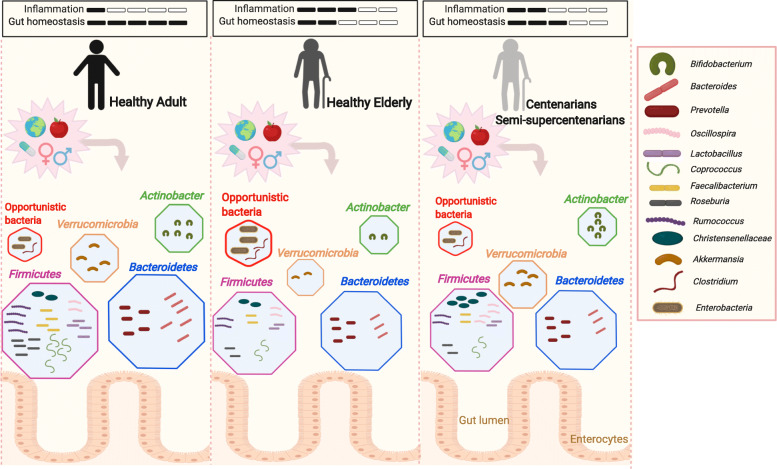
Fig. 1
Fig. 1
The composition of gut microbiota determines inflammation and possibly lifespan of elderly people. The lumen and particularly the mucin layer of the intestine of young adults are colonized by a diverse population of commensal microbes that co-exist with the host in a symbiotic relationship. Members of Verrucomicrobia phylum, particularly Akkermansia muciniphila, support gut barrier integrity and thus prevent leakage and subsequent induction of inflammation. In elderly people, the composition of the gut commensals is changed and microbial diversity is reduced due to accumulation of potentially pro-inflammatory commensals and decrease of beneficial microbes, such as members of Verrucomicrobia. It therefore leads to gut leakiness and consequent systemic inflammation that facilitates aging-associated morbidities and premature death. Although the microbiota of centenarians changes, its diversity and beneficial commensals are retained, thereby controlling overt inflammation and supporting healthy aging
Fig. 2
Fig. 2
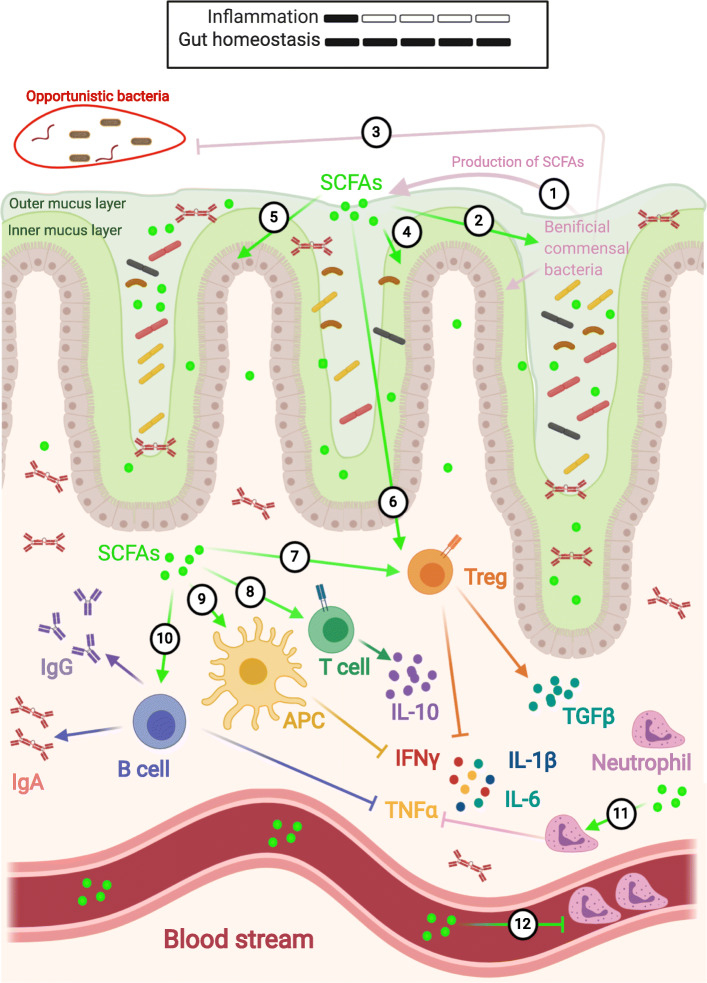
Commensal microbes are sole producers of beneficial SCFAs. 1, In the gut of healthy young people, beneficial commensal bacterial members of Firmicutes produce SCFAs. 2, SCFAs provide energy to the microbiota and 3, thereby can inhibit the colonization of opportunistic bacteria; and 4, promote the production of protective mucus. 5, SCFAs are also source of energy for enterocytes and 6, immune cells. They can cross the gut epithelium layer to promote immune tolerance by 7, inducing TGFβ producing FoxP3+ regulatory T cells (Tregs), 8, IL-10 producing T cells; 9, activating anti-inflammatory responses in antigen presenting cells (APCs); and 10, promoting the production of IgA and IgG from B cells. 11, SCFAs also initiate anti-inflammatory responses in neutrophils and 12, affect their recruitment
Fig. 3
Fig. 3
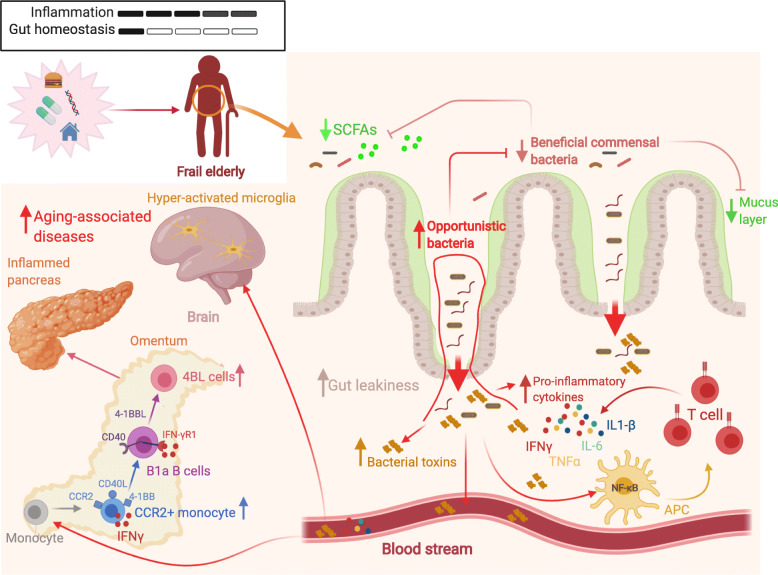
Gut dysbiosis in the elderly increases risk of aging-associated diseases. The composition of the gut microbiota changes with age, causing a mild inflammation in the elderly. This change can be exacerbated by additional intrinsic and extrinsic factors, such as uptake of antibiotics and diet. Frail elderly people show increased gut dysbiosis, a severe decrease of beneficial commensal bacteria, such as Akkermansia muciniphila and SCFA-producing bacteria, and a marked increase of opportunistic and potentially proinflammatory commensal microbes. It leads to impairment of the intestinal epithelial integrity and increases gut leakiness and translocation of opportunistic bacteria and endotoxin into the circulation, causing a chain of inflammatory events that enhance the risk of developing aging-associated pathologies. For instance, in aged mice, the A. muciniphila loss-caused inflammation recruits and activates CCR2+ monocytes in the omentum, where they upregulate 4-1BB, CD40L and the production of IFNγ and convert B1a B cells into 4BL cells via 4-1BBL/4-1BB axis. The 4BL cells then promote insulin resistance in aged hosts

References

    1. Galen, et al. Hygiene. Cambridge: Harvard University Press; 2018.
    1. Metchnikoff E, Mitchell PC. The prolongation of life; optimistic studies. London: W. Heinemann; G.P. Putnam's Sons. xx; 1907. p. 343.
    1. Gill SR, et al. Metagenomic analysis of the human distal gut microbiome. Science. 2006;312(5778):1355–1359. doi: 10.1126/science.1124234. - DOI - PMC - PubMed
    1. Honda K, Littman DR. The microbiota in adaptive immune homeostasis and disease. Nature. 2016;535(7610):75–84. doi: 10.1038/nature18848. - DOI - PubMed
    1. Atarashi K, et al. Th17 cell induction by adhesion of microbes to intestinal epithelial cells. Cell. 2015;163(2):367–380. doi: 10.1016/j.cell.2015.08.058. - DOI - PMC - PubMed