


Case Reports
doi: 10.1016/j.jiac.2020.11.016.
Epub 2020 Dec 23.
Immunochromatographic test for the detection of SARS-CoV-2 in saliva
Affiliations
- PMID: 33397587
- PMCID: PMC7755575
- DOI: 10.1016/j.jiac.2020.11.016
Item in Clipboard
Case Reports
Immunochromatographic test for the detection of SARS-CoV-2 in saliva
J Infect Chemother.
2021 Feb.
Abstract
We evaluated the rapid immunochromatographic test for severe acute respiratory coronavirus 2 (SARS-CoV-2) antigen detection using 16 saliva specimens collected from 6 COVID-19 hospitalized patients, and detected N-antigen in 4 of 7 RT-PCR positive specimens. This POCT detected SARS-CoV-2 antigen in saliva and would be useful for COVID-19 diagnosis.
Keywords: Antigen test; COVID-19; Immunochromatography; POCT; SARS-CoV-2.
Copyright © 2020 Japanese Society of Chemotherapy and The Japanese Association for Infectious Diseases. Published by Elsevier Ltd. All rights reserved.
Conflict of interest statement
Declaration of competing interest SY is an employee and KaA is the director of Fujirebio Inc.
Figures
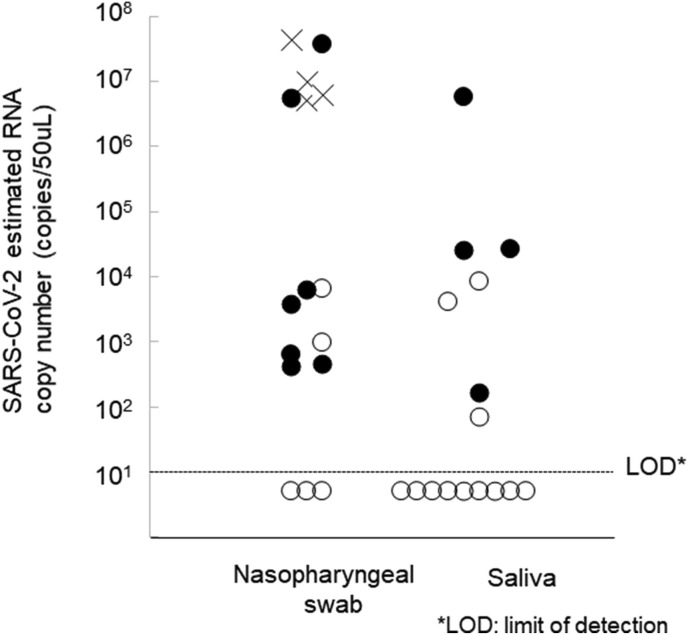
Detection of SARS-CoV-2 N antigen in nasopharyngeal swab and saliva specimens. N antigen-positive specimens are shown as solid circles; negative specimens are shown as open circles. Crosses indicate specimens that were not assayed by the antigen test. There were 4.525 in antigen-positive and 3.444 and log10 mean RNA copies/mL antigen-negative specimens were, and the difference was not significant (p = 0.1088, t-test).
Comment in
-
Letter of concern re: "Immunochromatographic test for the detection of SARS-CoV-2 in saliva. J Infect Chemother. 2021 Feb;27(2):384-386. doi: 10.1016/j.jiac.2020.11.016.".J Infect Chemother. 2021 Jul;27(7):1129-1130. doi: 10.1016/j.jiac.2021.04.003. Epub 2021 Apr 13. J Infect Chemother. 2021. PMID: 33888419 Free PMC article. No abstract available.
References
-
- To K.K.-W., Tsang O.T.-Y., Leung W.-S., Tam A.R., Wu T.-C., Lung D.C., et al. Temporal profiles of viral load in posterior oropharyngeal saliva samples and serum antibody responses during infection by SARS-CoV-2: an observational cohort study. Lancet Infect Dis. 2020 doi: 10.1016/s1473-3099(20)30196-1. - DOI - PMC - PubMed
-
- Wyllie A.L., Fournier J., Casanovas-Massana A., Campbell M., Tokuyama M., Vijayakumar P., et al. Saliva is more sensitive for SARS-CoV-2 detection in COVID-19 patients than nasopharyngeal swabs. Medrxiv. 2020 doi: 10.1101/2020.04.16.20067835. 2020. - DOI
-
- Yamakawa K., Fujimoto A., Miyamoto K., Ohshima T., Suzuki T., Nagata N., et al. Development of rapid lmmunochromatographic enzyme lmmunoassay for SARS-CoV-2 nucleocapsid protein. Jpn J Med Pharm Sci. 2020;77:937–944. (In Japanese)
Publication types
MeSH terms
Substances
LinkOut - more resources
Full Text Sources
Other Literature Sources
Medical
Miscellaneous
