. 2021 Jan 4;4(1):8.
doi: 10.1038/s42003-020-01545-5.

A framework for identifying the recent origins of mobile antibiotic resistance genes

Affiliations

A framework for identifying the recent origins of mobile antibiotic resistance genes

Stefan Ebmeyer et al. Commun Biol. .

Abstract

Since the introduction of antibiotics as therapeutic agents, many bacterial pathogens have developed resistance to antibiotics. Mobile resistance genes, acquired through horizontal gene transfer, play an important role in this process. Understanding from which bacterial taxa these genes were mobilized, and whether their origin taxa share common traits, is critical for predicting which environments and conditions contribute to the emergence of novel resistance genes. This knowledge may prove valuable for limiting or delaying future transfer of novel resistance genes into pathogens. The literature on the origins of mobile resistance genes is scattered and based on evidence of variable quality. Here, we summarize, amend and scrutinize the evidence for 37 proposed origins of mobile resistance genes. Using state-of-the-art genomic analyses, we supplement and evaluate the evidence based on well-defined criteria. Nineteen percent of reported origins did not fulfill the criteria to confidently assign the respective origin. Of the curated origin taxa, >90% have been associated with infection in humans or domestic animals, some taxa being the origin of several different resistance genes. The clinical emergence of these resistance genes appears to be a consequence of antibiotic selection pressure on taxa that are permanently or transiently associated with the human/domestic animal microbiome.


Conflict of interest statement

The authors declare no competing interests

Figures
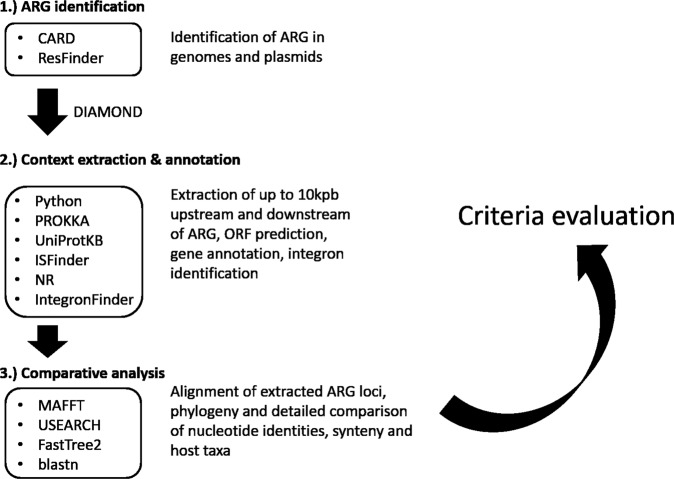
Fig. 1
Fig. 1. Comparative genomics workflow.
Workflow and tools/databases used for amendment and scrutinization of proposed origins of ARGs.
Fig. 2
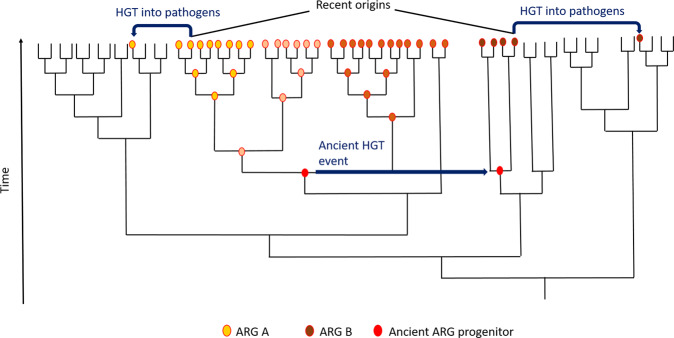
Fig. 2. The principle of recent origins.
Schematic phylogeny illustrating the principle of recent origins of ARGs. Blue arrows represent horizontal gene transfer events (HGT); red circle on node represents an ARG progenitor. Changing color of circle represents sequence evolution over time. Two possible scenarios are shown: ARG A evolves in the same taxonomic clade as the ARG progenitor prior to being transferred to a pathogen. In case of ARG B, the ARG progenitor is acquired through an ancient HGT event before it is, more recently, transferred to pathogens, and is thus not present in the sister clades of the recent origin of ARG B. In both cases, the recent origin is the taxon from which the gene is mobilized into clinically relevant contexts.
Fig. 3
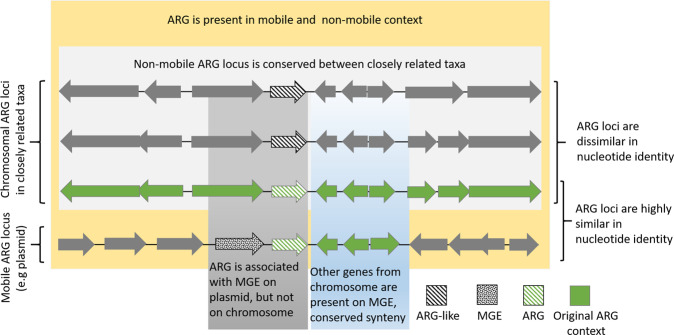
Fig. 3. Assigning the recent origin of an ARG.
Graphical representation of strong evidence for assigning the recent origin of an ARG using the evaluation criteria described above.
Fig. 4
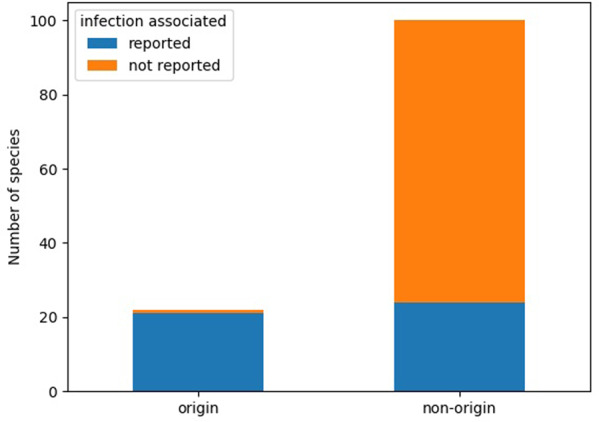
Fig. 4. Association with infection for randomly selected Proteobacteria and origin species.
Grouped barchart showing number of species reported in infection for origin and non-origin species (n = 122). Non-origin species were randomly selected from all proteobacterial species in the NCBI Assembly database. Fisher’s exact test odds ratio: 66.5, p = 3.13e − 10.
Fig. 5
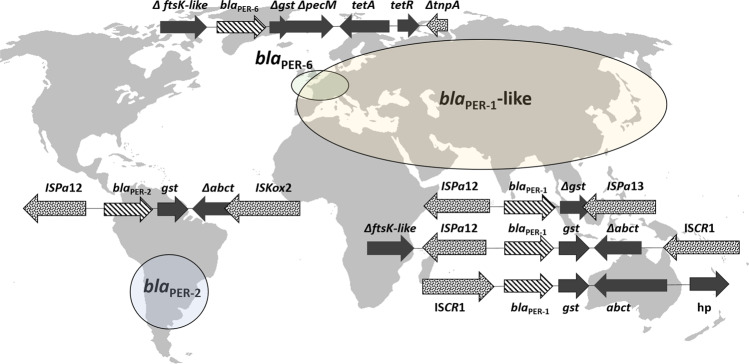
Fig. 5. Multiple mobilization events of an ARG may result in association with different mobile contexts.
Multiple contexts for ARGs of the same family as a consequence of multiple independent mobilization events on the example of blaPER ESBLs, mobilized from Pararheinheimera spp. Elliptic shapes (grossly) represent the areas from which different blaPER variants have been reported. Although blaPER-2 and blaPER-1 are both associated with ISPa12, the blaPER loci (including blaPER and co-mobilized genes) on the depicted MGEs are about 20% dissimilar in nucleotide identities. blaPER-6 is 13% dissimilar to blaPER-2 and about 20% dissimilar to blaPER-1. Transposable elements are presented with dotted pattern and blaPER genes with striped pattern.

References

    1. Siguier P, Gourbeyre E, Chandler M. Bacterial insertion sequences: their genomic impact and diversity. FEMS Microbiol. Rev. 2014;38:865–891. doi: 10.1111/1574-6976.12067. - DOI - PMC - PubMed
    1. Poirel L, Decousser J-W, Nordmann P. Insertion sequence ISEcp1B is involved in expression and mobilization of a blaCTX-M β-lactamase gene. Antimicrob. Agents Chemother. 2003;47:2938–2945. doi: 10.1128/AAC.47.9.2938-2945.2003. - DOI - PMC - PubMed
    1. Lallement C, Pasternak C, Ploy M-C, Jové T. The role of ISCR1-borne POUT promoters in the expression of antibiotic resistance genes. Front. Microbiol. 2018;9:2579. doi: 10.3389/fmicb.2018.02579. - DOI - PMC - PubMed
    1. Toleman MA, Bennett PM, Walsh TR. ISCR elements: novel gene-capturing systems of the 21st century? Microbiol. Mol. Biol. Rev. 2006;70:296–316. doi: 10.1128/MMBR.00048-05. - DOI - PMC - PubMed
    1. Chen Y-T, et al. Mobilization of qnrB2 and ISCR1 in plasmids. Antimicrob. Agents Chemother. 2009;53:1235–1237. doi: 10.1128/AAC.00970-08. - DOI - PMC - PubMed

Publication types

Substances