[Preprint]. 2020 Dec 31:rs.3.rs-132821.
doi: 10.21203/rs.3.rs-132821/v1.

SARS-CoV-2 infection induces long-lived bone marrow plasma cells in humans

Affiliations

SARS-CoV-2 infection induces long-lived bone marrow plasma cells in humans

Jackson S Turner et al. Res Sq. .

Update in

Abstract

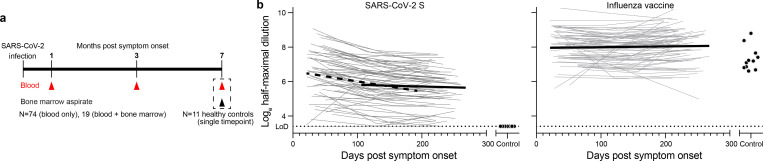
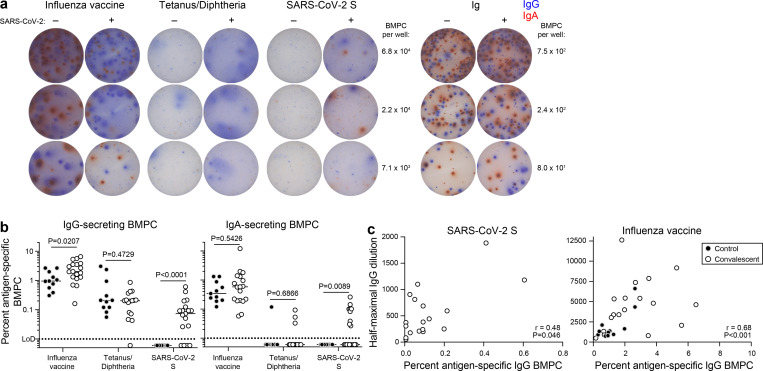
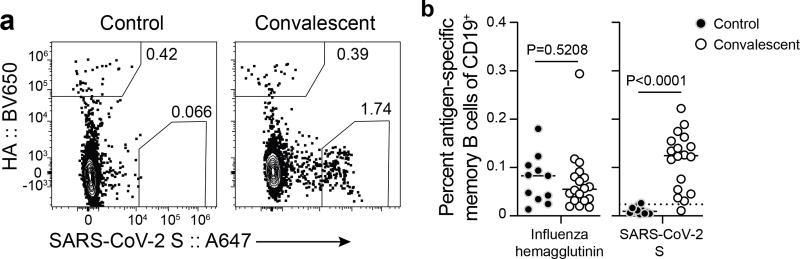
Infection or vaccination induces a population of long-lived bone marrow plasma cells (BMPCs) that are a persistent and essential source of protective antibodies1-5. Whether this population is induced in patients infected with the severe acute respiratory syndrome coronavirus 2 (SARS-CoV-2) is unknown. Recent reports have suggested that SARS-CoV-2 convalescent patients experience a rapid decay in their antigen-specific serum antibodies, raising concerns that humoral immunity against this virus may be short-lived6-8. Here we show that in patients who experienced mild infections (n=73), serum anti-SARS-CoV-2 spike (S) antibodies indeed decline rapidly in the first 3 to 4 months after infection. However, this is followed by a more stable phase between 4- and 8-months after infection with a slower serum anti-S antibody decay rate. The level of serum antibodies correlated with the frequency of S-specific long-lived BMPCs obtained from 18 SARS-CoV-2 convalescent patients 7 to 8 months after infection. S-specific BMPCs were not detected in aspirates from 11 healthy subjects with no history of SARS-CoV-2 infection. Comparable frequencies of BMPCs specific to contemporary influenza virus antigens or tetanus and diphtheria vaccine antigens were present in aspirates in both groups. Circulating memory B cells (MBCs) directed against the S protein were detected in the SARS-CoV-2 convalescent patients but not in uninfected controls, whereas both groups had MBCs against influenza virus hemagglutinin. Overall, we show that robust antigen specific long-lived BMPCs and MBCs are induced after mild SARS-CoV-2 infection of humans.


Figures
Extended Data Figure 1.
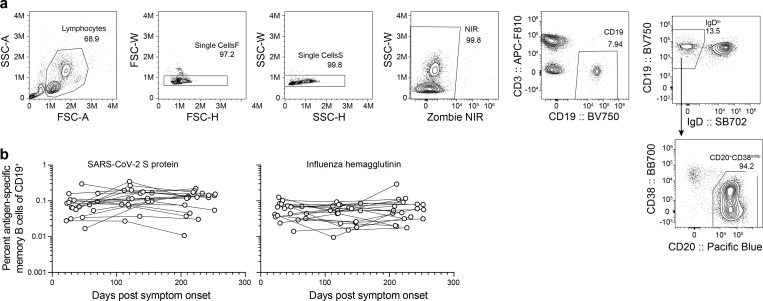
Extended Data Figure 1.. SARS-CoV-2 memory B cells.
a) Flow cytometry gating strategy for isotype-switched memory B cells in PBMC. (b) Kinetics of S- (left) and influenza virus hemagglutinin- (right) binding memory B cells, gated as in (a) and Fig. 3a, in PBMCs from convalescent patients collected at the indicated days post onset of symptoms. Symbols at each timepoint represent one sample (n=18). Data from the 7-month timepoint are also shown in Fig. 3b.
Figure 1.
Figure 1.. Biphasic decline in SARS-CoV-2 antibody titers
a) Study design. Seventy-three SARS-CoV-2 convalescent patients with mild disease (ages 21–69) were enrolled and blood was collected approximately 1 month, 4 months, and 7 months post onset of symptoms. Bone marrow aspirates were collected from eighteen of the participants 7 to 8 months after infection and from eleven healthy volunteers (ages 23–60) with no history of SARS-CoV-2 infection. b) Blood IgG titers against S (left) and influenza virus vaccine (right) measured by ELISA in convalescent patients (open circles) at the indicated time post onset of symptoms and controls (closed circles). Dotted line indicates limit of detection. Heavy lines represent modeled antibody decay kinetics for S titers 1–4 months (dashed line; decay rate −0.00595, P<0.001, t1/2=116.5 days) and 4–7 months (solid line; decay rate −0.00101, P=0.04, t1/2=686.3 days) post symptom onset and for influenza virus vaccine titers 1–7 months post symptom onset (decay rate 0.000455, P=0.33) estimated using a longitudinal linear mixed model approach (see Methods for details).
Figure 2.
Figure 2.. SARS-CoV-2 infection elicits long-lived BMPCs
a) Example images of ELISpot wells coated with the indicated antigens or anti-Ig and developed in blue and red for IgG and IgA, respectively after incubation of magnetically enriched BMPC from convalescent and control participants. b) Frequencies of BMPC secreting IgG (left) or IgA (right) antibodies specific for the indicated antigens, indicated as percentages of total IgG- or IgA-secreting BMPC in convalescent (open circles) and control (closed circles) participants. Horizontal lines indicate medians. P-values from two-sided Mann-Whitney U-tests. c) Frequencies of IgG BMPC specific for S (left) and influenza virus vaccine (right) plotted against respective IgG titers in paired blood samples from convalescent patients 7 months post symptom onset (open circles) and control participants (closed circles). Each symbol represents one sample (n=18 convalescent, 11 control). P- and r-values from two-sided Spearman’s correlations.
Figure 3.
Figure 3.. SARS-CoV-2 infection elicits a robust memory B cell response
a) Example plots of influenza virus hemagglutinin (HA) and S staining on IgDlo CD20+ CD38lo/int CD19+ CD3 live singlet lymphocytes (gating in Extended Data Fig. 1a) from control (left) and convalescent (right) PBMC 7 months after symptom onset. b) Frequencies of influenza virus HA- (left) and S- (right) binding memory B cells in PBMC from control (closed circles) and convalescent (open circles) participants 7 months after symptom onset. The dotted line in the S plot indicates limit of sensitivity, defined as the median + 2× SD of the controls. Each symbol represents one sample (n=18 convalescent, 11 control). Horizontal lines indicate medians. P-values from two-sided Mann-Whitney U-tests.

References

    1. Benner R., Hijmans W. & Haaijman J. J. The bone marrow: the major source of serum immunoglobulins, but still a neglected site of antibody formation. Clin. Exp. Immunol. 46, 1–8 (1981). - PMC - PubMed
    1. Slifka M. K., Antia R., Whitmire J. K. & Ahmed R. Humoral Immunity Due to Long-Lived Plasma Cells. Immunity 8, 363–372 (1998). - PubMed
    1. Hammarlund E. et al. Duration of antiviral immunity after smallpox vaccination. Nat. Med. 9, 1131–1137 (2003). - PubMed
    1. Halliley J. L. et al. Long-Lived Plasma Cells Are Contained within the CD19−CD38hiCD138+ Subset in Human Bone Marrow. Immunity 43, 132–145 (2015). - PMC - PubMed
    1. Nutt S. L., Hodgkin P. D., Tarlinton D. M. & Corcoran L. M. The generation of antibody-secreting plasma cells. Nat. Rev. Immunol. 15, 160–171 (2015). - PubMed

Publication types

LinkOut - more resources