


External validation of a deep learning electrocardiogram algorithm to detect ventricular dysfunction
- PMID: 33400971
- PMCID: PMC7955278
- DOI: 10.1016/j.ijcard.2020.12.065
External validation of a deep learning electrocardiogram algorithm to detect ventricular dysfunction
Abstract
Objective: To validate a novel artificial-intelligence electrocardiogram algorithm (AI-ECG) to detect left ventricular systolic dysfunction (LVSD) in an external population.
Background: LVSD, even when asymptomatic, confers increased morbidity and mortality. We recently derived AI-ECG to detect LVSD using ECGs based on a large sample of patients treated at the Mayo Clinic.
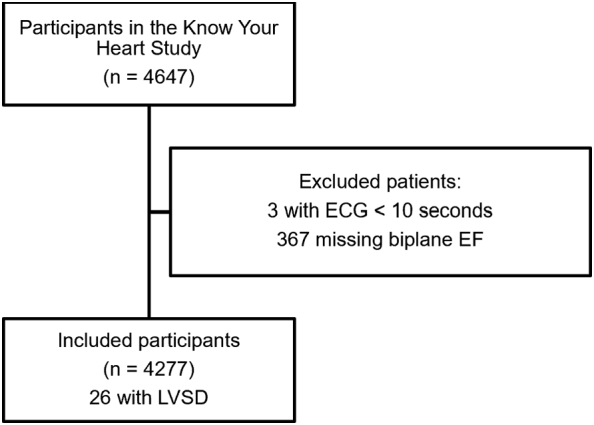
Methods: We performed an external validation study with subjects from the Know Your Heart Study, a cross-sectional study of adults aged 35-69 years residing in two cities in Russia, who had undergone both ECG and transthoracic echocardiography. LVSD was defined as left ventricular ejection fraction ≤ 35%. We assessed the performance of the AI-ECG to identify LVSD in this distinct patient population.
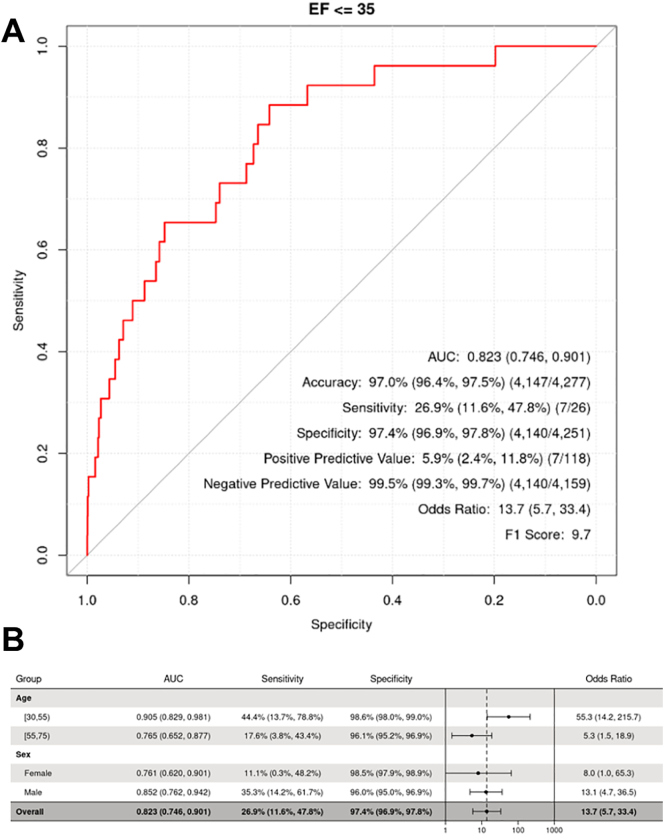
Results: Among 4277 subjects in this external population-based validation study, 0.6% had LVSD (compared to 7.8% of the original clinical derivation study). The overall performance of the AI-ECG to detect LVSD was robust with an area under the receiver operating curve of 0.82. When using the LVSD probability cut-off of 0.256 from the original derivation study, the sensitivity, specificity, and accuracy in this population were 26.9%, 97.4%, 97.0%, respectively. Other probability cut-offs were analysed for different sensitivity values.
Conclusions: The AI-ECG detected LVSD with robust test performance in a population that was very different from that used to develop the algorithm. Population-specific cut-offs may be necessary for clinical implementation. Differences in population characteristics, ECG and echocardiographic data quality may affect test performance.
Keywords: Artificial intelligence; Electrocardiogram; Left ventricular systolic dysfunction; Machine learning.
Copyright © 2020. Published by Elsevier B.V.
Conflict of interest statement
Declaration of Competing Interest Mayo Clinic has licensed the underlying technology to EKO, a maker of digital stethoscopes with embedded ECG electrodes. Mayo Clinic may receive financial benefit from the use of this technology, but at no point will Mayo Clinic benefit financially from its use for the care of subjects at Mayo Clinic. P.A.F., F.L.-J., S.K., and Z.I.A. may also receive financial benefit from this agreement.
Figures
Comment in
-
AI-based detection of reduced ejection fraction from the electrocardiogram: Is the future here already?Int J Cardiol. 2021 May 15;331:116-117. doi: 10.1016/j.ijcard.2021.01.012. Epub 2021 Jan 28. Int J Cardiol. 2021. PMID: 33516837 No abstract available.
References
-
- Yancy C.W. ACC/AHA/HFSA Focused Update of the 2013 ACCF/AHA Guideline for the Management of Heart Failure: A Report of the American College of Cardiology/American Heart Association Task Force on Clinical Practice Guidelines and the Heart Failure Society of America. J Card Fail. 2017;23(8):628–651. - PubMed
-
- Attia Z.I. Screening for cardiac contractile dysfunction using an artificial intelligence-enabled electrocardiogram. Nat Med. 2019;25(1):70–74. - PubMed
-
- Attia Z.I. Prospective validation of a deep learning electrocardiogram algorithm for the detection of left ventricular systolic dysfunction. J Cardiovasc Electrophysiol. 2019;30(5):668–674. - PubMed
-
- Abrams C. Google’s Effort to Prevent Blindness Shows AI Challenges. The Wall Street Journal. 2019 https://www.wsj.com/articles/googles-effort-to-prevent-blindness-hits-ro...
MeSH terms
LinkOut - more resources
Full Text Sources
Other Literature Sources
