


Failure to recognize Low non-treponemal titer syphilis infections in pregnancy May lead to widespread under-treatment
- PMID: 33401033
- PMCID: PMC8012229
- DOI: 10.1016/j.ijid.2020.12.076
Failure to recognize Low non-treponemal titer syphilis infections in pregnancy May lead to widespread under-treatment
Abstract
Objectives: Rates of maternal syphilis have increased five-fold in Brazil in the past decade. While penicillin remains the only appropriate treatment for maternal syphilis, we hypothesized that low non-treponemal titers (<1:16) may lead to reduced penicillin treatment in Brazil.
Methods: Using Brazilian Ministry of Health data on women diagnosed with maternal syphilis between January 1, 2010, and December 31, 2018, we conducted a random-effects logistic regression model with a cluster correction at the state level to evaluate predictive factors of penicillin treatment.
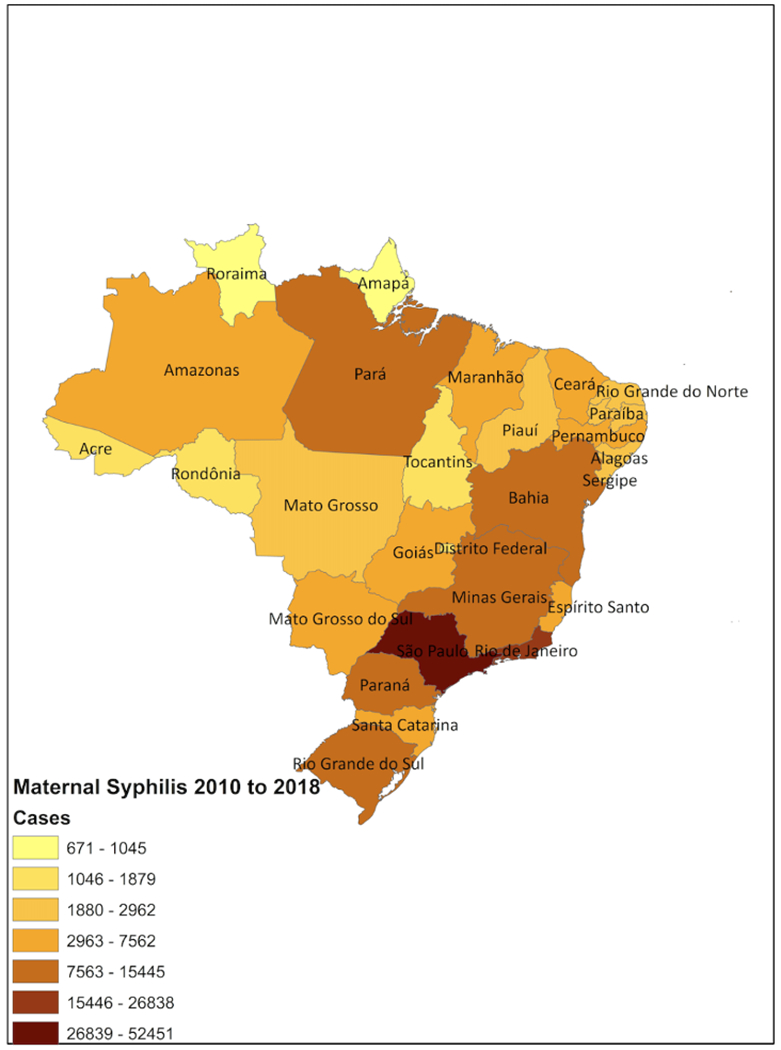
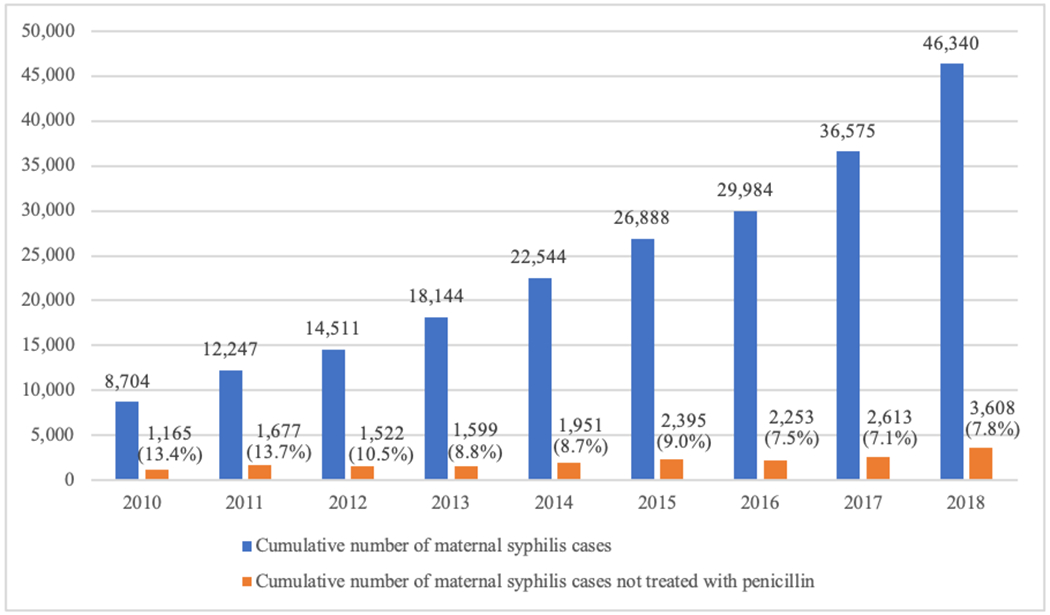
Results: We observed yearly increases in cases of pregnant women with syphilis from 2010 to 2018. There was significant variation by state: 52,451 cases were reported in São Paulo, followed by 26,838 in Rio de Janeiro. Among 215,937 cases of maternal syphilis, 91·3% received penicillin. In the random-effects model, a non-treponemal titer ≥1:16 was associated with 1·44 higher odds of receiving penicillin (95% confidence interval [CI]: 1·391·48), and prenatal care was associated with a 2·12 increased odds of receiving penicillin (95% CI: 2·022·21). Although there is an association between the absence of prenatal care and inadequate treatment for syphilis, 83·2% of women in this cohort who did not receive penicillin were engaged in prenatal care.
Conclusions: Providers may inappropriately exclude low non-treponemal titers and thereby fail to use penicillin treatment in maternal syphilis. While the cause of the maternal syphilis epidemic in Brazil is multifactorial, we believe our findings can be used to develop targeted interventions throughout Brazil as well as shape public health initiatives globally.
Keywords: Brazil; Health policy; Penicillin; Pregnancy; Syphilis; Treatment.
Copyright © 2021 The Authors. Published by Elsevier Ltd.. All rights reserved.
Conflict of interest statement
Disclosure of relationships and activities
All authors declare no competing interests.
Figures
References
-
- Boletim Epidemiológico Sífilis 2019. Departamento de Doenças de Condições Crônicas e Infecções Sexualmente Transmissíveis 2019. [Available from: http://www.aids.gov.br/pt-br/pub/2019/boletim-epidemiologico-sifilis-2019].
-
- Cambou M Are HIV and Syphilis Syndemic Among Pregnant Women in Brazil? Poster session presented at: 10th Annual IAS conference on HIV science; 2019. July 21–24; Mexico City, Mexico.
-
- Centers for Diseae Control and Prevention. Screening Recommendations: Clinician Timeline for Screening Syphilis, HIV, HBV, HCV, Chlamydia, and Gonorrhea 2019. [Available from: https://www.cdc.gov/nchhstp/pregnancy/screening/clinician-timeline.html].
MeSH terms
Substances
Grants and funding
LinkOut - more resources
Full Text Sources
Other Literature Sources
Medical
Miscellaneous
