


Prevalence of Clostridioides difficile Infection in Critically Ill Patients with Extreme Leukocytosis and Diarrhea
- PMID: 33401377
- PMCID: PMC7839043
- DOI: 10.3390/idr13010003
Prevalence of Clostridioides difficile Infection in Critically Ill Patients with Extreme Leukocytosis and Diarrhea
Abstract
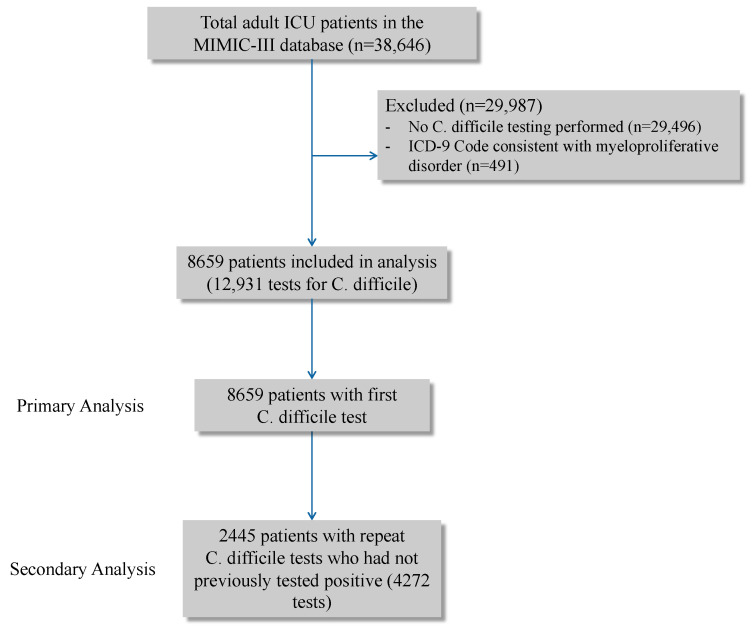
While early empiric antibiotic therapy is beneficial for patients presenting with sepsis, the presentation of sepsis from Clostridioides difficile (formerly Clostridium difficile) infection (CDI) has not been well studied in large cohorts. We sought to determine whether the combination of extreme leukocytosis and diarrhea was strongly predictive of CDI in a cohort of 8659 patients admitted to the intensive care unit. We found that CDI was present in 15.0% (95% CI, 12.1-18.3%) of patients with extreme leukocytosis and diarrhea and that mortality for those with CDI, diarrhea, and extreme leukocytosis was 33.8% (95% CI, 23.2-44.3%). These data support consideration of empiric treatment for CDI in unstable critically ill patients with extreme leukocytosis and diarrhea, along with treatment of other possible sources of sepsis as appropriate. Empiric treatment for CDI can usually be discontinued promptly, along with narrowing of other broad-spectrum antimicrobial coverage, if a sensitive C. difficile test is negative.
Keywords: Clostridioides difficile; Clostridium difficile; critical care medicine; leukocytosis; sepsis.
Conflict of interest statement
The authors declare that no competing interests exist.
References
-
- Karanika S., Paudel S., Zervou F.N., Grigoras C., Zacharioudakis I.M., Mylonakis E. Prevalence and Clinical Outcomes of Clostridium difficile Infection in the Intensive Care Unit: A Systematic Review and Meta-Analysis. Open Forum Infect. Dis. 2015;3:ofv186. doi: 10.1093/ofid/ofv186. - DOI - PMC - PubMed
-
- Consultant 360 Clostridium Difficile Infection: What You Need to Know. [(accessed on 20 May 2019)];2013 Available online: https://www.consultant360.com/article/clostridium-difficile-infection-wh....
LinkOut - more resources
Full Text Sources
Other Literature Sources
