. 2021 Jan 1;19(1):16.
doi: 10.3390/md19010016.

AhaP, A Quorum Quenching Acylase from Psychrobacter sp. M9-54-1 That Attenuates Pseudomonas aeruginosa and Vibrio coralliilyticus Virulence

Affiliations

AhaP, A Quorum Quenching Acylase from Psychrobacter sp. M9-54-1 That Attenuates Pseudomonas aeruginosa and Vibrio coralliilyticus Virulence

José Carlos Reina et al. Mar Drugs. .

Abstract

Although Psychrobacter strain M9-54-1 had been previously isolated from the microbiota of holothurians and shown to degrade quorum sensing (QS) signal molecules C6 and C10-homoserine lactone (HSL), little was known about the gene responsible for this activity. In this study, we determined the whole genome sequence of this strain and found that the full 16S rRNA sequence shares 99.78-99.66% identity with Psychrobacter pulmonis CECT 5989T and P. faecalis ISO-46T. M9-54-1, evaluated using the agar well diffusion assay method, showed high quorum quenching (QQ) activity against a wide range of synthetic N-acylhomoserine lactone (AHLs) at 4, 15, and 28 °C. High-performance liquid chromatography-mass-spectrometry (HPLC-MS) confirmed that QQ activity was due to an AHL-acylase. The gene encoding for QQ activity in strain M9-54-1 was identified from its genome sequence whose gene product was named AhaP. Purified AhaP degraded substituted and unsubstituted AHLs from C4- to C14-HSL. Furthermore, heterologous expression of ahaP in the opportunistic pathogen Pseudomonas aeruginosa PAO1 reduced the expression of the QS-controlled gene lecA, encoding for a cytotoxic galactophilic lectin and swarming motility protein. Strain M9-54-1 also reduced brine shrimp mortality caused by Vibrio coralliilyticus VibC-Oc-193, showing potential as a biocontrol agent in aquaculture.

Keywords: Psychrobacter; acylase; marine habitat; quorum quenching.


Conflict of interest statement

The authors declare no conflict of interest.

Figures
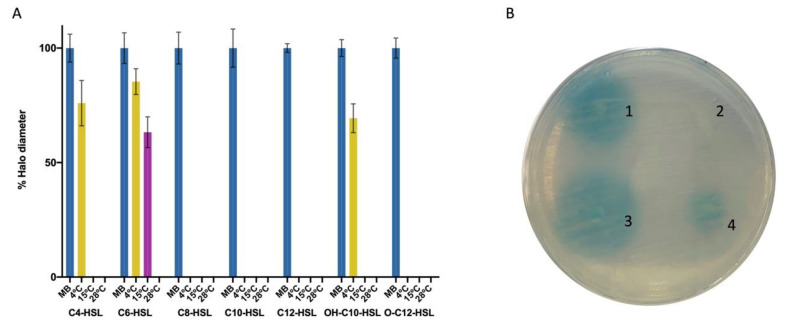
Figure 1
Figure 1
AHL-degradation activity of Psychrobacter sp. M9-54-1 explored using the agar plate diffusion assay method. (A) Degradation activity against synthetic AHLs, at different temperatures, expressed as percentage of halo diameter. Marine broth (MB) was used as negative control. (B) Detection of AHLs using biosensor strain Agrobacterium tumefaciens NTL4 (pZLR4): V. owensii VibC-Oc-106 crude extract (1), M9-54-1 degradation of V. owensii VibC-Oc-106 crude extract (2), P. aeruginosa PAO1 crude extract (3) and M9-54-1 degradation of a crude extract of P. aeruginosa PAO1 (4).
Figure 2
Figure 2
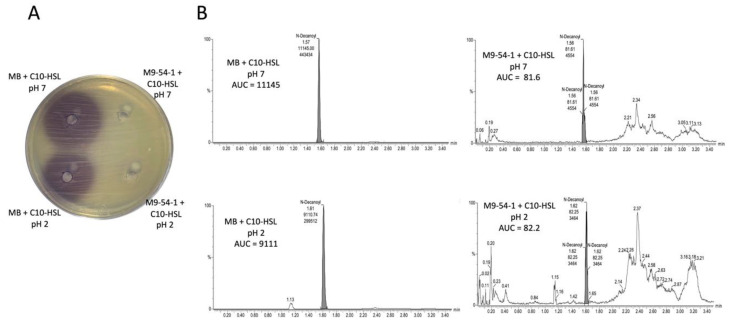
Detection of the remaining C10-HSL activity by agar well diffusion assay using C. violaceum VIR07 (A) and HPLC-MS (B) before and after Psychrobacter sp. M9-54-1 supernatant acidification to determine the quorum-quenching enzymatic mechanism present in this bacterium. Marine broth (MB) was used as negative control. HPLC values are referred to as area under the curve (AUC).
Figure 3
Figure 3
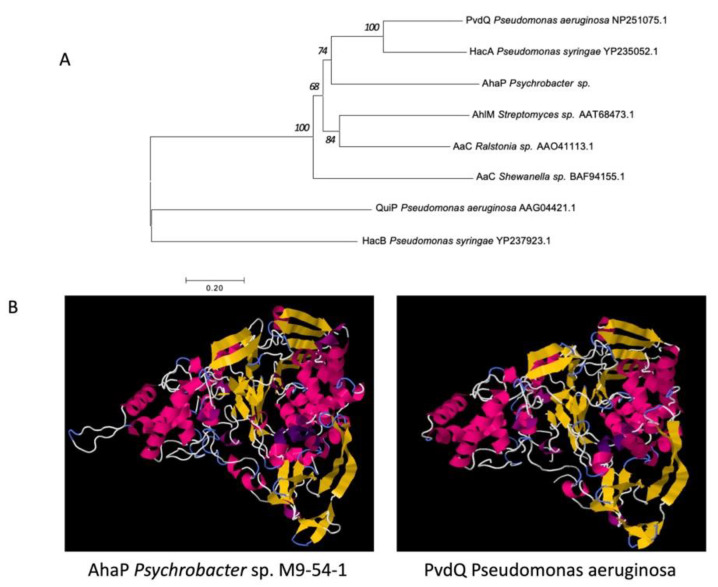
(A). Phylogenetic analysis of the acylase AhaP from Pyschrobacter sp. M9-54-1 and other known acylases using the neighbor-joining method with 1000 bootstrap replications. (B). Comparison of the predicted structures of the acylases AhaP from Psychrobacter sp. M9-54-1 and PvdQ from Pseudomonas aeruginosa PAO1 using the Phyre2 program.
Figure 4
Figure 4
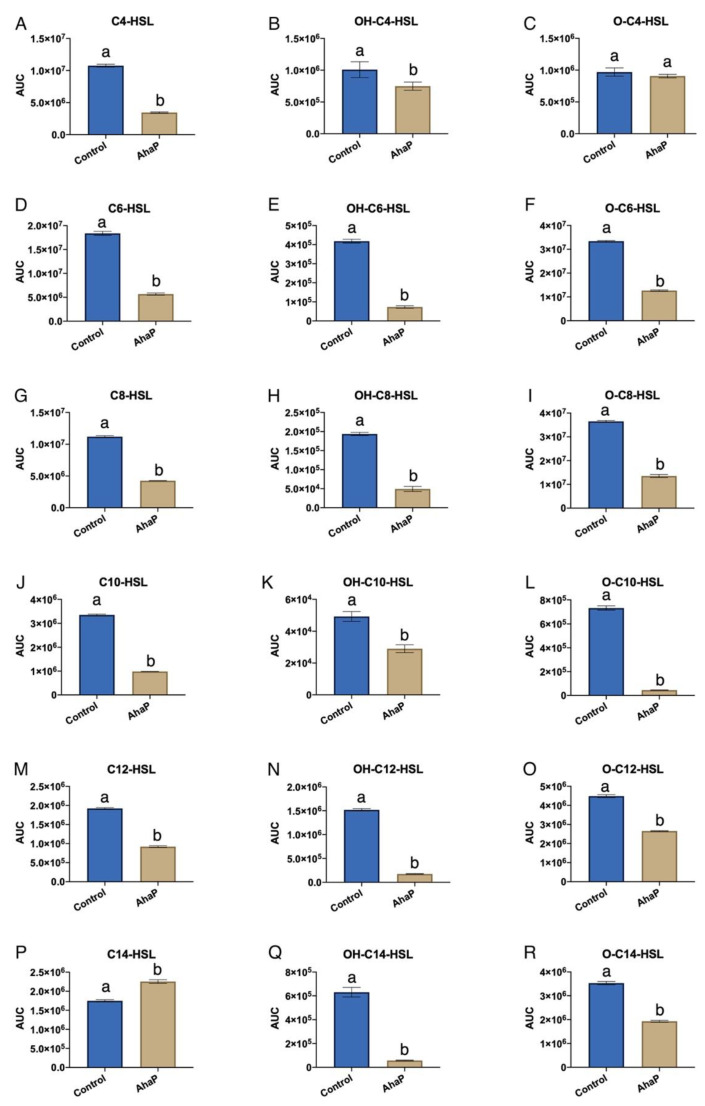
Quorum quenching activity of the purified enzyme AhaP against synthetic AHLs (C4-HSL (A), OH-C4-HSL (B), O-C4-HSL (C), C6-HSL (D), OH-C6-HSL (E), O-C6-HSL (F), C8-HSL (G), OH-C8-HSL (H), O-C8-HSL (I), C10-HSL (J), OH-C10-HSL (K), O-C10-HSL (L), C12-HSL (M), OH-C12-HSL (N), O-C12-HSL (O), C14-HSL (P), OH-C14-HSL (Q), O-C14-HSL (R). Autoinducer activity was detected with the biosensor strains E. coli (pSB536) for C4-HSL and its derivatives; E. coli (pSB401) for C6-, C8- and C10-HSL and their derivatives; and E. coli (pSB1142) for C12- and C14-HSL and their derivatives. Values are expressed as the area under the curve (AUC) of relative light units/OD600. Different letters above the bars indicate that the values are significantly different (p < 0.05).
Figure 5
Figure 5
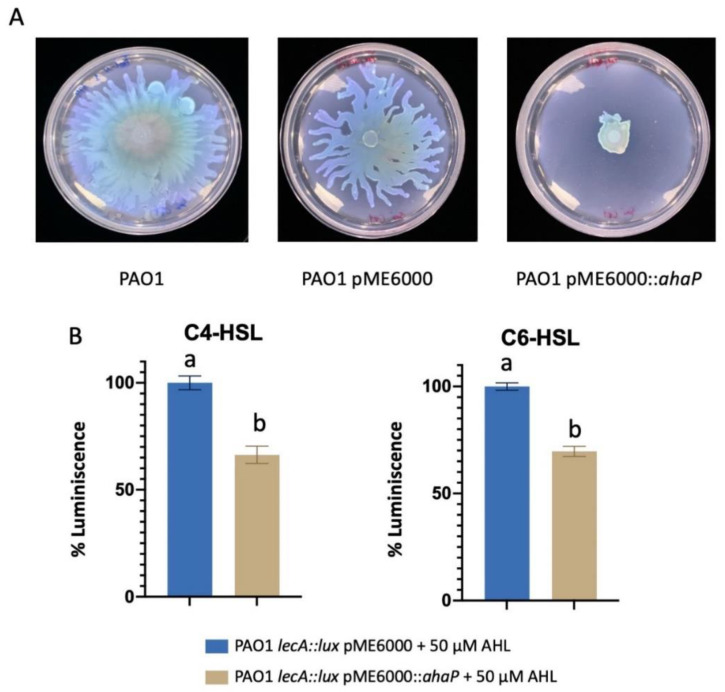
Evaluation of ahaP expression in P. aeruginosa PAO1. (A). Swarming motility assay of PAO1 wild type and strains containing the pME6000::ahaP construct and empty plasmid pME6000. (B). Detection of luminescence production in the biosensor strains PAO1 lecA::lux and PAO1 lecA::lux containing the pME6000::ahaP construct and empty plasmid pME6000 in the presence of C4- and C6-HSL. Different letters above the bars indicate that the values are significantly different (p < 0.05).
Figure 6
Figure 6
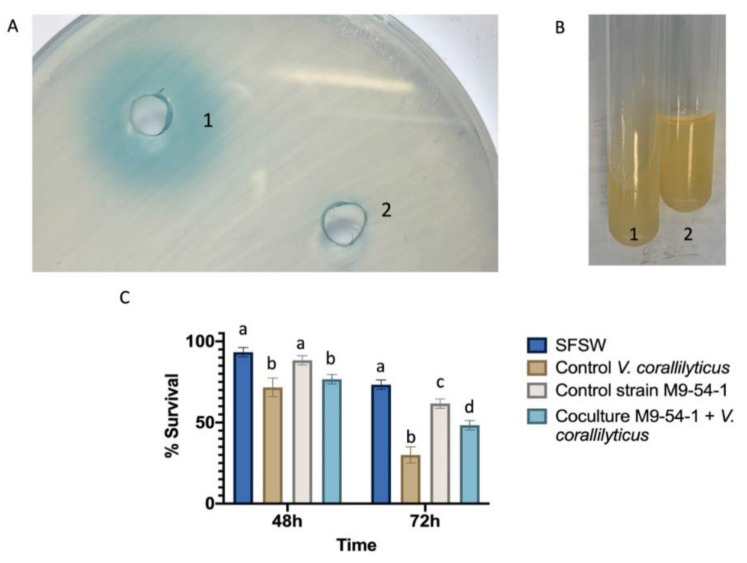
Production of AHLs (A) and gelatinase (B) by V. coralliilyticus VibC-Oc-193 (1) and the co-culture of Psychrobacter M9-54-1 and V. coralliilyticus VibC-Oc-193 (2). (C). Survival rate of Artemia salina nauplii after 48 h and 72 h of incubation with the different cultures. Different letters indicate significant differences (p < 0.05).

References

    1. Fuqua C., Winans S.C., Greenberg E.P. Quorum sensing in bacteria: The LuxR-LuxI family of cell density-responsive transcriptional regulators. J. Bacteriol. 1994;176:269–275. doi: 10.1128/JB.176.2.269-275.1994. - DOI - PMC - PubMed
    1. Whiteley M., Diggle S.P., Greenberg E.P., Wilson E.O. Bacterial quorum sensing: The progress and promise of an emerging research area. Nature. 2017;551:313–320. doi: 10.1038/nature24624. - DOI - PMC - PubMed
    1. Papenfort K., Bassler B.L. Quorum sensing signal–response systems in Gram-negative bacteria. Nat. Rev. Microbiol. 2016;14:576–588. doi: 10.1038/nrmicro.2016.89. - DOI - PMC - PubMed
    1. Abisado R.G., Benomar S., Klaus J.R., Dandekar A.A., Chandler J.R. Bacterial quorum sensing and microbial community interactions. MBio. 2018;9:1–13. doi: 10.1128/mBio.02331-17. - DOI - PMC - PubMed
    1. Williams P., Winzer K., Chan W.C., Camara M. Look who’s talking: Communication and quorum sensing in the bacterial world. Philos. Trans. R. Soc. B Biol. Sci. 2007;362:1119–1134. doi: 10.1098/rstb.2007.2039. - DOI - PMC - PubMed

Supplementary concepts

LinkOut - more resources