


Review of Graphene-Based Textile Strain Sensors, with Emphasis on Structure Activity Relationship
- PMID: 33401466
- PMCID: PMC7795091
- DOI: 10.3390/polym13010151
Review of Graphene-Based Textile Strain Sensors, with Emphasis on Structure Activity Relationship
Abstract
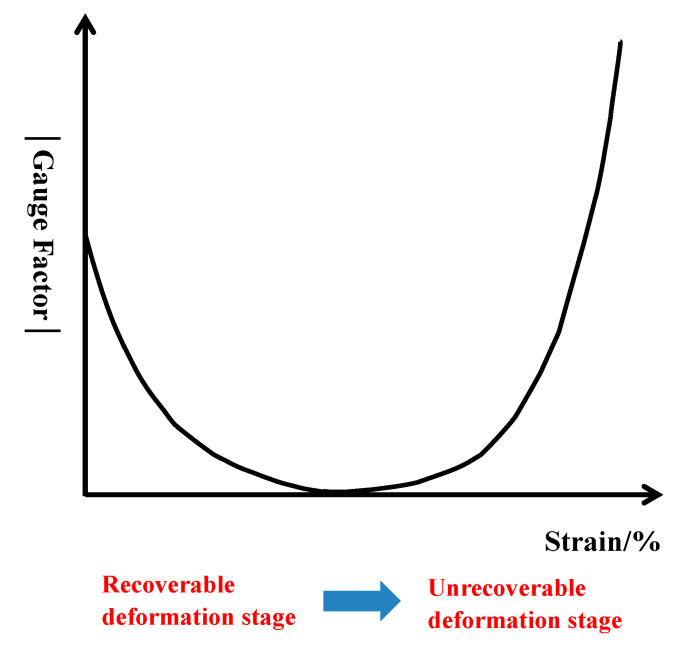
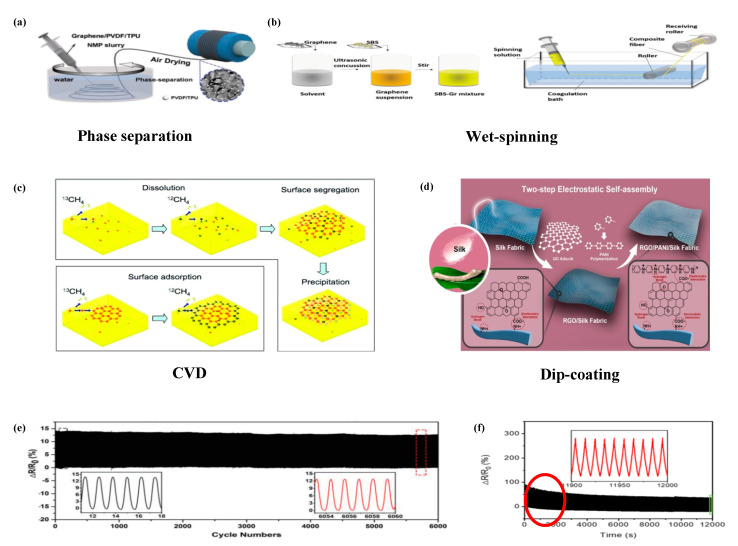
Graphene-based textile strain sensors were reviewed in terms of their preparation methods, performance, and applications with particular attention on its forming method, the key properties (sensitivity, stability, sensing range and response time), and comparisons. Staple fiber strain sensors, staple and filament strain sensors, nonwoven fabric strain sensors, woven fabric strain sensors and knitted fabric strain sensors were summarized, respectively. (i) In general, graphene-based textile strain sensors can be obtained in two ways. One method is to prepare conductive textiles through spinning and weaving techniques, and the graphene worked as conductive filler. The other method is to deposit graphene-based materials on the surface of textiles, the graphene served as conductive coatings and colorants. (ii) The gauge factor (GF) value of sensor refers to its mechanical and electromechanical properties, which are the key evaluation indicators. We found the absolute value of GF of graphene-based textile strain sensor could be roughly divided into two trends according to its structural changes. Firstly, in the recoverable deformation stage, GF usually decreased with the increase of strain. Secondly, in the unrecoverable deformation stage, GF usually increased with the increase of strain. (iii) The main challenge of graphene-based textile strain sensors was that their application capacity received limited studies. Most of current studies only discussed washability, seldomly involving the impact of other environmental factors, including friction, PH, etc. Based on these developments, this work was done to provide some merit to references and guidelines for the progress of future research on flexible and wearable electronics.
Keywords: fabric; graphene-based; staple and filament yarn; staple fiber; textile strain sensors.
Conflict of interest statement
The authors declare no conflict of interest.
Figures
References
-
- Wang P., Wei W., Li Z., Duan W., Han H., Xie Q. A superhydrophobic fluorinated PDMS composite as a wearable strain sensor with excellent mechanical robustness and liquid impalement resistance. J. Mater. Chem. A. 2020;8:3509–3516. doi: 10.1039/C9TA13281C. - DOI
-
- Filippidou M., Tegou E., Tsouti V., Chatzandroulis S. A flexible strain sensor made of graphene nanoplatelets/polydimethylsiloxane nanocomposite. Microelectron. Eng. 2015;142:7–11. doi: 10.1016/j.mee.2015.06.007. - DOI
-
- Chong Y.S., Yeoh K.H., Leow P.L., Chee P.S. Piezoresistive strain sensor array using polydimethylsiloxane-based conducting nanocomposites for electronic skin application. Sens. Rev. 2018;38:494–500. doi: 10.1108/SR-11-2017-0238. - DOI
Publication types
Grants and funding
- NSFC 51803185/the National Natural Science Foundation of China
- LGF21E030005/Public Welfare Project of Zhejiang Province
- 2020M681917/China Postdoctoral Science Foundation
- TYY202013/Postdoctoral Foundation of Zhejiang Sci-tech University Tongxiang Research Institute
- No. 18012107-Y/the Science Foundation of Zhejiang Sci-Tech University
LinkOut - more resources
Full Text Sources
Other Literature Sources
