Review
. 2021 Jan 1;9(1):26.
doi: 10.3390/biomedicines9010026.

Controlling Antibiotic Release from Polymethylmethacrylate Bone Cement

Affiliations
Review

Controlling Antibiotic Release from Polymethylmethacrylate Bone Cement

Victoria Wall et al. Biomedicines. .

Abstract

Bone cement is used as a mortar for securing bone implants, as bone void fillers or as spacers in orthopaedic surgery. Antibiotic-loaded bone cements (ALBCs) have been used to prevent and treat prosthetic joint infections by providing a high antibiotic concentration around the implanted prosthesis. High antibiotic concentrations are, on the other hand, often associated with tissue toxicity. Controlling antibiotic release from ALBCS is key to achieving effective infection control and promoting prosthesis integration with the surrounding bone tissue. However, current ALBCs still need significant improvement in regulating antibiotic release. In this review, we first provide a brief introduction to prosthetic joint infections, and the background concepts of therapeutic efficacy and toxicity in antibiotics. We then review the current state of ALBCs and their release characteristics before focusing on the research and development in controlling the antibiotic release and osteo-conductivity/inductivity. We then conclude by a discussion on the need for better in vitro experiment designs such that the release results can be extrapolated to predict better the local antibiotic concentrations in vivo.

Keywords: PMMA; antibiotics; bacterial infection; bone implant; cement; delivery; release.


Conflict of interest statement

The authors declare no conflict of interest.

Figures
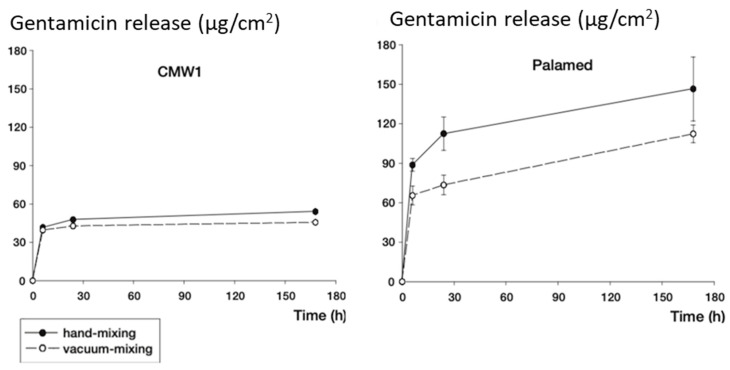
Figure 1
Figure 1
Gentamicin elution from two commercial cements (CMW and Palamed) prepared using hand- or vacuum- mixing technique (adapted and reprinted with permission from Neut et al. [60]).
Figure 2
Figure 2
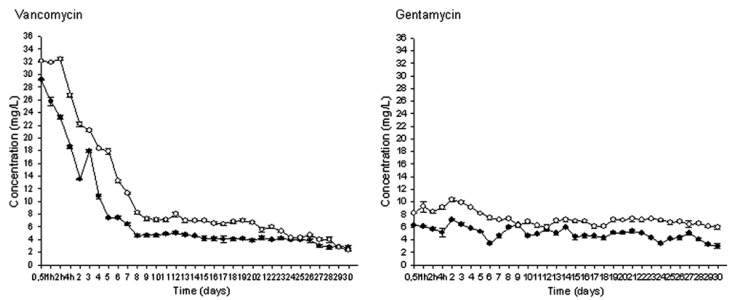
Release of vancomycin and gentamicin (mg/L) over the course of 30 days from PMMA [32]. Filled circles, 10% w/w concentration. Open circles, 20% w/w concentration. (Reprinted with permission from Gálvez-López et al. [32]).
Figure 3
Figure 3
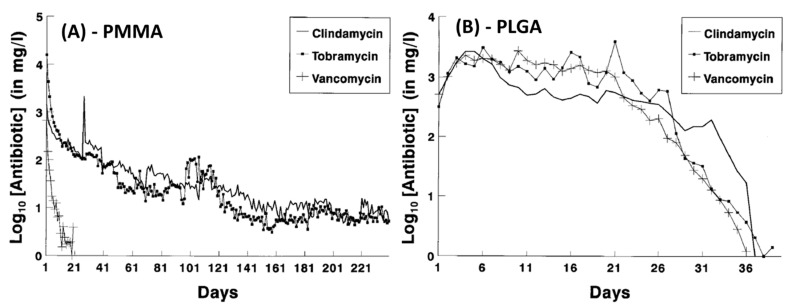
In vitro elution profile of clindamycin, tobramycin and vancomycin from PMMA beads (A) and PLGA beads (B) (Adapted and reprinted with permission from Mader et al. [86]).
Figure 4
Figure 4
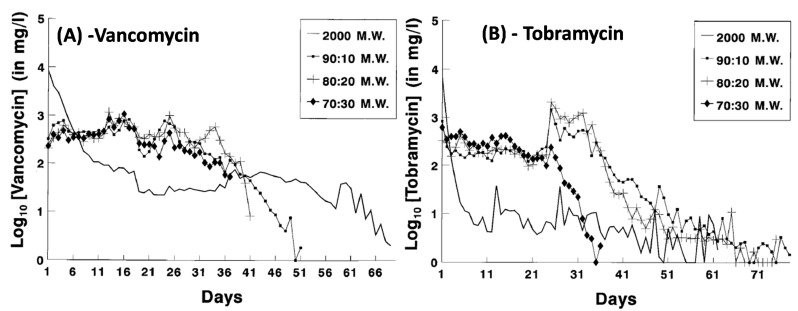
Vancomycin (A) and tobramycin (B) release from 2000 MW—PLA and PLGA with different lactide:glycolide copolymer ratios. (adapted and reprinted with permission from Mader et al. [86]).
Figure 5
Figure 5
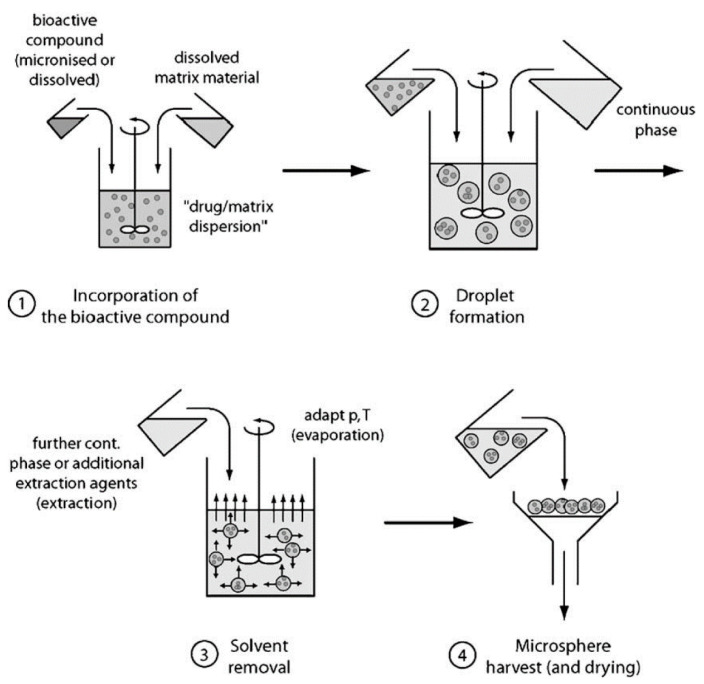
Schematic of solvent extraction/evaporation process to incorporate drugs into PLGA microsphere. (Reprinted with permission from Freitas et al. [87].).
Figure 6
Figure 6
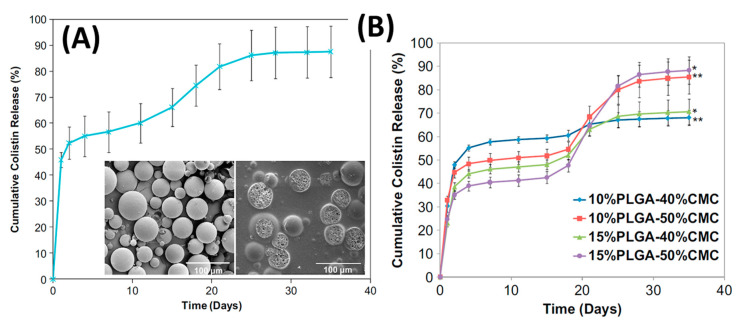
(A): Cumulative release of colistin from PLGA microspheres showing initial burst, lag phase and a second slower release. SEM images of external and internal PLGA microsphere morphology. (B): In vitro colistin release from PMMA cements modified with CMC and antibiotic-loaded PLGA microspheres showed that higher porosity compositions had greater cumulative release of antibiotic, but it occurs in the second release phase. (Adapted and reprinted with permission from Shi et al. [90]).
Figure 7
Figure 7
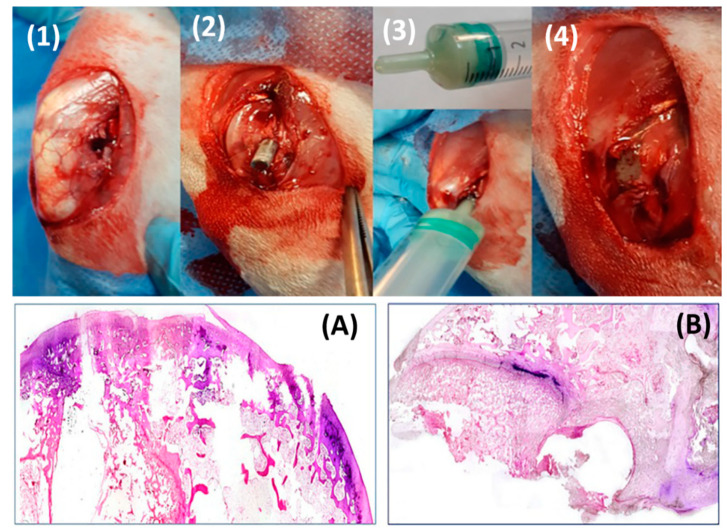
Surgical procedures: (1,2) insertion of the contaminated rod, (3,4) sealing the defect with bone cement. More extensive bone destruction was observed in the antibiotic-containing PMMA control group (A) compared to experimental PLGA-modified antibiotic-containing PMMA (B) (Adapted and reprinted with permission from Azuara et al. [91]).
Figure 8
Figure 8
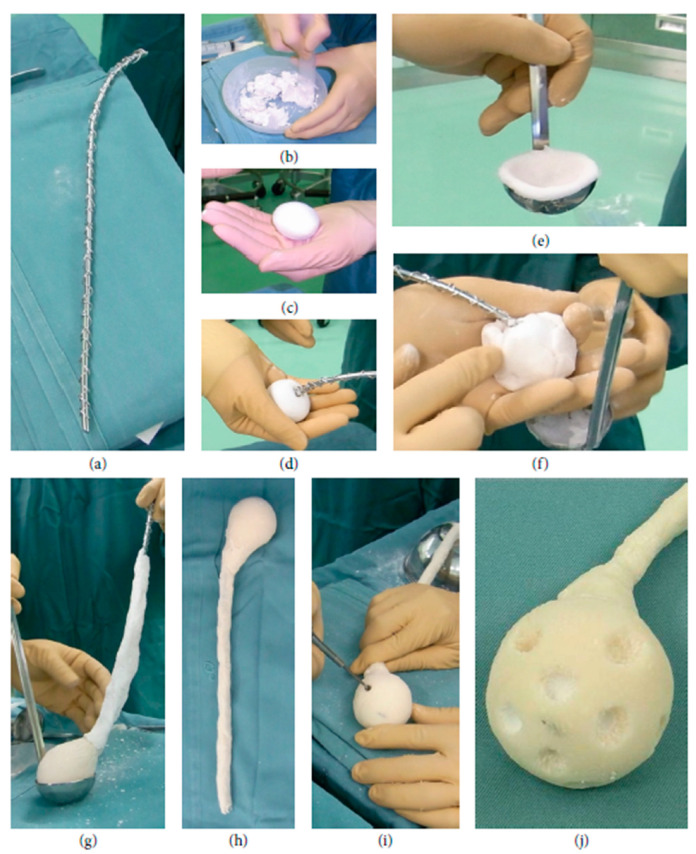
(a) An Ender nail was used as a stabilising core to help removal and avoid breakage. (bd) The femoral head was constructed from a ball of TCP+Vancomycin paste. PMMA loaded with TCP, gentamicin and vancomycin was used to wrap the rod (eh) and the ball to form a complete nail. (i,j) Holes were drilled through the PMMA to allow efficient delivery of the TCP+antibiotic core. (Reprinted with permission from Uchiyama et al. [100]).
Figure 9
Figure 9
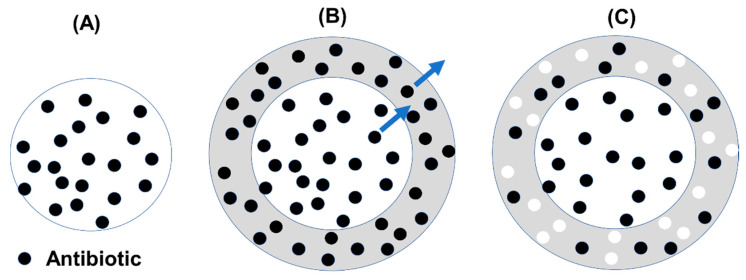
A new design for controlling antibiotic elution from PMMA cements by using coated ceramic particles as additives [102]. Porous ceramic particles are loaded with antibiotics by absorption (A). These particles are then coated in a biodegradable polymer coating consisted of PLGA which also contains antibiotics (B). The antibiotics in the biodegradable polymer coating release as the polymer swells and degrades, and create voids in the coating (C). The antibiotics in the ceramic particles release through these voids and the swollen/degrading polymer. These coated ceramic particles are designed to be mixed into PMMA to form an antibiotic-loaded cement whose antibiotic release can be controlled by multiple factors such as the antibiotic loading, the coating layer, the particle loading of the cement. The ceramic particles can be chosen to degrade, creating large pores in the cement which will facilitate bone ingrowth.
Figure 10
Figure 10
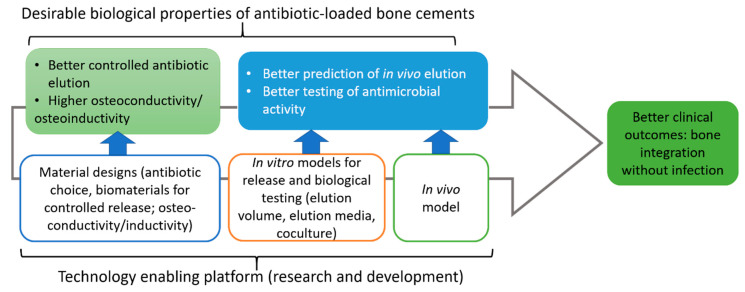
Designing better ALBCs.

References

    1. Kurtz S., Ong K., Lau E., Mowat F., Halpern M. Projections of primary and revision hip and knee arthroplasty in the United States from 2005 to 2030. J. Bone Jt. Surg. Am. 2007;89:780–785. doi: 10.2106/00004623-200704000-00012. - DOI - PubMed
    1. Koh C.K., Zeng I., Ravi S., Zhu M., Vince K.G., Young S.W. Periprosthetic Joint Infection Is the Main Cause of Failure for Modern Knee Arthroplasty: An Analysis of 11,134 Knees. Clin. Orthop. Relat. Res. 2017;475:2194–2201. doi: 10.1007/s11999-017-5396-4. - DOI - PMC - PubMed
    1. Tande A.J., Patel R. Prosthetic joint infection. Clin. Microbiol. Rev. 2014;27:302. doi: 10.1128/CMR.00111-13. - DOI - PMC - PubMed
    1. Zimmerli W., Trampuz A., Ochsner P.E. Prosthetic-Joint Infections. N. Engl. J. Med. 2004;351:1645–1654. doi: 10.1056/NEJMra040181. - DOI - PubMed
    1. Brandt C.M., Sistrunk W.W., Duffy M.C., Hanssen A.D., Steckelberg J.M., Ilstrup D.M., Osmon D.R. Staphylococcus aureus Prosthetic Joint Infection Treated with Debridement and Prosthesis Retention. Clin. Infect. Dis. 1997;24:914–919. doi: 10.1093/clinids/24.5.914. - DOI - PubMed

LinkOut - more resources