


COVID-19: Detecting Government Pandemic Measures and Public Concerns from Twitter Arabic Data Using Distributed Machine Learning
- PMID: 33401512
- PMCID: PMC7795453
- DOI: 10.3390/ijerph18010282
COVID-19: Detecting Government Pandemic Measures and Public Concerns from Twitter Arabic Data Using Distributed Machine Learning
Abstract
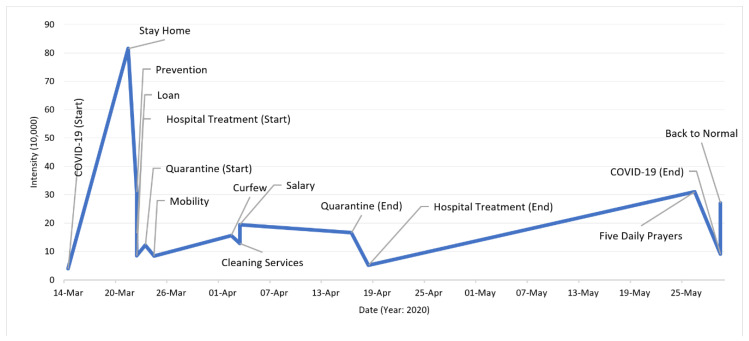
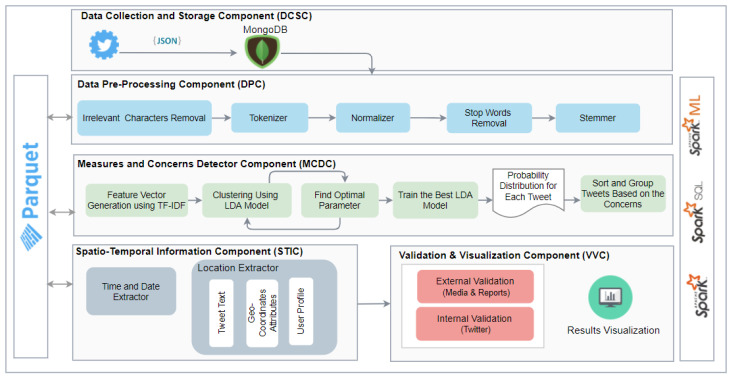
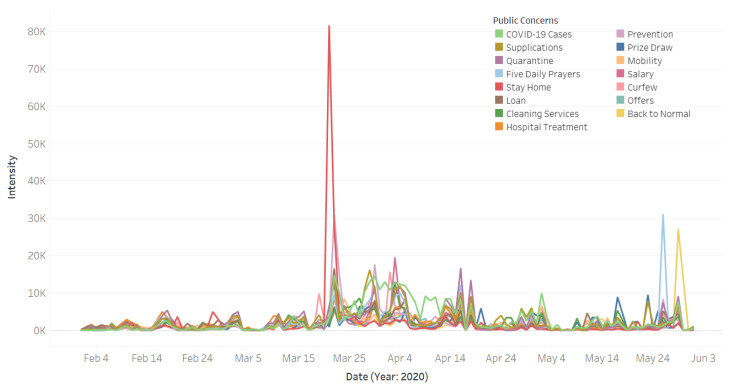
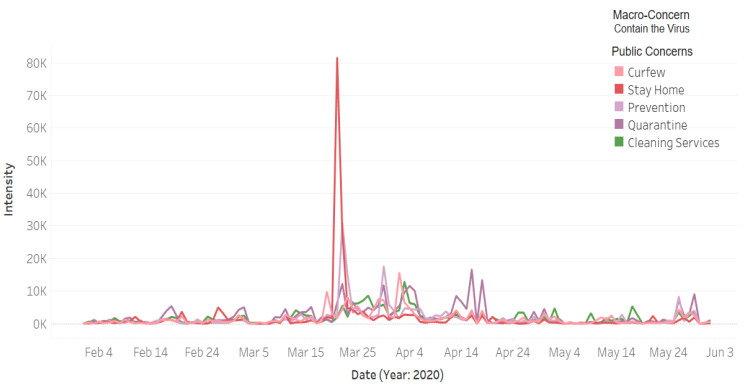
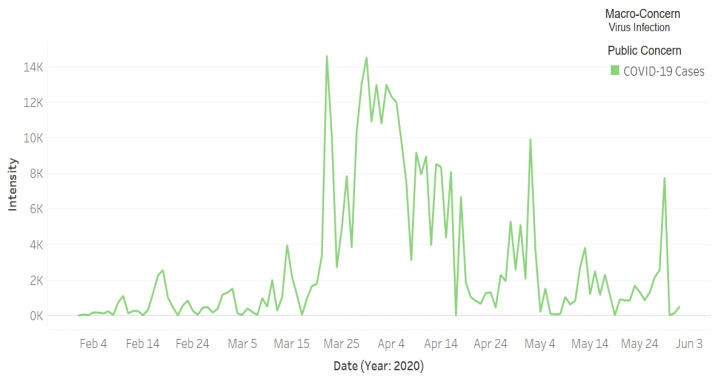
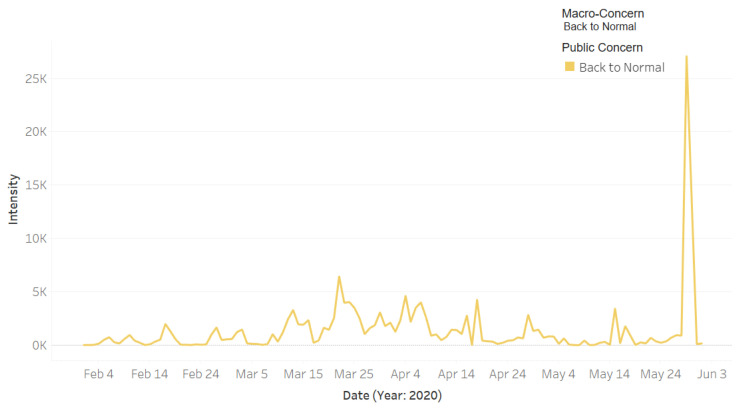
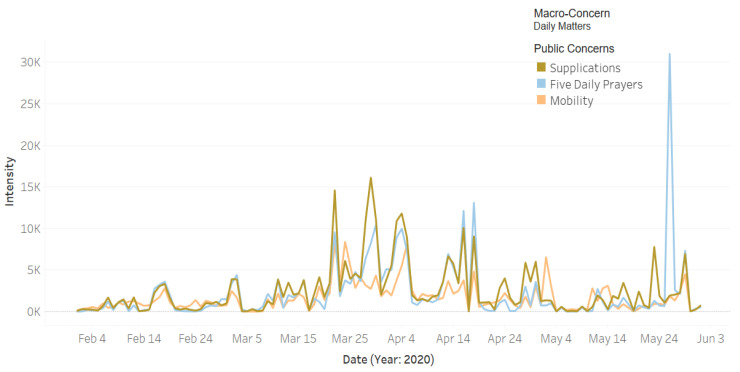
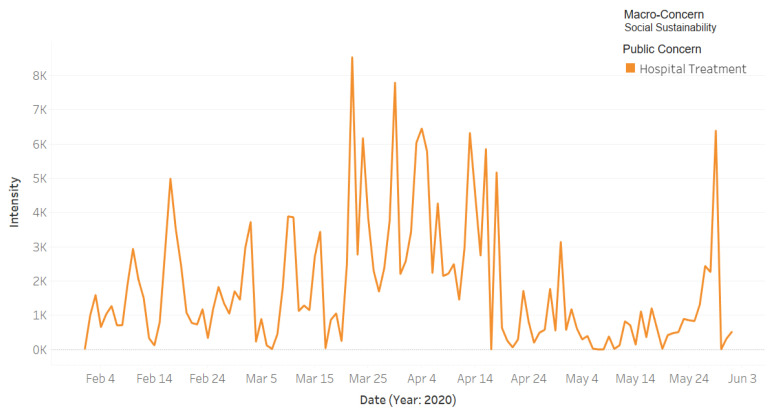
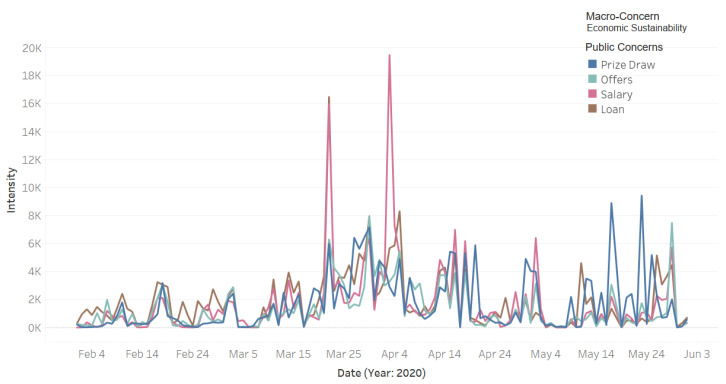
Today's societies are connected to a level that has never been seen before. The COVID-19 pandemic has exposed the vulnerabilities of such an unprecedently connected world. As of 19 November 2020, over 56 million people have been infected with nearly 1.35 million deaths, and the numbers are growing. The state-of-the-art social media analytics for COVID-19-related studies to understand the various phenomena happening in our environment are limited and require many more studies. This paper proposes a software tool comprising a collection of unsupervised Latent Dirichlet Allocation (LDA) machine learning and other methods for the analysis of Twitter data in Arabic with the aim to detect government pandemic measures and public concerns during the COVID-19 pandemic. The tool is described in detail, including its architecture, five software components, and algorithms. Using the tool, we collect a dataset comprising 14 million tweets from the Kingdom of Saudi Arabia (KSA) for the period 1 February 2020 to 1 June 2020. We detect 15 government pandemic measures and public concerns and six macro-concerns (economic sustainability, social sustainability, etc.), and formulate their information-structural, temporal, and spatio-temporal relationships. For example, we are able to detect the timewise progression of events from the public discussions on COVID-19 cases in mid-March to the first curfew on 22 March, financial loan incentives on 22 March, the increased quarantine discussions during March-April, the discussions on the reduced mobility levels from 24 March onwards, the blood donation shortfall late March onwards, the government's 9 billion SAR (Saudi Riyal) salary incentives on 3 April, lifting the ban on five daily prayers in mosques on 26 May, and finally the return to normal government measures on 29 May 2020. These findings show the effectiveness of the Twitter media in detecting important events, government measures, public concerns, and other information in both time and space with no earlier knowledge about them.
Keywords: Arabic language; COVID-19; Triple Bottom Line (TBL); Twitter; apache spark; big data; coronavirus; distributed computing; machine learning; smart cities; smart governance; smart healthcare; social media.
Conflict of interest statement
The authors declare no conflict of interest.
Figures
References
-
- Johns Hopkins University . Coronavirus COVID-19 Global Cases by the Center for Systems Science and Engineering (CSSE) at Johns Hopkins University (JHU) Johns Hopkins University; Baltimore, MD, USA: 2020.
-
- Agarwal S., Mittal N., Sureka A. Potholes and Bad Road Conditions- Mining Twitter to Extract Information on Killer Roads; Proceedings of the ACM India Joint International Conference on Data Science and Management of Data; Dona Paula, India. 11–13 January 2018.
-
- Klaithin S., Haruechaiyasak C. Traffic Information Extraction and Classification from Thai Twitter; Proceedings of the 13th International Joint Conference on Computer Science and Software Engineering (JCSSE); Khon Kaen, Thailand. 13–15 July 2016; pp. 1–6. - DOI
-
- D’Andrea E., Ducange P., Lazzerini B., Marcelloni F. Real-Time Detection of Traffic from Twitter Stream Analysis. IEEE Trans. Intell. Transp. Syst. 2015;16:2269–2283. doi: 10.1109/TITS.2015.2404431. - DOI
-
- Kurniawan D.A., Wibirama S., Setiawan N.A. Real-time Traffic Classification with Twitter Data Mining; Proceedings of the 2016 8th International Conference on Information Technology and Electrical Engineering (ICITEE); Yogyakarta, Indonesia. 5–6 October 2016; - DOI
Publication types
MeSH terms
Grants and funding
LinkOut - more resources
Full Text Sources
Other Literature Sources
Medical
Research Materials
Miscellaneous
