Review
. 2021 Jan 3;13(1):127.
doi: 10.3390/cancers13010127.

MicroRNA-Mediated Metabolic Shaping of the Tumor Microenvironment

Affiliations
Review

MicroRNA-Mediated Metabolic Shaping of the Tumor Microenvironment

Federico Virga et al. Cancers (Basel). .

Abstract

The metabolism of cancer cells is generally very different from what is found in normal counterparts. However, in a tumor mass, the continuous crosstalk and competition for nutrients and oxygen among different cells lead to metabolic alterations, not only in cancer cells, but also in the different stromal and immune cells of the tumor microenvironment (TME), which are highly relevant for tumor progression. MicroRNAs (miRs) are small non-coding RNAs that silence their mRNA targets post-transcriptionally and are involved in numerous physiological cell functions as well as in the adaptation to stress situations. Importantly, miRs can also be released via extracellular vesicles (EVs) and, consequently, take part in the bidirectional communication between tumor and surrounding cells under stress conditions. Certain miRs are abundantly expressed in stromal and immune cells where they can regulate various metabolic pathways by directly suppressing enzymes or transporters as well as by controlling important regulators (such as transcription factors) of metabolic processes. In this review, we discuss how miRs can induce metabolic reprogramming in stromal (fibroblasts and adipocytes) and immune (macrophages and T cells) cells and, in turn, how the biology of the different cells present in the TME is able to change. Finally, we debate the rebound of miR-dependent metabolic alterations on tumor progression and their implications for cancer management.

Keywords: metabolism; miR; tumor microenvironment.


Conflict of interest statement

Not applicable.

Figures
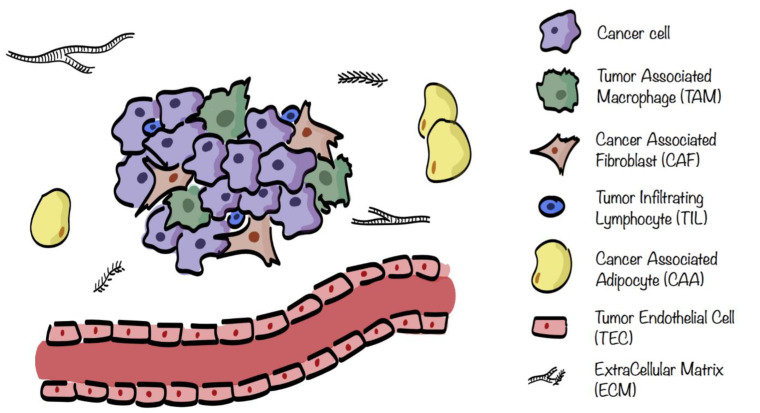
Figure 1
Figure 1
Tumor microenvironment (TME) composition. TME surrounding cancer cells consists of extracellular matrix (ECM) in which are embedded several stromal cells such as cancer associated fibroblasts (CAFs), tumor endothelial cells (TECs), cancer associated adipocytes (CAAs), and infiltrating immune cells (ICs), including tumorassociated macrophages (TAMs) and tumor infiltrating lymphocytes (TILs).
Figure 2
Figure 2
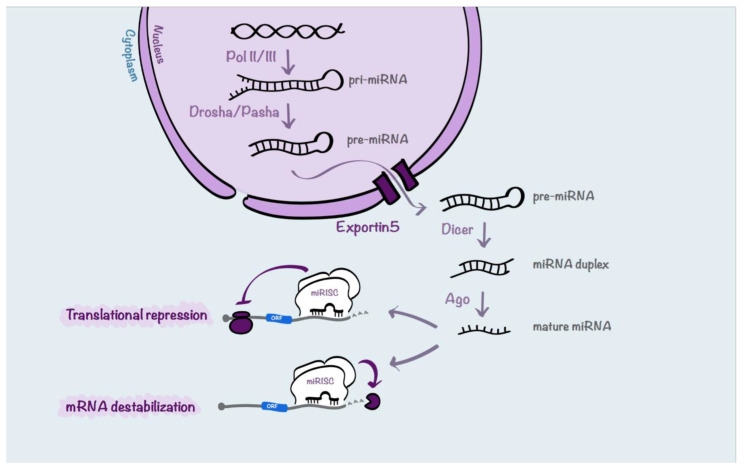
Schematic representation of miR processing. miRNA biogenesis begins with RNA polymerase II-dependent transcription that generates pri-miRNAs. Then, the pri-miRNAs are processed into pre-miRNAs by Drosha and Pasha. Next, pre-miRNAs are transported by Exportin5 from the nucleus to the cytoplasm where they are processed by Dicer into miRNA duplexes. The duplexes are loaded into the Argonaute-incorporated RNA-induced silencing complex (RISC) where, following the unwinding of the duplex, each mature miR strand, called guide, is retained. Then, the mature miR coordinates the RISC by partial complementarity between the miR and the mRNA target sequences. In this way, miRs can induce translational repression or mRNA destabilization and degradation.
Figure 3
Figure 3
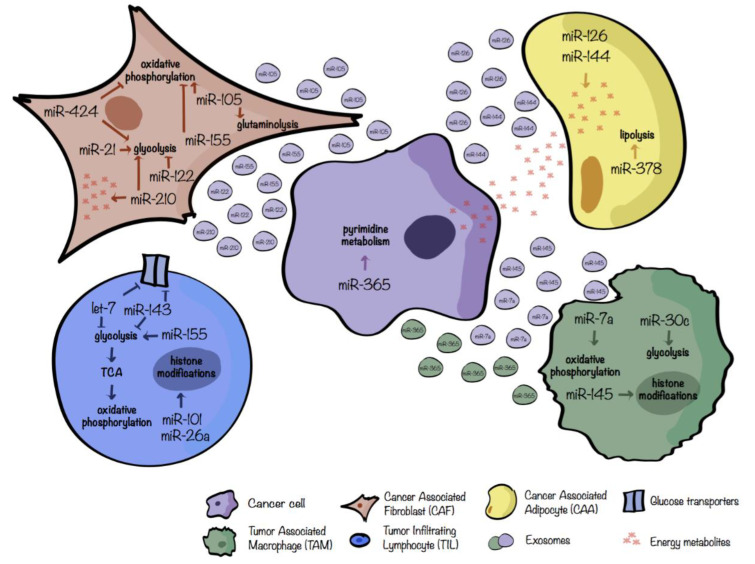
miRs involved in the regulation of tumor–stromal metabolic crosstalk. miRs involved in the metabolic crosstalk between tumor cells (violet); cancerassociated fibroblasts, CAFs (brown); cancerassociated adipocytes, CAAs (yellow); tumorinfiltrating lymphocytes, TILs (blue); tumorassociated macrophages, TAMs (green). Only the main metabolic pathways were taken into account and both secreted or differentially expressed miRs were considered. Extracellular vescicle color refers to the cell of origin.

References

    1. Hanahan D., Weinberg R.A. The hallmarks of cancer. Cell. 2000;100:57–70. doi: 10.1016/S0092-8674(00)81683-9. - DOI - PubMed
    1. Chaffer C.L., Weinberg R.A. A perspective on cancer cell metastasis. Science. 2011;331:1559–1564. doi: 10.1126/science.1203543. - DOI - PubMed
    1. Bray F., Ferlay J., Soerjomataram I., Siegel R.L., Torre L.A., Jemal A. Global cancer statistics 2018: GLOBOCAN estimates of incidence and mortality worldwide for 36 cancers in 185 countries. CA Cancer J. Clin. 2018;68:394–424. doi: 10.3322/caac.21492. - DOI - PubMed
    1. Hanahan D., Weinberg R.A. Hallmarks of cancer: The next generation. Cell. 2011;144:646–674. doi: 10.1016/j.cell.2011.02.013. - DOI - PubMed
    1. Greten F.R., Grivennikov S.I. Inflammation and Cancer: Triggers, Mechanisms, and Consequences. Immunity. 2019;51:27–41. doi: 10.1016/j.immuni.2019.06.025. - DOI - PMC - PubMed