Development and validation of the Cognitive Behavioural Therapy Skills Scale among college students
- PMID: 33402377
- PMCID: PMC8086257
- DOI: 10.1136/ebmental-2020-300217
Development and validation of the Cognitive Behavioural Therapy Skills Scale among college students
Abstract
Background: There are many different skill components used in cognitive behavioural therapy (CBT). However, there is currently no comprehensive way of measuring these skills in patients.
Objective: To develop a comprehensive and brief measure of five main CBT skills: self-monitoring, behavioural activation, cognitive restructuring, assertiveness training and problem-solving.
Methods: University students (N=847) who participated in a fully factorial randomised controlled trial of smartphone CBT were assessed with the CBT Skills Scale, the Patient Health Questionnaire-9 (PHQ-9), the Generalised Anxiety Disorder-7 (GAD-7) and the short form of the Japanese Big Five Scale. Structural validity was estimated with exploratory factor analysis (EFA) and confirmatory factor analysis (CFA), and internal consistency evaluated with Cronbach's α coefficients. Construct validity was evaluated with the correlations between each factor of the CBT Skills Scale, the PHQ-9, the GAD-7 and the Big Five Scale.
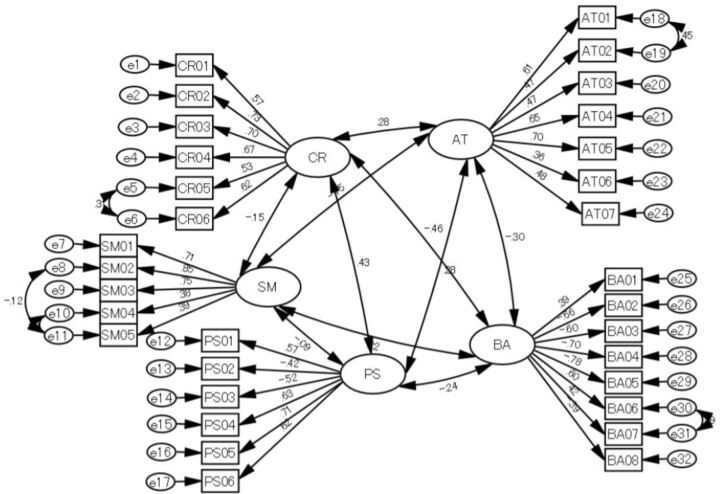
Findings: The EFA supported a five-factor solution based on the original instruments assessing each CBT skill component. The CFA showed sufficient goodness-of-fit indices for the five-factor structure. The Cronbach's α of each factor was 0.75-0.81. Each CBT skills factor was specifically correlated to the PHQ-9, GAD-7, and the Big Five Scale.
Conclusions: The CBT Skills Scale has a stable structural validity and internal consistency with a five-factor solution and appropriate content validity concerning the relationship with depression, anxiety and personality.
Clinical implications: The CBT Skills Scale will be potential predictor and effect modifier in studying the optimisation of CBT interventions.
Trial registration: CTR-000031307.
Keywords: depression & mood disorders.
© Author(s) (or their employer(s)) 2021. Re-use permitted under CC BY-NC. No commercial re-use. See rights and permissions. Published by BMJ.
Conflict of interest statement
Competing interests: TAF reports personal fees from Mitsubishi-Tanabe, MSD and Shionogi, a grant from Mitsubishi-Tanabe, and, outside the submitted work; TAF has a patent 2018-177688 pending and intellectual properties for Kokoro-app licensed. NS received lecture fees from Dainippon-Sumitomo and Meiji-seika Pharma for work that was not associated with this article.
Figures
References
-
- Beck AT, Rush AJ, Shaw BF, et al. . Cognitive therapy of depression. Guilford: NY, 1987.
-
- Nezu AM, Nezu CM, D’Zurilla TJ. Problem-Solving Therapy: A treatment manual. New York, NY: Springer, 2012.
Publication types
MeSH terms
LinkOut - more resources
Full Text Sources
Other Literature Sources