Review
. 2021 Apr;20(4):632-640.
doi: 10.1158/1535-7163.MCT-20-0741. Epub 2021 Jan 5.

Role of Polo-Like Kinase 4 (PLK4) in Epithelial Cancers and Recent Progress in its Small Molecule Targeting for Cancer Management

Affiliations
Review

Role of Polo-Like Kinase 4 (PLK4) in Epithelial Cancers and Recent Progress in its Small Molecule Targeting for Cancer Management

Debra R Garvey et al. Mol Cancer Ther. 2021 Apr.

Abstract

The polo-like kinases (PLKs) are a family of serine/threonine kinases traditionally linked to cell-cycle regulation. A structurally unique member of this family, PLK4, has been shown to regulate centriole duplication during the cell cycle via interactions with a variety of centrosomal proteins. Recent findings suggest that PLK4 is overexpressed in various human cancers and associated with poor cancer prognosis. Although several studies have shown that PLK4 inhibition may lead to cancer cell death, the underlying mechanisms are largely unknown. In this review, we discuss the structure, localization, and function of PLK4, along with the functional significance of PLK4 in epithelial cancers and some preliminary work suggesting a role for PLK4 in the key cancer progression process epithelial-mesenchymal transition. We also discuss the potential of PLK4 as a druggable target for anticancer drug development based on critical analysis of the available data of PLK4 inhibitors in preclinical development and clinical trials. Overall, the emerging data suggest that PLK4 plays an essential role in epithelial cancers and should be further explored as a potential biomarker and/or therapeutic target. Continued detailed exploration of available and next-generation PLK4 inhibitors may provide a new dimension for novel cancer therapeutics following successful clinical trials.


Conflict of interest statement

Declaration of Competing Interest

The authors declare that there are no conflicts of interest.

Figures
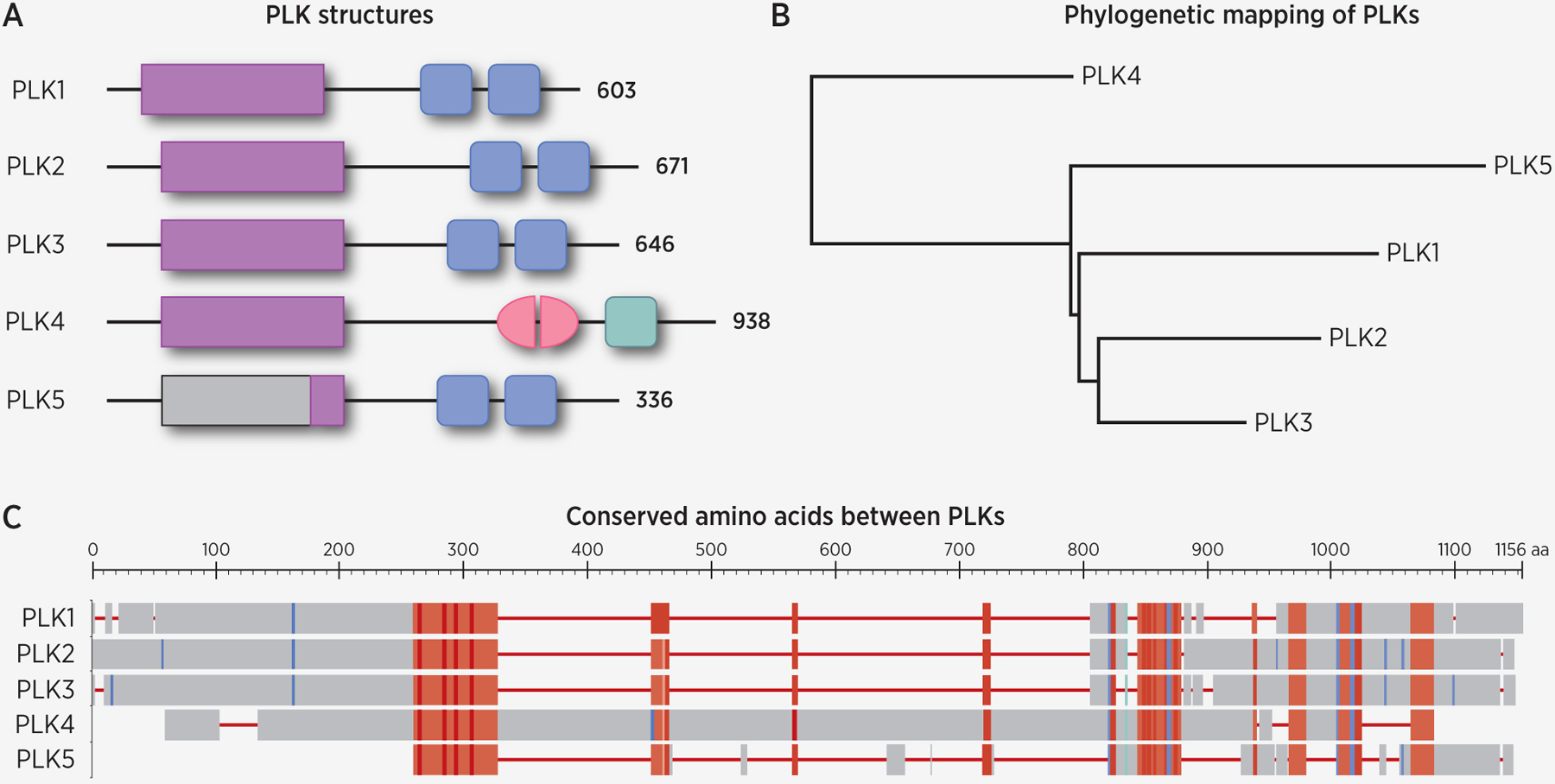
Figure 1.
Figure 1.
Comparisons of the mammalian polo-like kinases (PLKs). A, Mammalian PLKs have conserved kinase domains (purple rectangles) and polo box domains (PBD, blue/green squares). PLK4 is the most structurally divergent member of this family, as it contains only one PBD whose sequence is not fully homologous to the other PBDs, and one cryptic polo box (pink half-ovals). In humans, PLK5 contains an in-frame stop codon followed almost immediately by an in-frame start codon, resulting in a truncated kinase domain (purple rectangle). In all other mammals, the full PLK5 gene is encoded (light grey rectangle and line), although it shows no kinase activity. B, Phylogenetic analysis of PLK sequences show PLK4 as the most divergent, as determined using the COBALT Phylogenetic Tree widget (76). C, Alignment of PLK protein sequences using COBALT tool. Red areas are highly conserved, while blue areas are less conserved. Phylogenetic tree and alignment made using NCBI’s Constraint-based Multiple Alignment Tool and the following sequence IDs: NP_001177728.1, NP_001230008.1, NP_005021.2, NP_004064.2, and NP_001239155.1 (76).
Figure 2.
Figure 2.
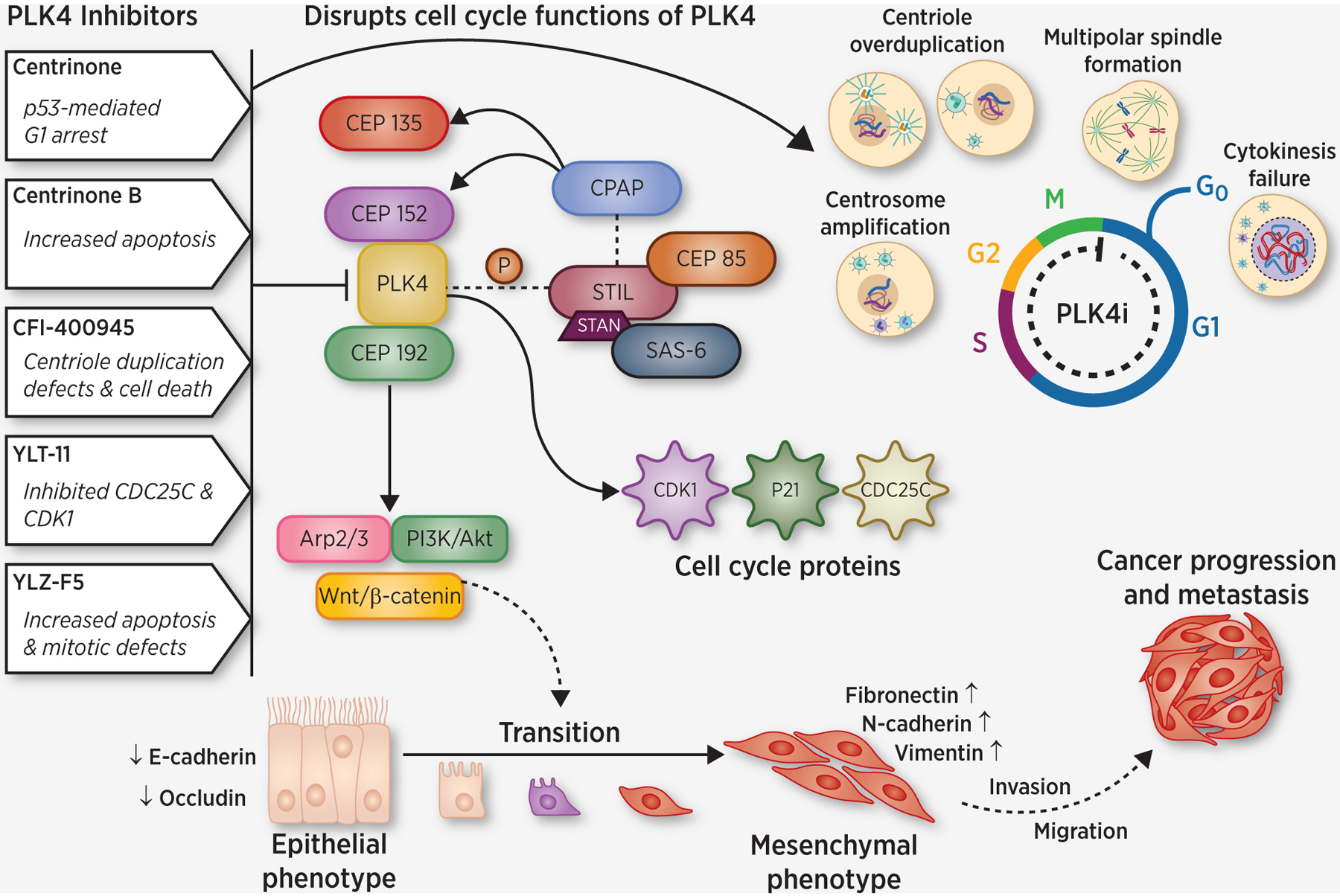
Schematic representation of PLK4 signaling in cancer with details of selected PLK4 inhibitors. Various PLK4 inhibitors along with their potential mechanisms to inhibit cancer progression are shown. PLK4 modulation, either by chemical/genetic inhibition, or overexpression, can disrupt cell cycle functions of PLK4, including induction of centrosome amplification through the simultaneous generation of multiple procentrioles adjoining each parental centriole during S phase of cell cycle leading to cancer progression. Various cellular proteins interact and complex with PLK4, leading to PLK4-mediated disruptions to cell cycle. Recent findings also suggest that PLK4 signaling is associated with epithelial-mesenchymal transition (EMT), which is well known to be linked to tumor invasion and metastasis. Visualization initially created with BioRender and professionally redrawn by the journal.

References

    1. Hanahan D, Weinberg RA. The hallmarks of cancer. Cell 2000;100:57–70. - PubMed
    1. Thompson SL, Bakhoum SF, Compton DA. Mechanisms of chromosomal instability. Curr Biol 2010;20:R285–95. - PMC - PubMed
    1. Levine MS, Holland AJ. The impact of mitotic errors on cell proliferation and tumorigenesis. Genes Dev 2018;32:620–38. - PMC - PubMed
    1. Bornens M The centrosome in cells and organisms. Science 2012;335:422–6. - PubMed
    1. Chan JY. A Clinical Overview of Centrosome Amplification in Human Cancers. Int J Biol Sci 2011;7:1122–44. - PMC - PubMed

Publication types

Substances