Review
. 2021 Jun;26(6):1738-1747.
doi: 10.1038/s41380-020-00980-4. Epub 2021 Jan 5.

The two-cell model of glucose metabolism: a hypothesis of schizophrenia

Affiliations
Review

The two-cell model of glucose metabolism: a hypothesis of schizophrenia

Dirk Roosterman et al. Mol Psychiatry. 2021 Jun.

Abstract

Schizophrenia is a chronic and severe mental disorder that affects over 20 million people worldwide. Common symptoms include distortions in thinking, perception, emotions, language, and self awareness. Different hypotheses have been proposed to explain the development of schizophrenia, however, there are no unifying features between the proposed hypotheses. Schizophrenic patients have perturbed levels of glucose in their cerebrospinal fluid, indicating a disturbance in glucose metabolism. We have explored the possibility that disturbances in glucose metabolism can be a general mechanism for predisposition and manifestation of the disease. We discuss glucose metabolism as a network of signaling pathways. Glucose and glucose metabolites can have diverse actions as signaling molecules, such as regulation of transcription factors, hormone and cytokine secretion and activation of neuronal cells, such as microglia. The presented model challenges well-established concepts in enzyme kinetics and glucose metabolism. We have developed a 'two-cell' model of glucose metabolism, which can explain the effects of electroconvulsive therapy and the beneficial and side effects of olanzapine treatment. Arrangement of glycolytic enzymes into metabolic signaling complexes within the 'two hit' hypothesis, allows schizophrenia to be formulated in two steps. The 'first hit' is the dysregulation of the glucose signaling pathway. This dysregulation of glucose metabolism primes the central nervous system for a pathological response to a 'second hit' via the astrocytic glycogenolysis signaling pathway.


Conflict of interest statement

The authors declare that they have no conflict of interest.

Figures
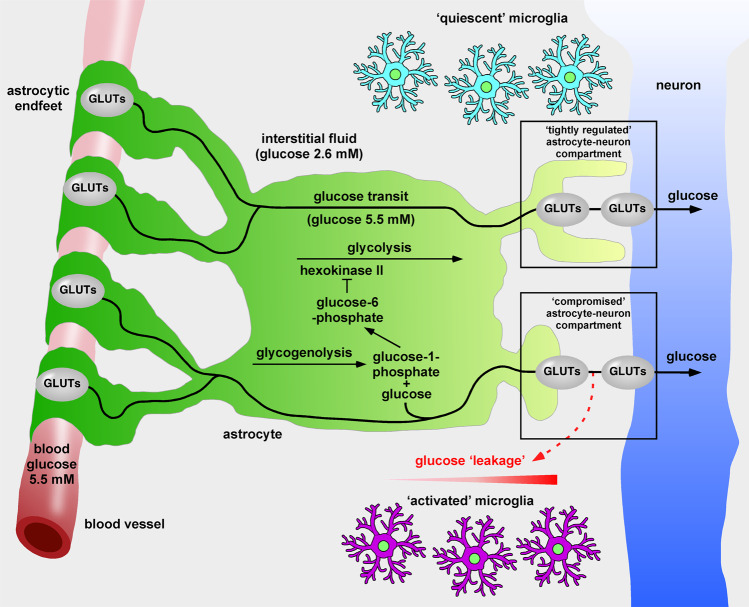
Fig. 1
Fig. 1. Hypothetical flow of glucose in the brain.
The concentration of glucose in the interstitial fluid is low (2.6 mM) [23] and insufficient to supply neuronal compartments of high-energy demand. Astrocytic endfeet completely cover capillaries, where the concentration of glucose is high (5.5 mM) [25]. Glucose is transported via glucose transporters (GLUTs) from the blood stream, across the astrocyte and delivered to neuronal compartments of high-energy demand via astrocytic and neuronal GLUTs. Astrocytic glycogenolysis is a signaling pathway producing glucose, which enters the glucose transit pathway and glucose-1-phosphate. The latter is converted to glucose-6-phosphate, which inhibits hexokinase II [73], thereby blocking astrocytic glycolysis. Decreased astrocytic glycolysis further increases the availability of glucose for neuronal transit. A ‘tightly’ regulated astrocyte-neuron compartment ensures delivery of glucose to the neuron and keep microglial cells in a ‘quiescent’ state. In contrast, a ‘compromised’ astrocyte-neuron compartment, perhaps due to the altered expression of stabilizing genes, genetic variations, or epigenetic modifications, may lead to glucose ‘leakage’, promoting formation of a glucose gradient and subsequent microglial activation.
Fig. 2
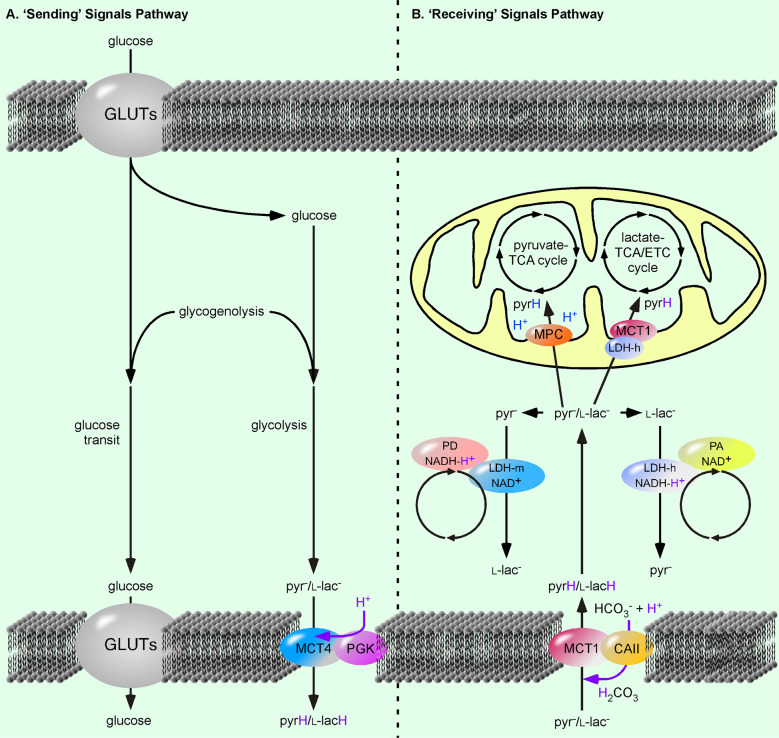
Fig. 2. The ‘sending’ and ‘receiving’ of signals via glucose metabolism.
a Glucose, taken up via glucose transporters (GLUTs) and produced by the breakdown of glycogen (glycogenolysis) is exported as a signal via GLUTs. In addition, glucose is converted to pyruvate (pyr) and lactate (l-lac) via glycolysis and exported as pyruvic acid (pyrH) and lactic acid (l-lacH) via the proton-linked monocarboxylate transporter 4 (MCT4)•phosphoglycerate kinase (PGK) complex [35]. b Pyr and l-lac- are imported as pyrH and l-lacH into the cell via the MCT1•carbonic anhydrase II (CAII) complex [35]. A cytosolic muscle lactate dehydrogenase (LDH-m)•proton donor (PD) complex converts pyruvate (pyr) to lactate (l-lac−) and a cytosolic heart LDH (LDH-m)•proton acceptor (PA) complex converts lactate (l-lac) to pyruvate (pyr). Alternatively, l-lac is converted to pyr by the proton-linked mitochondrial MCT1•LDH-h complex to fuel the l-lac-tricarboxylic acid (TCA)/electron transport chain (ETC) cycle [35]. Pyr is transported into the mitochondrial matrix via the mitochondrial pyr carrier (MPC) to power the pyr-TCA cycle [35] tit. A violet H+ indicates the H+ is part of a proton-coupled reaction. The blue H+ indicated on the pyrH transferred by the MPC, comes from the mitochondrial matrix.

References

    1. Stöber G, Ben-Shachar D, Cardon M, Falkai P, Fonteh AN, Gawlik M, et al. Schizophrenia: from the brain to peripheral markers. A consensus paper of the WFSBP task force on biological markers. World J Biol Psychiatry. 2009;10:127–55. doi: 10.1080/15622970902898980. - DOI - PubMed
    1. Maynard TM, Sikich L, Lieberman JA, LaMantia AS. Neural development, cell-cell signaling, and the “two-hit” hypothesis of schizophrenia. Schizophrenia Bull. 2001;27:457–76. doi: 10.1093/oxfordjournals.schbul.a006887. - DOI - PubMed
    1. Weinberger DR. Implications of normal brain development for the pathogenesis of schizophrenia. Arch Gen Psychiatry. 1987;44:660–9. doi: 10.1001/archpsyc.1987.01800190080012. - DOI - PubMed
    1. Gibbs ME. Role of glycogenolysis in memory and learning: regulation by noradrenaline, serotonin and ATP. Front Integr Neurosci. 2015;9:70. - PMC - PubMed
    1. Rowland LM, Pradhan S, Korenic S, Wijtenburg SA, Hong LE, Edden RA, et al. Elevated brain lactate in schizophrenia: a 7T magnetic resonance spectroscopy study. Transl Psychiatry. 2016;6:e967. doi: 10.1038/tp.2016.239. - DOI - PMC - PubMed

Publication types