Review
. 2021 Feb;28(2):455-472.
doi: 10.1038/s41418-020-00707-6. Epub 2021 Jan 5.

Adaptors as the regulators of HECT ubiquitin ligases

Affiliations
Review

Adaptors as the regulators of HECT ubiquitin ligases

Sonia Shalini Shah et al. Cell Death Differ. 2021 Feb.

Erratum in

Abstract

The HECT (homologous to E6AP C-terminus) ubiquitin ligases (E3s) are a small family of highly conserved enzymes involved in diverse cellular functions and pathological conditions. Characterised by a C-terminal HECT domain that accepts ubiquitin from E2 ubiquitin conjugating enzymes, these E3s regulate key signalling pathways. The activity and functional regulation of HECT E3s are controlled by several factors including post-translational modifications, inter- and intramolecular interactions and binding of co-activators and adaptor proteins. In this review, we focus on the regulation of HECT E3s by accessory proteins or adaptors and discuss various ways by which adaptors mediate their regulatory roles to affect physiological outcomes. We discuss common features that are conserved from yeast to mammals, regardless of the type of E3s as well as shed light on recent discoveries explaining some existing enigmas in the field.


Conflict of interest statement

The authors declare that they have no conflict of interest.

Figures
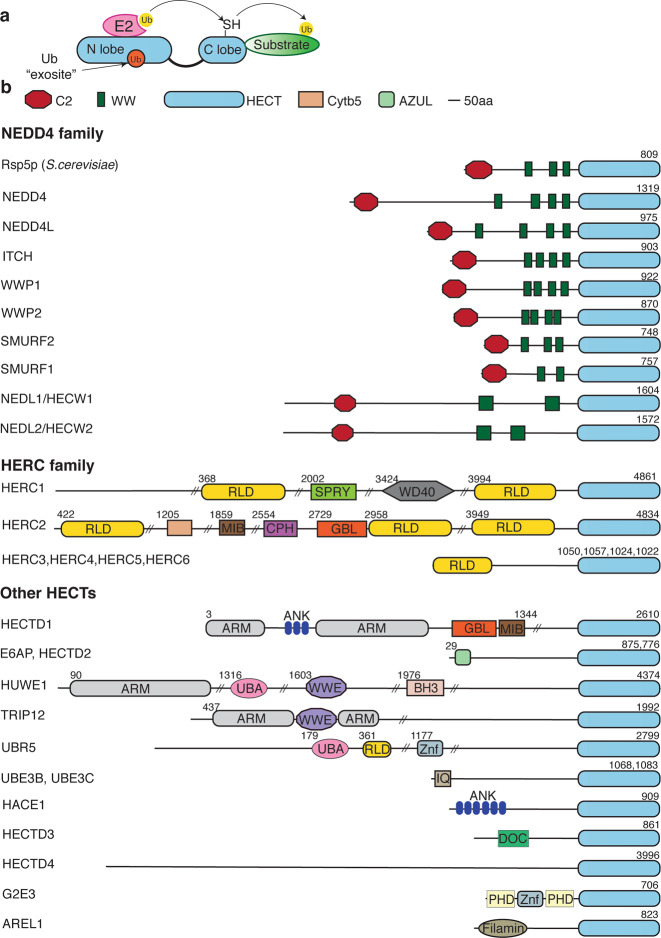
Fig. 1
Fig. 1. The HECT ubiquitin ligase family.
a HECT domain contains a bulky N-terminal lobe (N lobe) and a smaller C-terminal lobe (C lobe) that contains the catalytic Cys. N lobe contains a site to receive the charged E2 that then transfers ubiquitin (Ub) to the Cys residue. A flexible linker region allows changes in orientation to occur easily. Ub-binding exosite that can non-covalently hold Ub is shown. b Schematic representation of domain structure of the S. cerevisiae HECT E3 Rsp5p as the prototypic NEDD4 family member, and various human HECT E3s. C2 calcium-binding domain, WW WW domains, RLD RCC1 like domain, SPRY B30.2 SPRY domain, WD40 W-D repeat domain, MIB MIB/HERC2 domain, CPH conserved domain within Cul7, PARC and HERC2 proteins, GBL galactose-binding like domain, ARM armadillo repeat containing domain, BH3 Bcl-2 homology 3 domain, UBA ubiquitin-associated domain, WWE WWE-containing domain, Znf zinc finger–containing domain, IQ IQ motif/ EF hand-binding site, DOC APC10/DOC domain, AZUL amino terminal Zn finger of Ube3a ligase, ANK ankyrin repeat-containing domain, PHD PHD-type zinc finger, CytB cytochrome-b5–like heme/steroid-binding domain.
Fig. 2
Fig. 2. Multiple processes that regulate HECT E3 activity.
(1) Post-translational modifications, e.g., phosphorylation; (2) intermolecular interactions, e.g., trimerisation of E6AP; (3) intramolecular interactions, e.g., NEDD4 autoinhibition by C2–HECT interaction; (4) intrinsic catalytic activity (Ub-exosite) mediated ubiquitination; (5) strength of E2–E3 interaction; (6) adaptor protein binding and (7) interaction with DUBs.
Fig. 3
Fig. 3. Regulation of HECT E3 autoinhibition and activity.
a JNK1 binds a region in HECT domain of ITCH and phosphorylates 3 sites in its N-terminal proline-rich region (PRR). This relieves the autoinhibition, allowing JunB to bind ITCH and its ubiquitination. Regulatory linker region (L) is shown. b Tyrosine phosphorylation of NEDD4 by c-Src both at C2 and HECT domain enhances its catalytic activity, fibroblast growth factor receptor 1 (FGFR1) ubiquitination, internalisation and degradation. c NEDD4-2 autoinhibition can be relieved by increasing Ca2+ concentration. High Ca2+ enables competition between HECT-binding and Ca2+-binding regions on C2 domain, and can also determine cellular relocalisation of NEDD4-2 via its interaction with membrane bound PIP2/IP3 (phosphatidylinositol 4,5 biphosphate)/IP3 (inositol 1,4,5 triphosphate). d Non-covalent binding of interferon stimulated gene 15 (ISG15) to NEDD4 prevents it interaction with E2 and attenuates catalytic activity.
Fig. 4
Fig. 4. Schematic representation of domain structure for various adaptor proteins in S. cerevisiae and humans.
TM transmembrane, ARR N N-terminal arrestin domain, ARR C C-terminal arrestin domain, Ldb19 low dye–binding protein-19, PTB phosphotyrosine-binding domain, MH1 MAD homology 1, MH2 MAD homology2, Gla gamma carboxy-glutamic acid domain, UBA ubiquitin-associated domain.
Fig. 5
Fig. 5. Role of adaptors in regulating ubiquitin-mediated protein trafficking in S cerevisiae.
a (i) Transmembrane (TM) proteins such as amino acid transporters (AAT; e.g., Mup1p) and metal ion transporters (e.g., Smf1p) are normally trafficked to the plasma membrane (PM). (ii) The adaptor protein Bsd2p (Ndfip orthologous) localised at Golgi recruits Rsp5p to ubiquitinate TM proteins (e.g., Smf1p) that can then be trafficked via endosome and degraded in the vacuole. Bsd2p–substrate interaction is assisted by PY motif–containing adaptors Tre1. (iii) Environmental stress can initiate adaptor-induced ubiquitination of other transporters to overcome stress. For example, under basal conditions, Chitin synthase3 (Chs3p) undergoes constitutive protein endocytosis (blue arrows). Stressed cells display increased intracellular calcium levels, resulting in enhanced Calcineurin activity, Rcr1 upregulation and sorting to the PM. As a result more Rsp5p is recruited to PM leading to increased Chs3p ubiquitination, exiting the retrograde trafficking and endocytosis, and degradation in the vacuole. (iv) Selective endocytosis is utilised in order to adapt to nutrient availability. This is brought about by the E3 recognising and complexing with different adaptors. For example, during amino acid and nutrient starvation, Art2 is upregulated and recognises C-terminal acidic sorting motifs in AATs and recruits Rsp5p to ubiquitinate proximal Lys residues (starvation-induced endocytosis). When amino acids are in excess, Rsp5p instead uses TORC1-activated Art1 to detect N-terminal acidic sorting motifs within the same AATs, to target Lys residues in the C-terminal thus facilitating substrate-induced endocytosis. b Adaptors also control HECT E3 activity by self-ubiquitination. Several adaptors compete for occupancy on Rsp5p. For example, the PY motif–containing protein Hua1 acts as an adaptor for Rsp5p. On binding, Hua1 undergoes ubiquitination by Rsp5p, binding Rsp5p more efficiently and increasing its catalytic activity. Ub-Hua1 also prevents other adaptors to bind to Rsp5p. DUBs such as Ubp2p then remove the ubiquitinated adaptor, allowing other adaptors to bind.
Fig. 6
Fig. 6. Adaptors relieve autoinhibition of NEDD4 family of E3s.
a NDFIPs bind to WW domains of NEDD4 via their PY motifs and this induces conformational alterations enabling NEDD4 to bind PTEN, undergo mono-ubiquitination and subsequent translocation to nucleus. However, recruitment of WWP2 by NDFIPs causes K48-linked polyubiquitination and degradation of PTEN. NUMB is another adaptor for NEDD4 that ubiquitinates PTEN and targets it for degradation. This suggests that adaptors can target the same substrate to form different type of ubiquitin linkages resulting in different outcomes. b and c Roles of the mammalian adaptor proteins NDFIPS and ARRDC in regulating ubiquitin-mediated protein trafficking. b Multistep regulation of G-coupled protein receptors (GCPR; e.g., β2-AR). Both α- and β-arrestins have been implicated in receptor trafficking. While both arrestins can act together at PM, others [114] propose their sequential recruitment. First, the activated receptor is phosphorylated and this allows β-arrestin2 to bind MDM2 (a RING E3), causing its ubiquitination and internalisation of the entire complex. Next, MDM2 is displaced by NEDD4 that ubiquitinates the receptor. ARRDC3 is activated at PM and, along with other ESCRT members, recognises and binds NEDD4–β2-AR complex leading to further sorting of the internalised ubiquitinated receptor to the lysosomes. c NDFIPs recruit NEDD4 E3s to ubiquitinate several TM proteins (e.g., DMT1) at Golgi that can be trafficked to the endosome and targeted for degradation in the lysosome. Some substrates are also released in exosomes (such as PTEN). Other adaptors such as ARRDC family are often localised near plasma membrane where they hijack a viral budding mechanism involving other proteins from the ESCRT pathway and an ATPase, to interact with an E3, promoting ubiquitination of TM proteins (such as DMT1) and their release into large EVs called microvesicles.
Fig. 7
Fig. 7. Mechanisms by which adaptors regulate some of the HECT E3s.
a The viral protein VP40 contains a PY motif that binds to WW3 domain of NEDD4 to facilitate viral budding. b Binding of HPV E6 to a distinct site in E6AP allows it to recruit p53 and target it for ubiquitination, thus promoting HPV-induced carcinogenesis. c NUMB binds to ITCH and this allows Gli ubiquitination and degradation. d The adaptor SMAD7 has a dual role in activating its E3 SMURF2. Through its PY motif it binds to WW domains of SMURF2. It also binds to the E2, UbcH7, enhancing E2–E3 reaction and activation of the HECT ligase. e Adaptors can bind to sites other than WW domain such as in case of SMURF1 where CDH1 (Cadherin1) binds to the C2 domain and CKIP (casein kinase-interacting protein) binds to the WW domain linker region. Allosteric interactions of these adaptor proteins prevent homodimerisation of SMURF1 (C2-HECT) and increased ubiquitination of SMURF1 substrates. f 14-3-3 proteins bind NEDD4–2 phosphorylated by either PKA or SGK. This induces conformational change preventing the E3 from effectively assessing its substrates and results in reduced E3 activity. Regulatory linker region (L) between WW domains is shown.
Fig. 8
Fig. 8. Regulation of HECT E3s by DUBs.
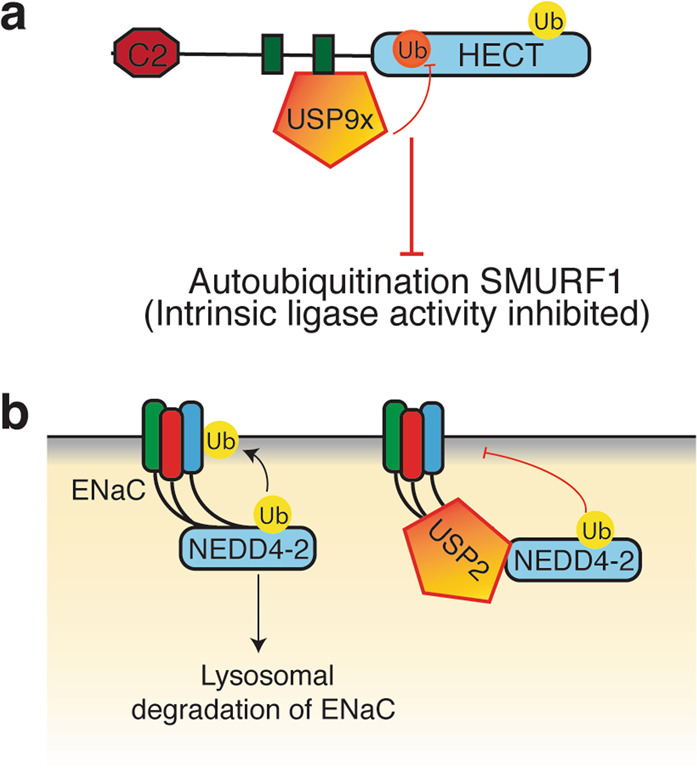
a USP9x binds to WW2 of SMURF1 and prevents its autoubiquitination. b The epithelial sodium channel (ENaC) is normally targeted for degradation following NEDD4-2–mediated ubiquitination at the PM. However, USP2-45 can bind to ENaC, facilitating its deubiquitination and/or interact with NEDD4-2 and prevent ENaC channel degradation.

References

    1. Foot N, Henshall T, Kumar S. Ubiquitination and the regulation of membrane proteins. Physiol Rev. 2017;97:253–81. doi: 10.1152/physrev.00012.2016. - DOI - PubMed
    1. Rotin D, Kumar S. Physiological functions of the HECT family of ubiquitin ligases. Nat Rev Mol Cell Biol. 2009;10:398–409. doi: 10.1038/nrm2690. - DOI - PubMed
    1. Scheffner M, Kumar S. Mammalian HECT ubiquitin-protein ligases: biological and pathophysiological aspects. Biochim Biophys Acta. 2014;1843:61–74. doi: 10.1016/j.bbamcr.2013.03.024. - DOI - PubMed
    1. Haas AL, Warms JV, Rose IA. Ubiquitin adenylate: structure and role in ubiquitin activation. Biochemistry. 1983;22:4388–94. doi: 10.1021/bi00288a007. - DOI - PubMed
    1. Jentsch S. The ubiquitin-conjugation system. Annu Rev Genet. 1992;26:179–207. doi: 10.1146/annurev.ge.26.120192.001143. - DOI - PubMed

Publication types

MeSH terms

LinkOut - more resources