


Postacute COVID-19: An Overview and Approach to Classification
- PMID: 33403218
- PMCID: PMC7665635
- DOI: 10.1093/ofid/ofaa509
Postacute COVID-19: An Overview and Approach to Classification
Abstract
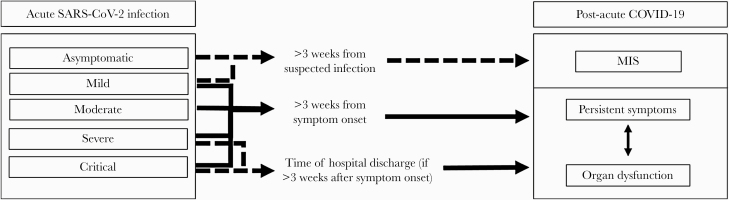
As the coronavirus disease 2019 (COVID-19) pandemic has progressed, a large volume of literature has developed delineating the clinical manifestations of acute infection. Recent reports have also started to describe persistent symptoms extending beyond the period of initial illness or hospitalization. Anecdotes of different signs and symptoms occurring after acute infection have also arisen in the lay press. Here we describe the current existing medical literature on the emerging concept of postacute COVID-19 and suggest an approach to classifying different manifestations of the syndrome. We also review long-term clinical manifestations observed in patients who recovered from infection due to other epidemic coronaviruses and briefly discuss potential mechanisms driving the phenomenon of postacute COVID-19.
Keywords: COVID-19; definition; long COVID; postacute.
Published by Oxford University Press on behalf of Infectious Diseases Society of America 2020.
Figures
References
-
- National Institutes of Health. COVID-19 treatment guidelines Updated 17 July 2020. Available at: https://www.covid19treatmentguidelines.nih.gov/overview/management-of-co.... Accessed 7 October 2020.
-
- Greenhalgh T, Knight M, Buxton M, Husain L. Management of post-acute covid-19 in primary care. BMJ 2020; 370:m3026. - PubMed
-
- Centers for Disease Control and Prevention. Duration of isolation and precautions for adults with COVID-19. Updated 16 August 2020. Available at: https://www.cdc.gov/coronavirus/2019-ncov/hcp/duration-isolation.html. Accessed 31 August 2020.
Publication types
Grants and funding
LinkOut - more resources
Full Text Sources
Other Literature Sources
Medical
