Colonoscopy-related injury among colonoscopists: an international survey
- PMID: 33403242
- PMCID: PMC7775804
- DOI: 10.1055/a-1311-0561
Colonoscopy-related injury among colonoscopists: an international survey
Abstract
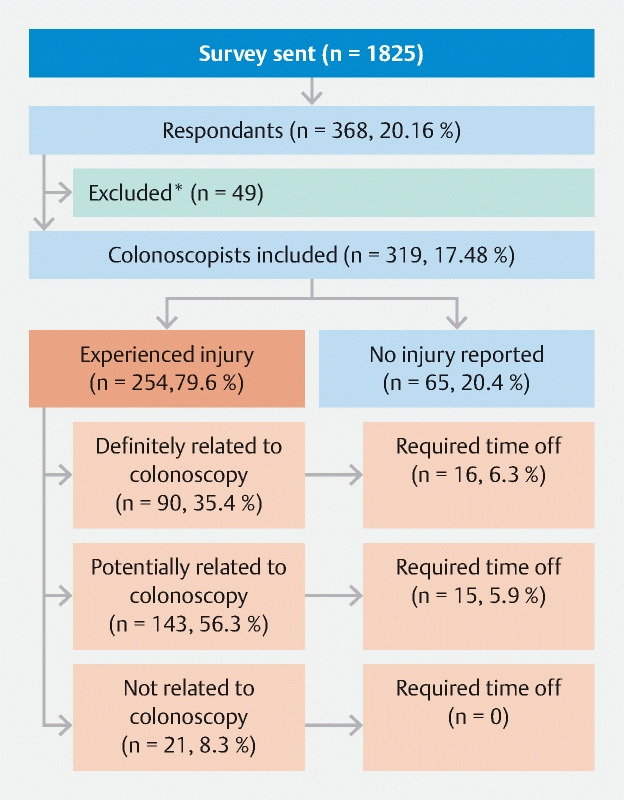
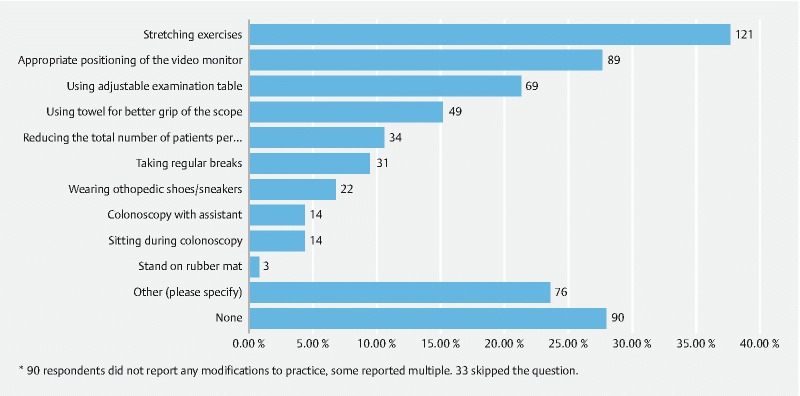
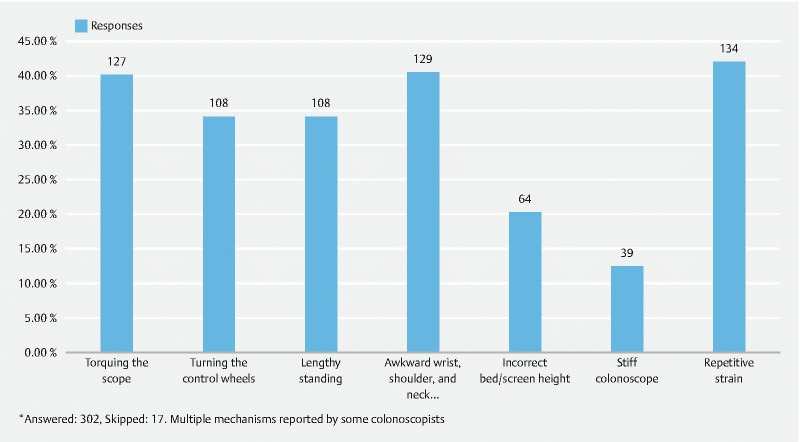
Background and study aims Colonoscopy is physically demanding for endoscopists and patients. Repetitive movements during colonoscopy can lead to overuse injuries. We aimed to explore the prevalence and range of colonoscopy-related musculoskeletal injuries (CRIs) in endoscopists. Methods A cross-sectional electronic survey of 1825 endoscopists was performed. The sample was composed of members of the British Society of Gastroenterology, European Society of Gastrointestinal Endoscopy, and National Nurse Endoscopy Group (UK). The survey comprised 20 questions. These included: endoscopists' workload, level of experience, and their perceived CRIs. All endoscopists who perform colonoscopy independently were included in the analysis. Results A total of 368 questionnaires were completed of 1825 surveyed (20.16 %). Of those, 319 participants (17.48 %) were fully independent in colonoscopy. Of 319 endoscopists, 254 (79.6 %) have experienced musculoskeletal injuries. These were reported as either possibly (n = 143, 56.3 %) or definitely (n = 90, 35.4 %) related to colonoscopy. Commonly injured areas were the lower back (n = 85, 36.5 %), neck (n = 82, 35.2 %) and left thumb (n = 79, 33.9 %). Of the injured endoscopists, 98 (30.7 %) made some modification to their practice, such as stretching exercises and ergonomic changes. Of the endoscopists, 134 (42.0 %) thought that repetitive limb strain was a likely causative mechanism. Around 40 % believed that torquing the scope and challenging body position were precipitating CRIs. Several treatment modalities were used to treat CRIs. These included; physiotherapy (n = 109), medications (n = 70), rest (n = 43), splinting (n = 31), steroid injections (n = 26) and surgery (n = 11). Conclusions A significant proportion of colonoscopists experience CRIs. The majority of the suggested modifications to practice can be adopted by any endoscopist. These results highlight the need to recognise CRI as an important occupational health hazard and to adopt preventative strategies routinely in the future.
The Author(s). This is an open access article published by Thieme under the terms of the Creative Commons Attribution-NonDerivative-NonCommercial License, permitting copying and reproduction so long as the original work is given appropriate credit. Contents may not be used for commecial purposes, or adapted, remixed, transformed or built upon. (https://creativecommons.org/licenses/by-nc-nd/4.0/).
Conflict of interest statement
Competing interests The authors declare that they have no conflict of interest.
Figures
References
-
- Levy I, Gralnek I M. Complications of diagnostic colonoscopy,upper endoscopy, and enteroscopy. Best Pract Res Clin Gastroenterol. 2016;30:705–718. - PubMed
-
- Shergill A K, Asundi K R, Barr A et al. Pinch force and forearm muscle load during colonoscopy: a pilot study. Gastrointest Endosc. 2009;69:142–146. - PubMed
LinkOut - more resources
Full Text Sources
Other Literature Sources