


Relationships Between Pain, Life Stress, Sociodemographics, and Cortisol: Contributions of Pain Intensity and Financial Satisfaction
- PMID: 33403312
- PMCID: PMC7745543
- DOI: 10.1177/2470547020975758
Relationships Between Pain, Life Stress, Sociodemographics, and Cortisol: Contributions of Pain Intensity and Financial Satisfaction
Abstract
Objective: The relationship between psychosocial stress and chronic pain is bidirectional. An improved understanding regarding the relationships among chronic pain, life stress, and ethnicity/race will inform identification of factors contributing to health disparities in chronic pain and improve health outcomes. This study aims to assess relationships between measures of clinical pain, life stress, sociodemographics, and salivary cortisol levels.
Methods: A cross-sectional analysis involving data from 105 non-Hispanic White (NHW) and non-Hispanic Black (NHB) participants aged 45-85 years old with or at risk for knee osteoarthritis. Data included sociodemographics, clinical pain, psychosocial stress, and salivary cortisol across five time points over an approximate 12-hour period. Non-parametric correlation analysis, sociodemographic group comparisons, and regression analyses were performed.
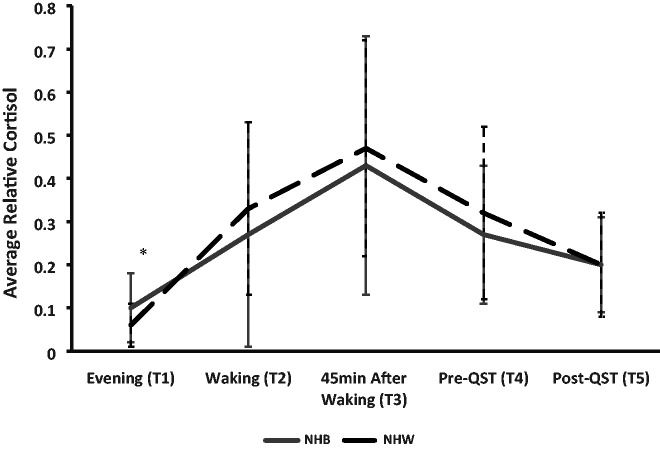
Results: Clinical pain and psychosocial stress were associated with salivary cortisol levels, particularly morning waking and the evening to morning awakening slope. With the inclusion of recognized explanatory variables, the Graded Chronic Pain Scale characteristic pain intensity and financial satisfaction were identified as the primary pain and psychosocial measures associated with cortisol levels. Sociodemographic group differences were indicated such that NHB participants reported higher pain-related disability, higher levels of discrimination, lower financial and material satisfaction, and showed higher evening salivary cortisol levels compared to NHW participants. In combined pain and psychosocial stress analyses, greater financial satisfaction, lower pain intensity, and lower depression were associated with higher morning waking saliva cortisol levels while greater financial satisfaction was the only variable associated with greater evening to morning awakening slope.
Conclusion: Our findings show relationships among clinical pain, psychosocial stress, sociodemographic factors, and salivary cortisol levels. Importantly, with inclusion of recognized explanatory variables, financial satisfaction remained the primary factor accounting for differences in morning waking cortisol and evening to morning awakening cortisol slope in an ethnic/racially diverse group of middle aged and older adults with or at risk for knee osteoarthritis.
Keywords: chronic pain; health disparities; psychosocial stress; salivary cortisol; stress system functioning.
© The Author(s) 2020.
Conflict of interest statement
Declaration of Conflicting Interests: The author(s) declared no potential conflicts of interest with respect to the research, authorship, and/or publication of this article.
Figures
References
-
- Generaal E, Vogelzangs N, Macfarlane GJ, et al. Biological stress systems, adverse life events and the onset of chronic multisite musculoskeletal pain: a 6-year cohort study. Ann Rheum Dis. 2016; 75(5): 847–854. - PubMed
Grants and funding
LinkOut - more resources
Full Text Sources
