


Multimorbidity burden and dementia risk in older adults: The role of inflammation and genetics
- PMID: 33403740
- PMCID: PMC8247430
- DOI: 10.1002/alz.12237
Multimorbidity burden and dementia risk in older adults: The role of inflammation and genetics
Abstract
Introduction: We investigate dementia risk in older adults with different disease patterns and explore the role of inflammation and apolipoprotein E (APOE) genotype.
Methods: A total of 2,478 dementia-free participants with two or more chronic diseases (ie, multimorbidity) part of the Swedish National study on Aging and Care in Kungsholmen (SNAC-K) were grouped according to their multimorbidity patterns and followed to detect clinical dementia. The potential modifier effect of C-reactive protein (CRP) and apolipoprotein E (APOE) genotype was tested through stratified analyses.
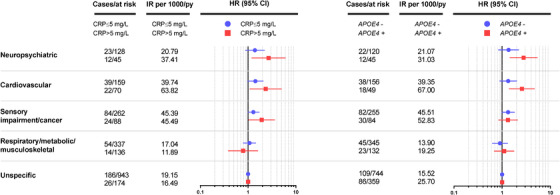
Results: People with neuropsychiatric, cardiovascular, and sensory impairment/cancer multimorbidity had increased hazards for dementia compared to the unspecific (Hazard ration (HR) 1.66, 95% confidence interval [CI] 1.13-2.42; 1.61, 95% CI 1.17-2.29; 1.32, 95% CI 1.10-1.71, respectively). Despite the lack of statistically significant interaction, high CRP increased dementia risk within these patterns, and being APOE ε4 carriers heightened dementia risk for neuropsychiatric and cardiovascular multimorbidity.
Discussion: Individuals with neuropsychiatric, cardiovascular, and sensory impairment/cancer patterns are at increased risk for dementia and APOE ε4, and inflammation may further increase the risk. Identifying such high-risk groups might allow tailored interventions for dementia prevention.
Keywords: dementia; genetics; inflammation; multimorbidity patterns.
© 2020 The Authors. Alzheimer's & Dementia published by Wiley Periodicals LLC on behalf of Alzheimer's Association.
Conflict of interest statement
No conflict of interest to declare.
Figures
References
-
- Shah H, Albanese E, Duggan C, et al. Research priorities to reduce the global burden of dementia by 2025. Lancet Neurol. 2016;15:1285‐1294. - PubMed
-
- Grande G, Qiu C, Fratiglioni L. Prevention of dementia in an ageing world: evidence and biological rationale. Ageing Res Rev. 2020:101045. - PubMed
-
- Winblad B, Amouyel P, Andrieu S, et al. Defeating Alzheimer's disease and other dementias: a priority for European science and society. Lancet Neurol. 2016;15:455‐532. - PubMed
-
- Shang Y, Fratiglioni L, Marseglia A, et al. Association of diabetes with stroke and post‐stroke dementia: a population‐based cohort study. Alzheimers Dement. 2020. - PubMed
Publication types
MeSH terms
Substances
LinkOut - more resources
Full Text Sources
Other Literature Sources
Medical
Research Materials
Miscellaneous
