. 2021 Jan 19;37(2):666-674.
doi: 10.1021/acs.langmuir.0c02592. Epub 2021 Jan 6.

Nanoscale Hydration in Layered Manganese Oxides

Affiliations

Nanoscale Hydration in Layered Manganese Oxides

Wei Cheng et al. Langmuir. .

Abstract

Birnessite is a layered MnO2 mineral capable of intercalating nanometric water films in its bulk. With its variable distributions of Mn oxidation states (MnIV, MnIII, and MnII), cationic vacancies, and interlayer cationic populations, birnessite plays key roles in catalysis, energy storage solutions, and environmental (geo)chemistry. We here report the molecular controls driving the nanoscale intercalation of water in potassium-exchanged birnessite nanoparticles. From microgravimetry, vibrational spectroscopy, and X-ray diffraction, we find that birnessite intercalates no more than one monolayer of water per interlayer when exposed to water vapor at 25 °C, even near the dew point. Molecular dynamics showed that a single monolayer is an energetically favorable hydration state that consists of 1.33 water molecules per unit cell. This monolayer is stabilized by concerted potassium-water and direct water-birnessite interactions, and involves negligible water-water interactions. Using our composite adsorption-condensation-intercalation model, we predicted humidity-dependent water loadings in terms of water intercalated in the internal and adsorbed at external basal faces, the proportions of which vary with particle size. The model also accounts for additional populations condensed on and between particles. By describing the nanoscale hydration of birnessite, our work secures a path for understanding the water-driven catalytic chemistry that this important layered manganese oxide mineral can host in natural and technological settings.


Conflict of interest statement

The authors declare no competing financial interest.

Figures
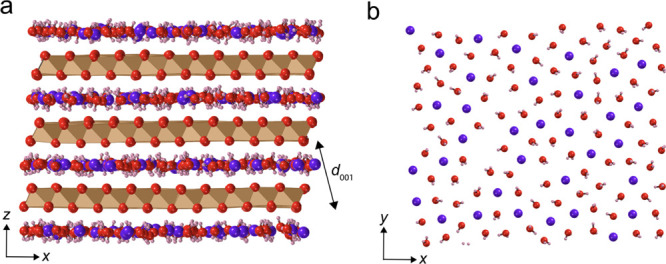
Figure 1
Figure 1
(a) Side view of the birnessite structure with an idealized 1-layer (1 W) interlayer hydration state of 1.33 H2O (red/pink) per unit cell. Sheets of Mn octahedra (brown/beige) are connected through edge-sharing basal oxygens (red). Charge imbalance caused by MnIII and MnII is compensated by interlayer countercations (purple) and/or vacancies (not shown). (b) Basal face view of a single water layer, also partially hydrating interlayer countercations, in this case, K+. These images were generated by a snapshot of a molecular dynamics simulations and then edited for illustration purposes.
Figure 2
Figure 2
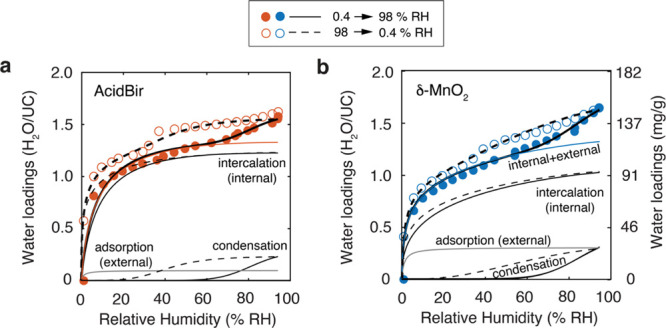
Gravimetrically derived water loadings on (a) AcidBir (59.2 m2/g) and (b) δ-MnO2 (204 m2/g), collected as adsorption (closed symbols) and desorption (open symbols) isotherms at 25 °C. Loadings are shown in terms of bound water molecules per unit cell (H2O/UC) and birnessite mass-normalized (left ordinate axis) mass of H2O (mg/g). Lines (see labels) are predictions of water binding during the adsorption (full) and desorption (dashed) leg of the data collection and generated using the composition adsorption–condensation–intercalation model of this study. The orange line in (a) and the blue line in (b) show the sum of internally and externally bound water to the basal faces of birnessite.
Figure 3
Figure 3
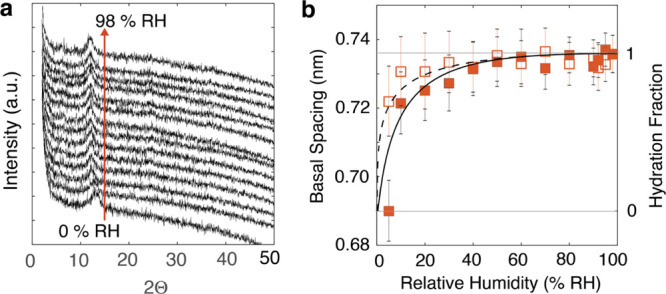
(a) Transmission-mode XRD diffractograms of AcidBir exposed to 0–98% RH and (b) result of d001 basal spacing (left ordinate axis) analyses from these data (filled square = adsorption; open square = desorption), also showing uncertainties. The model predictions of d001 in (b) (full line for adsorption; dashed for desorption) were taken from the Dubinin–Asthakhov theory term derived from the microgravimetric water binding data (Figure 2a). This model prediction of the hydration fraction (right ordinate axis) was scaled such that d001 = 0.690 nm at 0 W (0 H2O/UC) and d001 = 0.735 nm at 1 W (1.33 H2O/UC). Diffractograms for δ-MnO2 were of insufficient quality to be shown here, due to the small particle size.
Figure 4
Figure 4
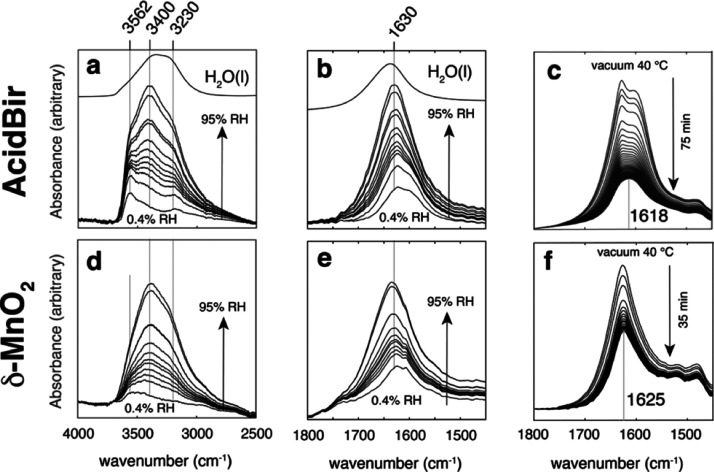
FTIR spectra of (a–c) AcidBir and (d–f) δ-MnO2. Samples were collected in ATR mode for experiments in the 0.4–95% RH range (adsorption leg) at 25 °C (a,b,d,e) and in transmission mode for samples exposed to vacuum at 40 °C (c,f). Note that the intensities in c and f are lower than those at 0.4% RH, and represent very low hydration states.
Figure 5
Figure 5
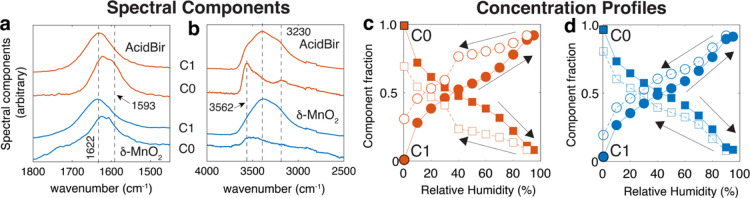
Chemometric analysis of FTIR spectra of AcidBir (orange) and δ-MnO2 (blue) from the adsorption (Figure 4a,b,d,e) and desorption (not shown) legs. The analysis decomposed the spectra into spectral components (a,b) and relative concentration profiles (c,d). Concentration profiles show both adsorption (filled) and desorption (open) legs.
Figure 6
Figure 6
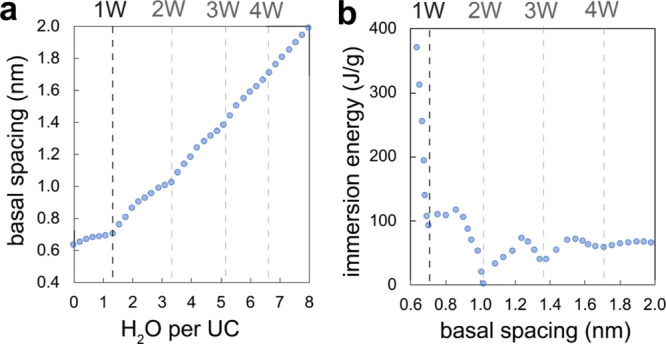
(a) Predicted d001 (along the UC c axis) as a function of water loading, here expressed as the water molecule per UC of K+-birnessite. (b) Corresponding immersion energy profiles vs d001. Here, 0.705 nm = 1 W and 1.02 nm = 2 W. Note that the immersion energy curve indicates possible higher and quasi-stable hydration states at 1.36 (3 W) and 1.68 (4 W) nm. See Figure S8 for comparison with Na-birnessite, which was also reported in the literature. Dashed vertical lines indicate the loci of hydration states.
Figure 7
Figure 7
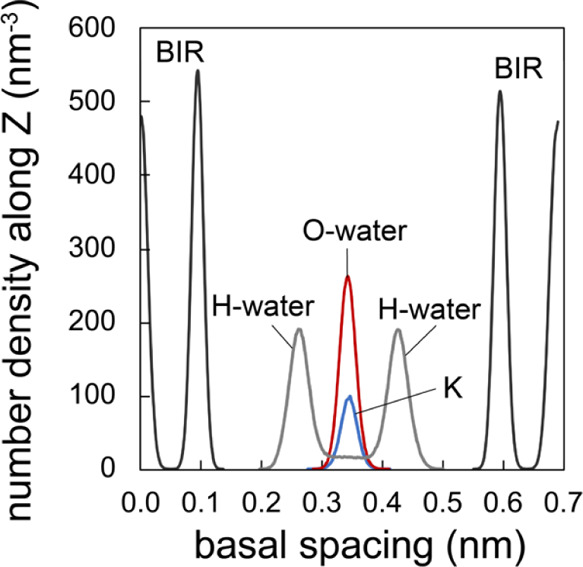
Density profile data binned over a single 6 × 12 1 W birnessite layer with the composition K36[Mn144O288] × (H2O)96, demonstrating the position of the K+ counterions and water oxygens being fully centered in the interlayer region. This contrasts with water hydrogens, which are almost exclusively oriented toward the basal oxygens of the birnessite lattice.
Figure 8
Figure 8
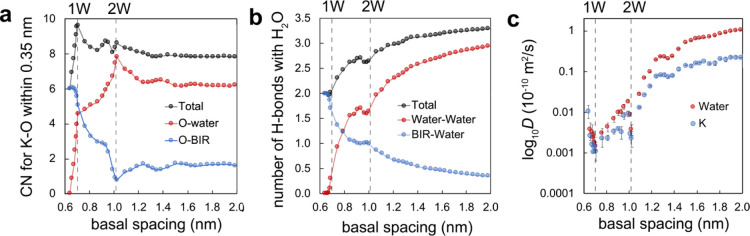
MD simulation results showing the basal spacing dependence (d001) on (a) the coordination environment of K+, (b) hydrogen bond populations, and (c) diffusion coefficients of water. (a) First-shell coordination of K+ to oxygens, belonging to either water (O-water, red) or birnessite (O-BIR, blue).The coordination numbers were calculated from the radial distribution functions up to the minima of the first coordination shell at 0.35 nm (Figure S9). (b) Number of hydrogen bonds between water and birnessite. (c) Diffusion coefficients of water (red) and K+ (blue). Dashed vertical lines indicate ideal 1 W and 2 W hydration states.

References

    1. Post J. E. Manganese oxide minerals: Crystal structures and economic and environmental significance. Proc. Natl. Acad. Sci. 1999, 96, 3447–3454. 10.1073/pnas.96.7.3447. - DOI - PMC - PubMed
    1. Chukhrov F. V.; Gorshkov A. I.; Rudnitskaya E. S.; Beresovskaya V. V.; Sivtsov A. V. Manganese Minerals in Clays: A Review. Clays Clay Miner. 1980, 28, 346–354. 10.1346/ccmn.1980.0280504. - DOI
    1. McKenzie R.Manganese Oxides and Hydroxides. In Minerals in Soil Environments, 2 ed.; Dixon J. B., Weed S. B., Eds.; Soil Science Society of America: Madison, Wisconsin, USA, 1989; Vol. 1, pp 439–465.
    1. Johnson E. A.; Post J. E. Water in the interlayer region of birnessite: Importance in cation exchange and structural stability. Am. Miner. 2006, 91, 609–618. 10.2138/am.2006.2090. - DOI
    1. Villalobos M.; Carrillo-Cárdenas M.; Gibson R.; López-Santiago N. R.; Morales J. A. The influence of particle size and structure on the sorption and oxidation behaviour of birnessite: II. Adsorption and oxidation of four polycyclic aromatic hydrocarbons. Environ. Chem. 2014, 11, 279–288. 10.1071/en13161. - DOI

LinkOut - more resources