


Theory Before the Test: How to Build High-Verisimilitude Explanatory Theories in Psychological Science
- PMID: 33404356
- PMCID: PMC8273840
- DOI: 10.1177/1745691620970604
Theory Before the Test: How to Build High-Verisimilitude Explanatory Theories in Psychological Science
Abstract
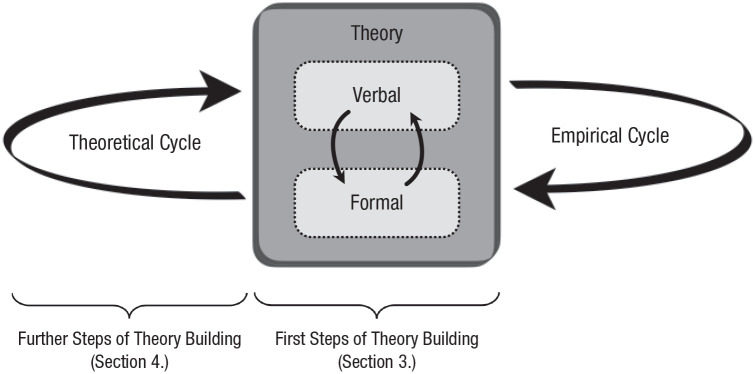
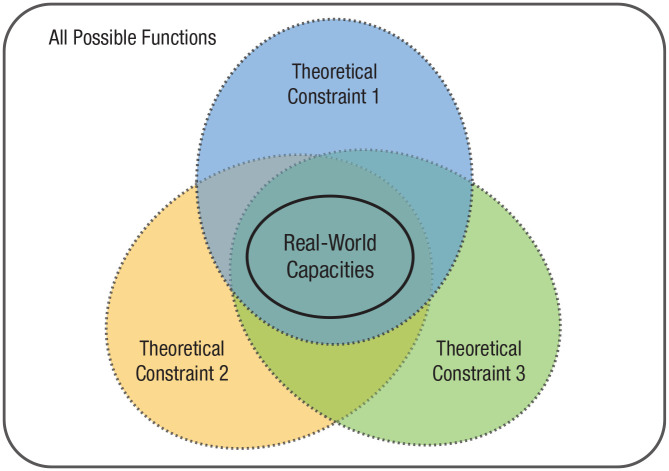
Drawing on the philosophy of psychological explanation, we suggest that psychological science, by focusing on effects, may lose sight of its primary explananda: psychological capacities. We revisit Marr's levels-of-analysis framework, which has been remarkably productive and useful for cognitive psychological explanation. We discuss ways in which Marr's framework may be extended to other areas of psychology, such as social, developmental, and evolutionary psychology, bringing new benefits to these fields. We then show how theoretical analyses can endow a theory with minimal plausibility even before contact with empirical data: We call this the theoretical cycle. Finally, we explain how our proposal may contribute to addressing critical issues in psychological science, including how to leverage effects to understand capacities better.
Keywords: computational analysis; computational-level theory; formal modeling; levels of explanation; psychological explanation; theoretical cycle; theory development.
Conflict of interest statement
Figures
Update of
References
-
- Anderson J. R. (1990). The adaptive character of thought. Erlbaum.
-
- Anderson J. R. (1991). Is human cognition adaptive? Behavioral and Brain Sciences, 14(3), 471–517.
-
- Ausiello G., Crescenzi P., Gambosi G., Kann V., Marchetti-Spaccamela A., Protasi M. (1999). Complexity and approximation: Combinatorial optimization problems and their approximability properties. Springer.
-
- Baggio G. (2018). Meaning in the brain. MIT Press.
-
- Baggio G., Stenning K., van Lambalgen M. (2016). Semantics and cognition. In Aloni M., Dekker P. (Eds.), The Cambridge handbook of formal semantics (pp. 756–774). Cambridge University Press.
MeSH terms
LinkOut - more resources
Full Text Sources
Other Literature Sources
Miscellaneous
