. 2019 Sep 16;1(1):100002.
doi: 10.1016/j.xplc.2019.100002. eCollection 2020 Jan 13.

Dose-Dependent AGO1-Mediated Inhibition of the miRNA165/166 Pathway Modulates Stem Cell Maintenance in Arabidopsis Shoot Apical Meristem

Affiliations

Dose-Dependent AGO1-Mediated Inhibition of the miRNA165/166 Pathway Modulates Stem Cell Maintenance in Arabidopsis Shoot Apical Meristem

Fei Du et al. Plant Commun. .

Abstract

Pluripotent stem cells localized in proliferating growth centers, the meristems, are the origin of life-long organ formation and growth in higher plants. In the shoot apical meristem of Arabidopsis thaliana, the closely related ARGONAUTE proteins AGO1 and ZLL/AGO10 bind miR165/166 species to regulate mRNAs of HD-ZIP III transcription factors that are essential to maintaining stem cells. Several genetic studies showed that AGO1 and ZLL/AGO10 act redundantly to maintain stem cells. By contrast, the reported biochemical data suggested antagonistic functions: AGO1 utilizes miR165/166 to slice HD-ZIP III mRNAs, whereas ZLL/AGO10 promotes degradation of miR165/166 and thus stabilizes HD-ZIP III mRNAs. How these different functions are balanced in stem cell regulation has remained enigmatic. Here, we show that autorepression of AGO1 through miR168-mediated slicing of its own RNA is required to maintain the ability of AGO1 to suppress HD-ZIP III mRNAs. Increased AGO1 expression, either in the miR168a-2 mutant or by transgenic expression, inhibits this ability despite the presence of high levels of miR165/166, effectively uncoupling HD-ZIP III and miR165/166 expression. AGO1 activity can be restored, however, by increasing the levels of chaperones SQN and HSP90, which promote assembly of RNA-induced silencing complex (RISC). This suggests that cellular abundance of SQN and HSP chaperones limits AGO1-mediated RNA interference in shoot meristem stem cell regulation. Localized misexpression of AGO1 indicates that the cells surrounding the shoot meristem primordium play a crucial role in stem cell development. Taken together, our study provides a framework that reconciles biochemical and genetic data, showing that restriction of AGO1 levels by miR168-mediated autorepression is key to RISC homeostasis and the function of AGO1 in stem cell regulation.

Keywords: ARGONAUTE1; Arabidopsis; HD-ZIP III; ZWILLE (ARGONAUTE10); shoot meristem; stem cell.


Figures

Figure 1
Figure 1
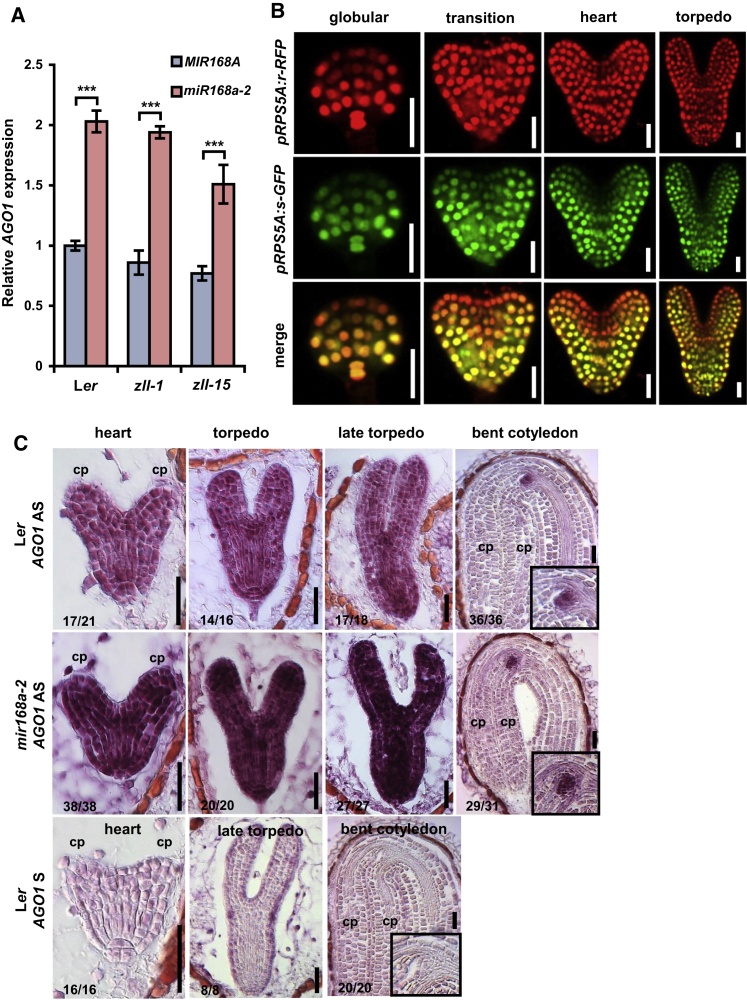
miR168 Regulates AGO1 Expression in a Dynamic Manner during Embryogenesis. (A) Levels of AGO1 transcript in seedling shoots of the indicated genotypes with or without mir168a-2 mutation. Date represent means ± SD from three biological replicates. ***p < 0.001 by two-sided, non-paired t-test. AGO1 expression levels in Ler, zll-1 and zll-15 carrying the MIR168 wild-type allele are not significantly different. (B) A tandem reporter co-expressing a miR168-resistant RFP (r-RFP) and a miR168-sensitive GFP (s-GFP) driven by the RPS5A promoter in embryos at the indicated stages. The lower panel shows merged channels. The same pattern was found in 13 out of 14 independent transgenic lines of the tandem reporter. (C) mRNA pattern of the endogenous AGO1 gene detected by in situ hybridization with antisense AGO1 probe 1 (Supplemental Figure 4). Genotypes, frequencies of observed patterns, and embryo stages are indicated. Insets show higher magnification of the embryonic shoot apical meristems. AS, antisense; S, sense; cp, cotyledon primordium. Scale bars: 20 μm.
Figure 2
Figure 2
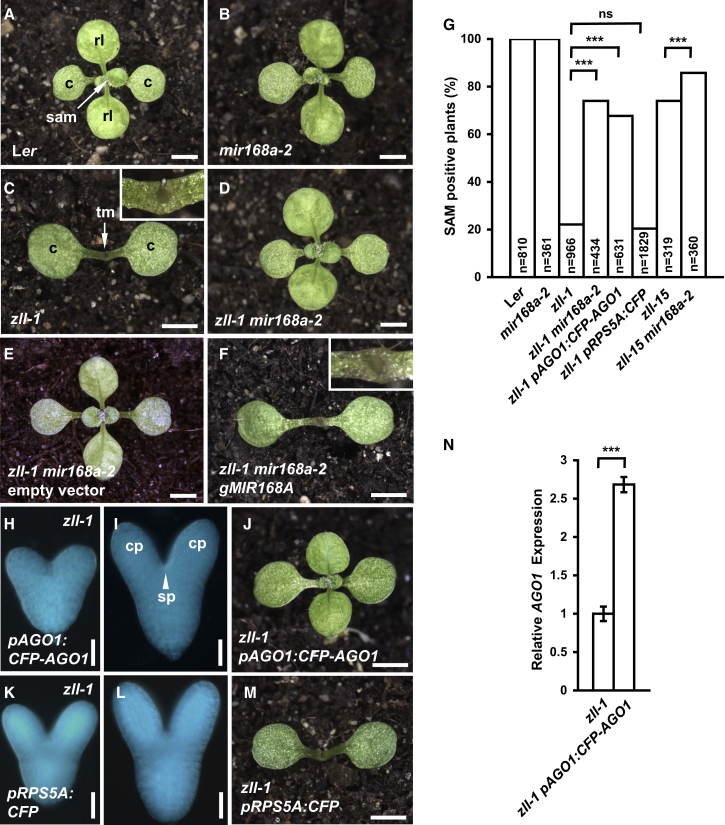
Increased AGO1 Expression Recovers Shoot Meristem Formation in zll-1. (A–F) Phenotypes of 14-day-old seedlings of indicated genotypes. The functional shoot apical meristems (sam) in (A), (B), and (D) produce rosette leaves (rl), while the terminated meristem (tm) in (C) only produces a filamentous structure (inset). (E and F)zll-1 mir168a-2 double mutants transformed with empty vector (E) or genomic MIR168A(F). (G) Frequency of 14-day-old seedlings containing a functional shoot meristem (SAM) for the indicated genotypes. n, number of seedlings. For the transgenic seedlings, data from three independent transgenic lines were pooled. ***p < 0.0001 by two-sided, non-paired Fisher’s exact tests and Bonferroni correction. ns, not significant. (H and I) Expression patterns of a functional CFP-AGO1 fusion protein driven by the AGO1 promoter in heart (H) and torpedo (I) stage zll-1 embryos. cp, cotyledon primordium; sp, shoot apical meristem primordium. (J) Phenotype of a 14-day-old transgenic zll-1 seedling expressing pAGO1:CFP-AGO1. (KL) Expression patterns of a CFP fluorescent protein driven by the RPS5A promoter in heart (K) and torpedo (L) stage zll-1 embryos. The exposure time of microscopy is one-tenth of that used for pAGO1:CFP-AGO1 embryos. (M) Phenotype of a 14-day-old transgenic zll-1 seedling expressing pRPS5A:CFP. (N)AGO1 transcript levels in 14-day-old seedlings of the indicated genotypes. Data represent means ± SD from three biological replicates. ***p < 0.001 by two-sided, non-paired t-test. Scale bars, 2.5 mm (A–F, J, M) and 20 μm (HIK, L).
Figure 3
Figure 3
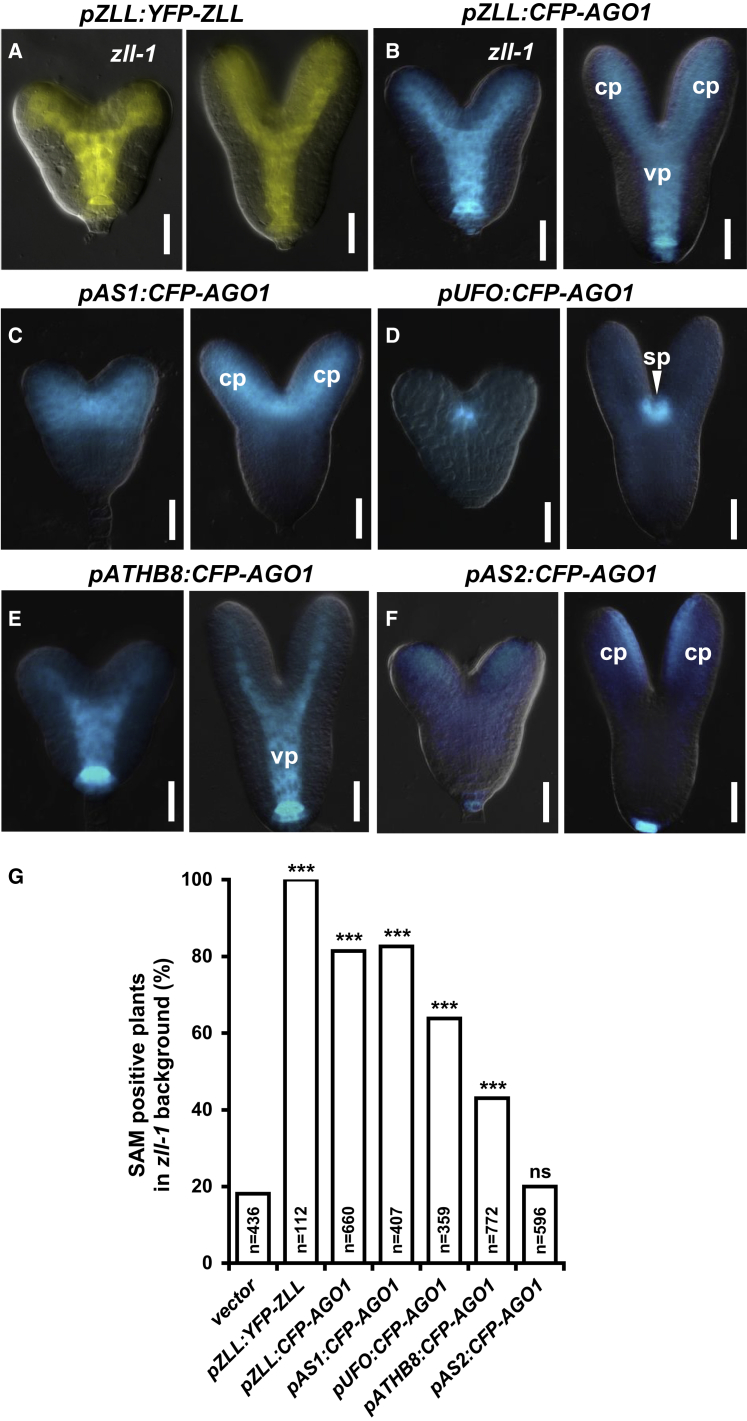
Domain-Specific Rescue of the zll-1 Phenotype by AGO1 Expression. (A–F) Expression patterns of YFP-ZLL and CFP-AGO1 driven by domain-specific promoters as indicated above each panel. For each transgene, a heart-stage embryo (left) and a torpedo-stage embryo (right) are shown. vp, vascular primordium. Scale bars, 20 μm. (G) Frequencies of 14-day-old zll-1 seedlings with a shoot meristem (SAM) by expressing transgenes as indicated. The numbers were generated by combining data from three independent transgenic lines. ***p < 0.00002 by two-sided, non-paired Fisher’s exact tests and Bonferroni correction. ns, not significant.
Figure 4
Figure 4
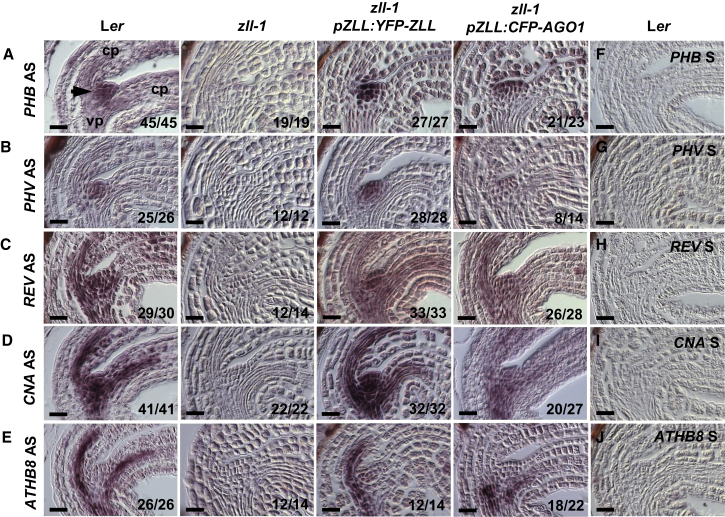
Increased AGO1 Levels Restore HD-ZIP III mRNA Levels in zll-1 Shoot Apices. (A–E)In situ hybridization analysis of transcripts of all five HD-ZIP III genes in bent-cotyledon-stage embryos of indicated genotypes using the antisense probes of PHB(A), PHV(B), REV(C), CNA(D), and ATHB8(E). (F–J) Hybridization using the sense probes of PHB(F), PHV(G), REV(H), CNA(I), and ATHB8(J) in Ler bent-cotyledon-stage embryos. The position of the embryonic shoot apical meristem is marked by an arrow. The ratio of embryos showing the corresponding pattern of HD-ZIP III transcript is indicated. cp, cotyledon primordium; vp, vascular primordium. Scale bars, 10 μm.
Figure 5
Figure 5
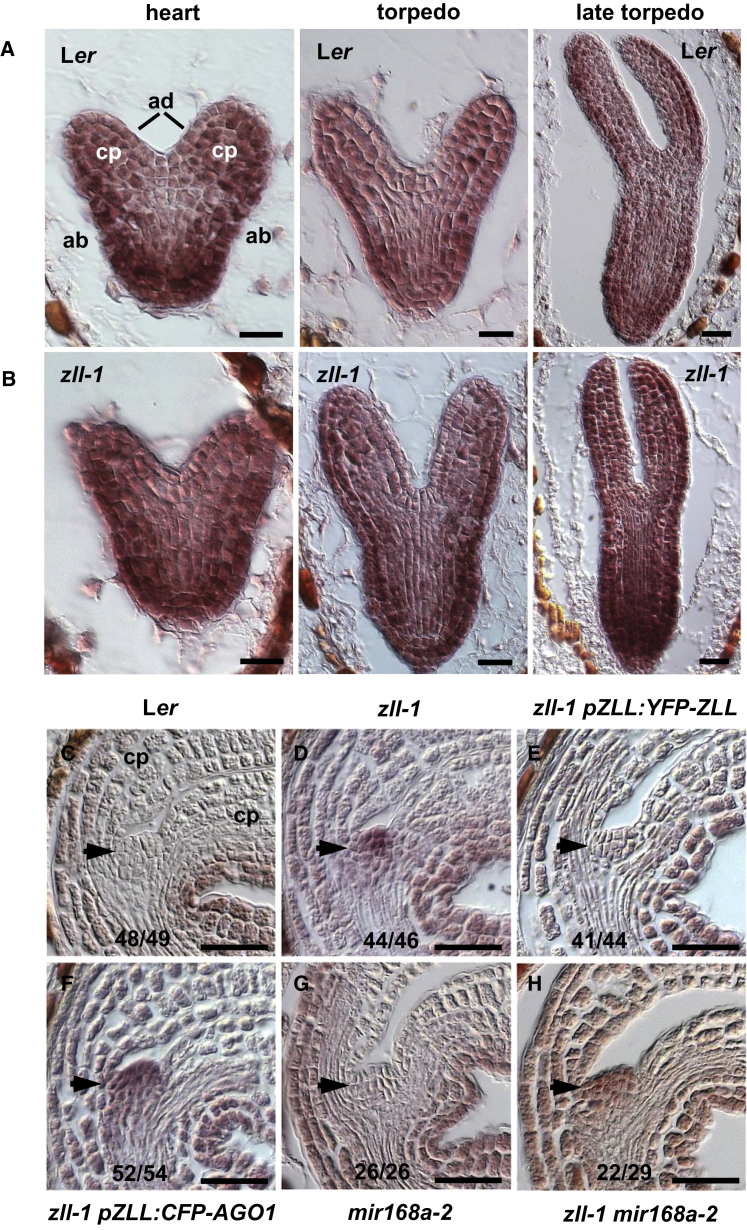
Increased AGO1 Levels Do Not Alter miR165/166 Accumulation in the zll-1 Shoot Apical Meristem. (A and B)In situ hybridization using an antisense miR166 LNA probe in Ler(A) and zll-1(B) embryos at heart, torpedo, and late torpedo stages. Representative patterns for each stage of Ler and zll-1 embryos are shown (n > 20 embryos per stage were examined). (C–H) miR165/166 accumulation patterns in bent-cotyledon stage embryos of six indicated genotypes. The position of the embryonic shoot apical meristem is marked by an arrow. The ratio of embryos showing the corresponding miR165/166 pattern is indicated. cp, cotyledon primordium; ad, adaxial region; ab, abaxial region. Scale bars, 20 μm.
Figure 6
Figure 6
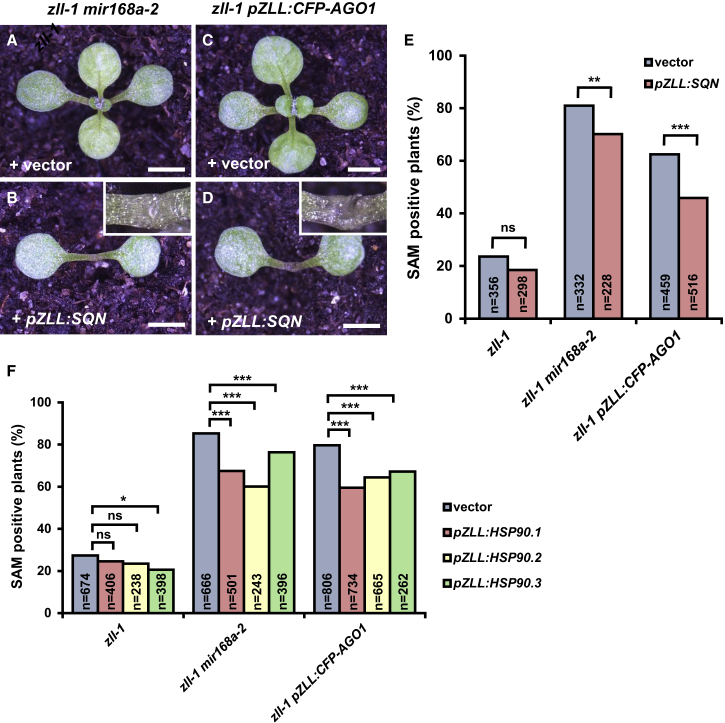
Expression of AGO1 Co-factors SQN and HSP90 Partially Suppresses the Recovery of Shoot Apical Meristem in zll-1. (A–D) Phenotypes of 14-day-old seedlings of the indicated genotypes expressing either empty vector or pZLL:SQN as indicated. Insets show the magnification of terminated shoot apices. (E) Shoot apical meristem phenotypes of 14-day-old seedlings of the indicated genotypes in homozygous T3 generations. The numbers from at least two independent transgenic lines were combined. **p < 0.01, ***p < 0.001 by two-sided, non-paired Fisher’s exact tests. ns, not significant. (F) Shoot apical meristem phenotypes of 14-day-old seedlings of the indicated genotypes in homozygous T3 generations. For the transgenic seedlings, individual counts from two or three independent transgenic lines not significantly different by chi-square test were pooled. *p < 0.0017, ***p < 0.0003 by two-sided, non-paired Fisher’s exact tests and Bonferroni correction. ns, not significant.

References

    1. Aichinger E., Kornet N., Friedrich T., Laux T. Plant stem cell niches. Annu. Rev. Plant Biol. 2012;63:615–636. - PubMed
    1. Bohmert K., Camus I., Bellini C., Bouchez D., Caboche M., Benning C. AGO1 defines a novel locus of Arabidopsis controlling leaf development. EMBO J. 1998;17:170–180. - PMC - PubMed
    1. Byrne M.E. Shoot meristem function and leaf polarity: the role of class III HD-ZIP genes. PLoS Genet. 2006;2:e89. - PMC - PubMed
    1. Carlsbecker A., Lee J.Y., Roberts C.J., Dettmer J., Lehesranta S., Zhou J., Lindgren O., Moreno-Risueno M.A., Vaten A., Thitamadee S. Cell signalling by microRNA165/6 directs gene dose-dependent root cell fate. Nature. 2010;465:316–321. - PMC - PubMed
    1. Czechowski T., Stitt M., Altmann T., Udvardi M.K., Scheible W.R. Genome-wide identification and testing of superior reference genes for transcript normalization in Arabidopsis. Plant Physiol. 2005;139:5–17. - PMC - PubMed

Publication types

LinkOut - more resources