. 2019 Oct 31;1(1):100006.
doi: 10.1016/j.xplc.2019.100006. eCollection 2020 Jan 13.

Alternative Splicing in the Anthocyanin Fruit Gene Encoding an R2R3 MYB Transcription Factor Affects Anthocyanin Biosynthesis in Tomato Fruits

Affiliations

Alternative Splicing in the Anthocyanin Fruit Gene Encoding an R2R3 MYB Transcription Factor Affects Anthocyanin Biosynthesis in Tomato Fruits

Sara Colanero et al. Plant Commun. .

Abstract

Tomato (Solanum lycopersicum) fruits are typically red at ripening, with high levels of carotenoids and a low content in flavonoids. Considerable work has been done to enrich the spectrum of their health-beneficial phytochemicals, and interspecific crosses with wild species have successfully led to purple anthocyanin-colored fruits. The Aft (Anthocyanin fruit) tomato accession inherited from Solanum chilense the ability to accumulate anthocyanins in fruit peel through the introgression of loci controlling anthocyanin pigmentation, including four R2R3 MYB transcription factor-encoding genes. Here, we carried out a comparative functional analysis of these transcription factors in wild-type and Aft plants, and tested their ability to take part in the transcriptional complexes that regulate the biosynthetic pathway and their efficiency in inducing anthocyanin pigmentation. Significant differences emerged for SlAN2like, both in the expression level and protein functionality, with splicing mutations determining a complete loss of function of the wild-type protein. This transcription factor thus appears to play a key role in the anthocyanin fruit pigmentation. Our data provide new clues to the long-awaited genetic basis of the Aft phenotype and contribute to understand why domesticated tomato fruits display a homogeneous red coloration without the typical purple streaks observed in wild tomato species.

Keywords: Aft; MBW complex; R2R3 MYB transcription factors; Solanum lycopersicum; anthocyanin; tomato.


Figures

Figure 1
Figure 1
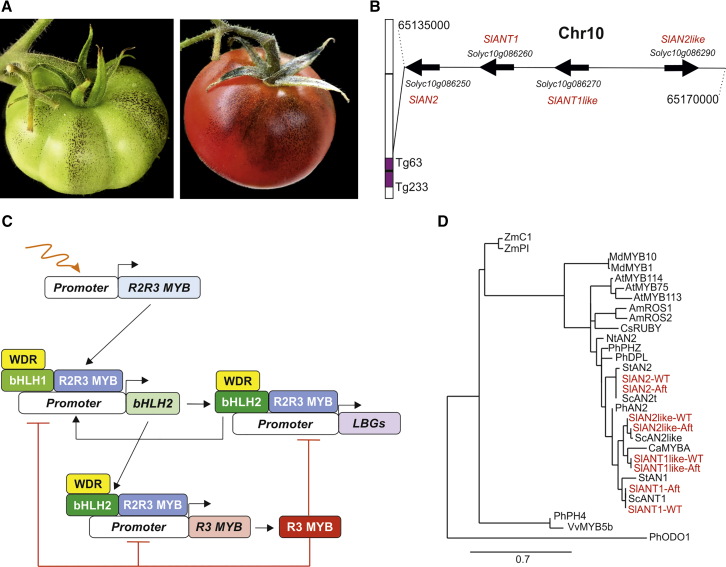
Anthocyanin Synthesis in Aft Tomato Is Associated with Four R2R3 MYB Genes Introgressed into Chromosome 10. (A)Aft tomato fruit at mature green (left) and red ripening (right) stages. (B) Location of the four R2R3 MYB encoding genes in the distal part of the long arm of chromosome 10 introgressed into Aft from Solanum chilense. (C) Model describing the regulatory mechanism controlling anthocyanin synthesis in dicots. Wavy orange arrow represents inductive environmental or developmental stimuli that trigger anthocyanin production. Black arrows indicate activation. Red lines indicate repression. Adapted from Albert et al. (2014) and Liu et al. (2018). (D) Phylogenetic tree showing the relatedness of the tomato R2R3 MYB proteins under study with other plant R2R3 MYB factors involved in anthocyanin synthesis. Protein sequences were identified on the SOL Genomics Network and NCBI websites. The relative accession numbers were as follows: SlAN2 (Solyc10g086250.1.1), SlAN2_Aft (ACT36608.1), SlANT1 (Solyc10g086260.1.1), SlANT1_Aft (ABO26065.1), SlANT1like (Solyc10g086270.1.1), SlANT1like_Aft (MN242013), SlAN2like (Solyc10g086290.1.1), SlAN2like_Aft (MN242011), ScAN2like (MN242012), StAN1 (AAX53089.1), StAN2 (AAX53091.1), PhAN2 (ABO21074.1), PhDPL (HQ116169), PhPHZ (HQ116170), PhPH4 (BAP28594.1), PhODO1 (Q50EX6.1), NtAN2 (ACO52470.1), AmROS1 (ABB83826.1), AmROS2 (ABB83827.1), AtMYB75 (AAG42001.1), AtMYB113 (NM_105308), AtMYB114 (NM_105309), ZmC1 (AAA33482), ZmPl (AAA19819), MdMYB10 (ABB84753), ScANT1 (ABO26065.1), ScAN2 (ACT36604.1), CsRuby (NP_001275818.1), CaMYBA (BBJ25251.1), MdMYB1 (ADQ27443.1), VvMYB5b (NP_001267854.1).
Figure 2
Figure 2
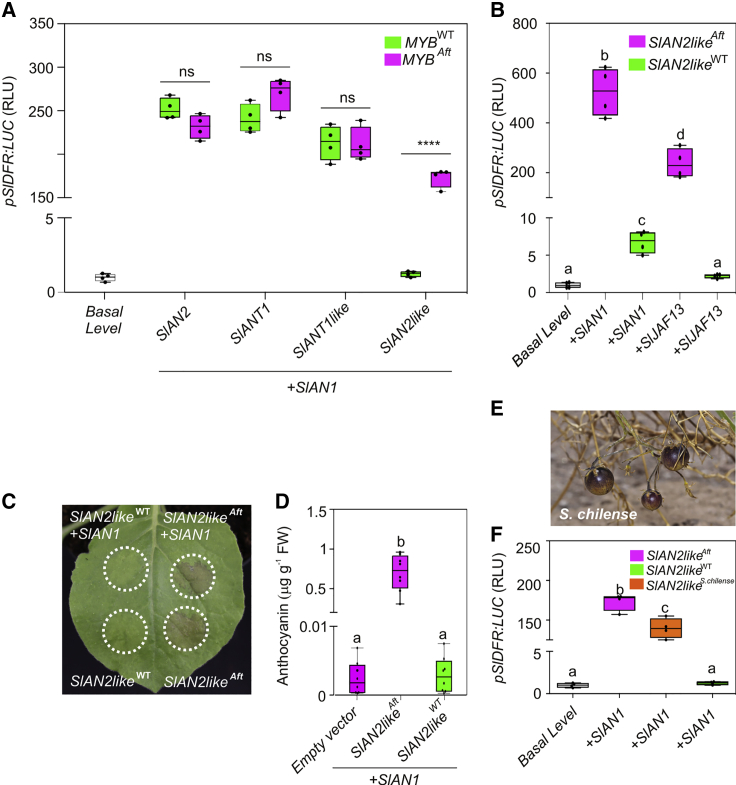
Functional Analysis of the R2R3 MYB Proteins from WT and Aft Plants. (A) Transactivation of the SlDFR promoter driving firefly luciferase in protoplasts with effector plasmids containing the MYB SlAN2, SlANT1, SlANT1like, or SlAN2like genomic sequences from WT or Aft plants, in combination with the effector plasmid containing the bHLH factor SlAN1. Data are expressed as relative luciferase activity (RLU) (FireflyLuc/RenillaLuc) with the value of the promoter basal level set to 1 and are means of four biological replicates ± SE. One-way ANOVA with Tukey's HSD post hoc test was performed. ns, P > 0.5; ****P ≤ 0.0001. (B) Transactivation of the SlDFR promoter driving firefly luciferase in protoplasts with effector plasmids containing the MYB SlAN2like genomic sequence from WT or Aft plants, in combination with effector plasmids containing the bHLH factor SlAN1 or SlJAF13. Data are expressed as RLU with the value of the promoter basal level set to 1 and are means of four biological replicates ± SE. One-way ANOVA with Tukey's HSD post hoc test was performed. Different letters indicate significant differences at P ≤ 0.05. (C) Anthocyanin accumulation in tobacco leaves agroinfiltrated with effector plasmids containing the SlAN2like genomic sequence cloned in WT or Aft plants expressed with or without the effector plasmid containing the bHLH factor SlAN1. White dotted circles indicate the agroinfiltrated areas. (D) Quantification of the anthocyanins produced in the areas of tobacco leaves agroinfiltrated with WT or Aft SlAN2like in combination with SlAN1. Anthocyanins are expressed in μg petunidin-3-(p-coumaroyl rutinoside)-5-glucoside g1 fresh weight (FW). Data are means of eight biological replicates ± SE. One-way ANOVA with Tukey's HSD post hoc test was performed. Different letters indicate significant differences at P ≤ 0.05. (E)Solanum chilense mature fruits (picture reproduced with the permission of the author from https://giorgetta.ch/fl_solanaceae_solanum_chilense.htm). (F) Transactivation of the SlDFR promoter driving the firefly luciferase gene in protoplasts transfected with effector plasmids containing SlAN2like genomic sequences from WT or Aft plants or ScAN2like genomic sequence from S. chilense, in combination with the effector plasmid containing the bHLH factor SlAN1. Data are expressed as RLU with the value of the promoter basal level set to 1 and are means of four biological replicates ± SE. One-way ANOVA with Tukey's HSD post hoc test was performed. Different letters indicate significant differences at P ≤ 0.05.
Figure 3
Figure 3
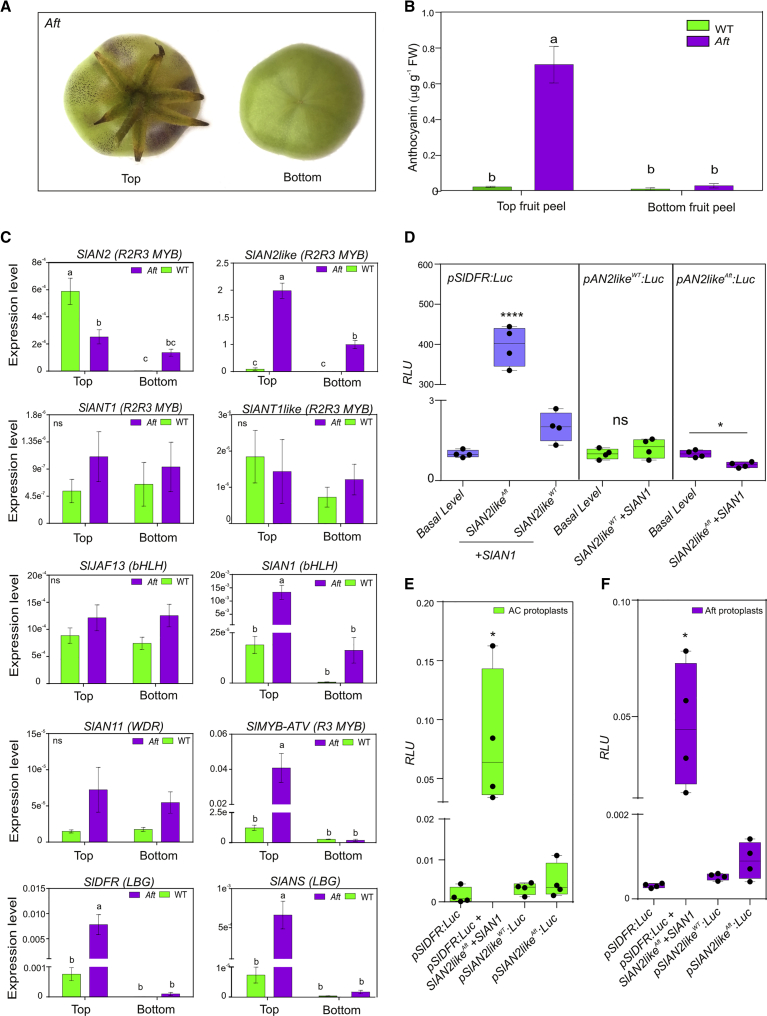
SlAN2likeAft Is the Major R2R3 MYB Factor Promoting Anthocyanin Synthesis in Aft Fruit Peel. (A) Top half (stem end) and bottom half (stylar end) of Aft fruit developed under permissive light conditions and photographed at the mature green stage. (B) Anthocyanin content measured in the peel sampled from top and bottom halves of WT and Aft fruits at the mature green stage. Anthocyanins are expressed in μg petunidin-3-(p-coumaroyl rutinoside)-5-glucoside g1 fresh weight (FW). Data are means of three biological replicates ± SE. One-way ANOVA with Tukey's HSD post hoc test was performed. Different letters indicate significant differences at P ≤ 0.05. (C) qPCR analysis of regulatory R2R3 MYB (SlAN2, SlAN2like, SlANT1, SlANT1like), bHLH (SlJAF13, SlAN1), WDR (SlAN11), and R3 MYB (SlMYB-ATV) genes performed in the skin from top and bottom halves of WT and Aft fruits at the mature green stage. Data are means of eight biological replicates ± SE. One-way ANOVA with Tukey's HSD post hoc test was performed. Different letters indicate significant differences at P ≤ 0.05. (D) Transactivation of the SlAN2like promoters from WT and Aft plants and of the SlDFR promoter, all of them driving the firefly luciferase gene, in leaf protoplasts. As positive control, transactivation of the SlDFR promoter in protoplasts transfected with the effector plasmids containing the SlAN2likeAft genomic sequence and the bHLH factor SlAN1 is shown. Data are expressed as relative luciferase activity (RLU) (FireflyLuc/RenillaLuc) with the value of the promoter basal level set to 1 and are means of four biological replicates ± SE. One-way ANOVA with Tukey's HSD post hoc test was performed. ns, P > 0.5; *P ≤ 0.05; ****P ≤ 0.0001. (E) Transactivation of the SlAN2like promoters from WT and Aft plants and of SlDFR promoter, all of them driving the firefly luciferase gene, in fruit peel protoplasts isolated from WT fruits at the mature green stage. As positive control, transactivation of the SlDFR promoter in protoplasts transfected with the effector plasmids containing the SlAN2likeAft genomic sequence and the bHLH factor SlAN1 is shown. Data are expressed as RLU and are means of four biological replicates ± SE. One-way ANOVA with Tukey's HSD post hoc test was performed. “∗” P ≤ 0.05. (F) Transactivation of the SlAN2like promoters from WT and Aft plants and of SlDFR promoter, all of them driving the firefly luciferase gene, in fruit peel protoplasts isolated from Aft fruits at the mature green stage. As positive control, transactivation of the SlDFR promoter in protoplasts transfected with the effector plasmids containing the SlAN2likeAft genomic sequence and the bHLH factor SlAN1 is shown. Data are expressed as RLU and are means of four biological replicates ± SE. One-way ANOVA with Tukey's HSD post hoc test was performed. ∗P ≤ 0.05.
Figure 4
Figure 4
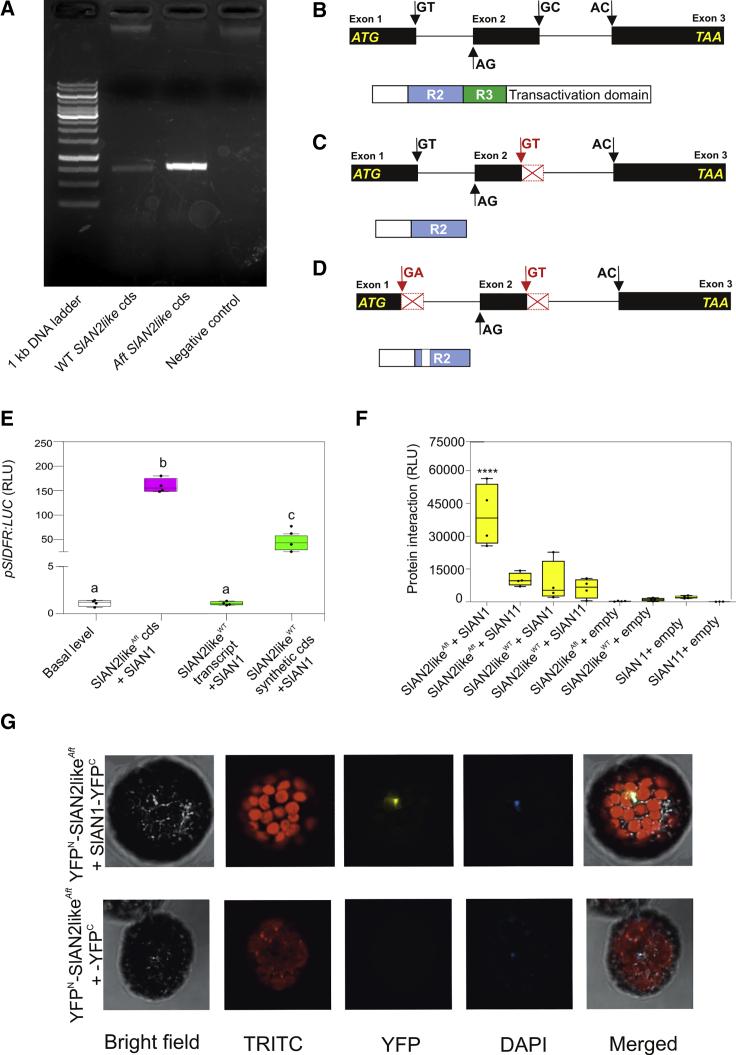
Structural and Functional Analysis of the SlAN2like Factors Produced from the Transcripts Identified in WT and Aft Fruit Peel. (A) Agarose gel electrophoresis of the RT–PCR products showing the SlAN2like transcripts amplified from WT and Aft fruit peel cDNAs. The expected length of the WT SlAN2like CDS (Solyc10g086290.1.1) is 798 bp. (B) Schematic representation of intron–exon structure of the WT genomic sequence of SlAN2like with the positions of the “canonical” splicing sites (black arrows), which produce the theoretical transcript registered in the SOL Genomics Network database (Solyc10g086290.1.1) (above), and protein produced from its mature mRNA with major functional domains (below). Gene and protein sequences are shown at different scales. (C) Schematic representation of intron–exon structure of the WT genomic sequence of SlAN2like with the positions of the “canonical” splicing sites (black arrows) and the alternative ones (red arrows), which produce the first shorter transcript identified in fruit peel (above), and protein produced from its mature mRNA with major functional domains (below). Gene and protein sequences are shown at different scales. (D) Schematic representation of intron–exon structure of the WT genomic sequence of SlAN2like with the positions of the “canonical” splicing sites (black arrows) and the alternative ones (red arrows), which produce the second shorter transcript identified in fruit peel, and protein produced from its mature mRNA with major functional domains (below). Gene and protein sequences are shown at different scales. (E) Transactivation of the SlDFR promoter driving the firefly luciferase gene in protoplasts with effector plasmids containing the SlAN2like transcripts cloned in WT and Aft fruit peel and the SlAN2like synthetic CDS (corresponding to the theoretical transcript produced from the WT pre-mRNA using the “canonical” splicing sites used in the processing of the pre-mRNA of SlAN2likeAft). MYB proteins were expressed in combination with SlAN1. Data are expressed as relative luciferase activity (RLU) (FireflyLuc/RenillaLuc) with the value of the promoter basal level set to 1 and are means of four biological replicates ± SE. One-way ANOVA with Tukey's HSD post hoc test was performed. Different letters indicate significant differences at P ≤ 0.05. (F) Split-luciferase complementation assay in WT protoplasts expressing the fusion proteins NLuc-SlAN2likeWT or NLuc-SlAN2likeAft with CLuc-SlAN1 or CLuc-SlAN11. Combinations of each construct with the empty vectors expressing the complementary half of the luciferase gene represent negative controls. Data are expressed as RLU and are means of four biological replicates ± SE. One-way ANOVA with Tukey's HSD post hoc test was performed. Each box was compared with the first one, with significant difference at ****P ≤ 0.0001. (G) Bimolecular fluorescence complementation assay analyzing the interaction between SlAN2likeAft and SlAN1 in tomato protoplasts expressing the fusion proteins YFPN-SlN2likeAft and YFPC-SlAN1. As a control, YFPC-half protein was expressed in combination with YFPN-SlAN2likeAft fusion protein.

References

    1. Albert N.W., Davies K.M., Lewis D.H., Zhang H., Montefiori M., Brendolise C., Boase M.R., Ngo H., Jameson P.E., Schwinn K.E. A conserved network of transcriptional activators and repressors regulates anthocyanin pigmentation in eudicots. Plant Cell. 2014;26:962–980. - PMC - PubMed
    1. An X.H., Tian Y., Chen K.Q., Wang X.F., Hao Y.J. The apple WD40 protein MdTTG1 interacts with bHLH but not MYB proteins to regulate anthocyanin accumulation. J. Plant Physiol. 2012;169:710–717. - PubMed
    1. Bai Y., Lindhout P. Domestication and breeding of tomatoes: what have we gained and what can we gain in the future? Ann. Bot. 2007;100:1085–1094. - PMC - PubMed
    1. Bedinger P.A., Chetelat R.T., McClure B., Moyle L.C., Rose J.K., Stack S.M., van der Knaap E., Baek Y.S., Lopez-Casado G., Covey P.A. Interspecific reproductive barriers in the tomato clade: opportunities to decipher mechanisms of reproductive isolation. Sex. Plant Reprod. 2011;24:171–187. - PubMed
    1. Bovy A., de Vos R., Kemper M., Schijlen E., Almenar Pertejo M., Muir S., Collins G., Robinson S., Verhoeyen M., Hughes S. High-flavonol tomatoes resulting from the heterologous expression of the maize transcription factor genes LC and C1. Plant Cell. 2002;14:2509–2526. - PMC - PubMed

Publication types

MeSH terms