Review
. 2019 Dec 28;1(1):100019.
doi: 10.1016/j.xplc.2019.100019. eCollection 2020 Jan 13.

A Roadmap toward Engineered Nitrogen-Fixing Nodule Symbiosis

Affiliations
Review

A Roadmap toward Engineered Nitrogen-Fixing Nodule Symbiosis

Rik Huisman et al. Plant Commun. .

Abstract

In the late 19th century, it was discovered that legumes can establish a root nodule endosymbiosis with nitrogen-fixing rhizobia. Soon after, the question was raised whether it is possible to transfer this trait to non-leguminous crops. In the past century, an ever-increasing amount of knowledge provided unique insights into the cellular, molecular, and genetic processes controlling this endosymbiosis. In addition, recent phylogenomic studies uncovered several genes that evolved to function specifically to control nodule formation and bacterial infection. However, despite this massive body of knowledge, the long-standing objective to engineer the nitrogen-fixing nodulation trait on non-leguminous crop plants has not been achieved yet. In this review, the unsolved questions and engineering strategies toward nitrogen-fixing nodulation in non-legume plants are discussed and highlighted.

Keywords: Parasponia; actinorhizal plants; engineering nitrogen fixation; legumes; nodulation.


Figures

Figure 1
Figure 1
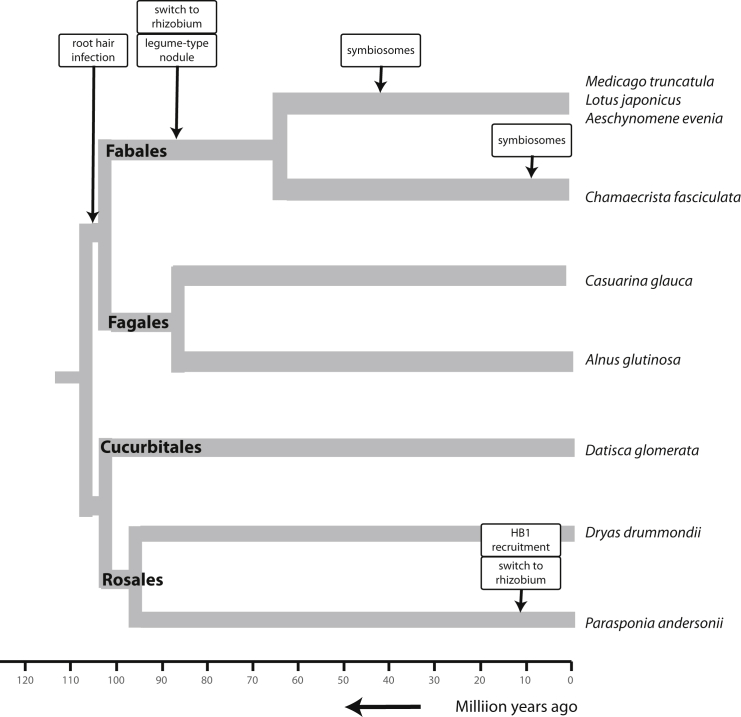
The Nitrogen-Fixing Clade Depicting the Phylogenetic Relation of Nodulating Plant Species Selected for Comparative Studies. The nitrogen-fixing nodulation trait finds its origin about 110 million years ago prior to the diversification into four orders: Fabales, Fagales, Cucurbitales, and Rosales. The major lineage-specific adaptations are indicated.
Figure 2
Figure 2
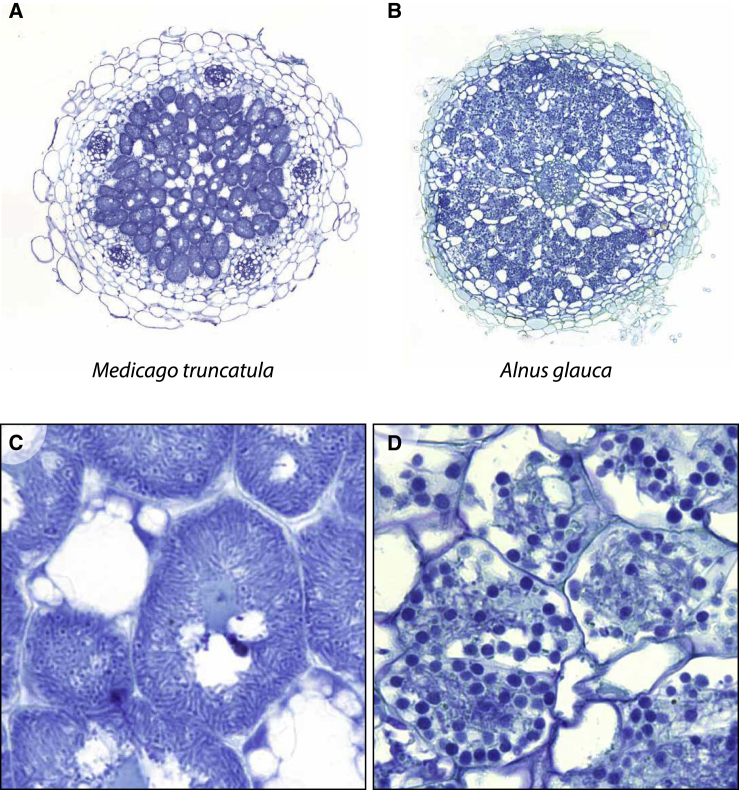
Cytoarchitecture of a Legume (Medicago truncatula) and an Actinorhizal Nodule (Alnus glutinosa). (A) A cross section of an M. truncatula nodule visualizing a large central zone of infected cells and five peripheral vascular bundles. (B) A cross section of an A. glutinosa nodule visualizing a central vascular bundle surrounded by infected cortical cells. (C) Infected M. truncatula nodule cells containing hundreds of elongated rhizobia as transient nitrogen-fixing organelle-like structures. (D) Infected A. glutinosa nodule cells containing fixation threads and tens of densely stained nitrogen-fixing Frankia vesicles.
Figure 3
Figure 3
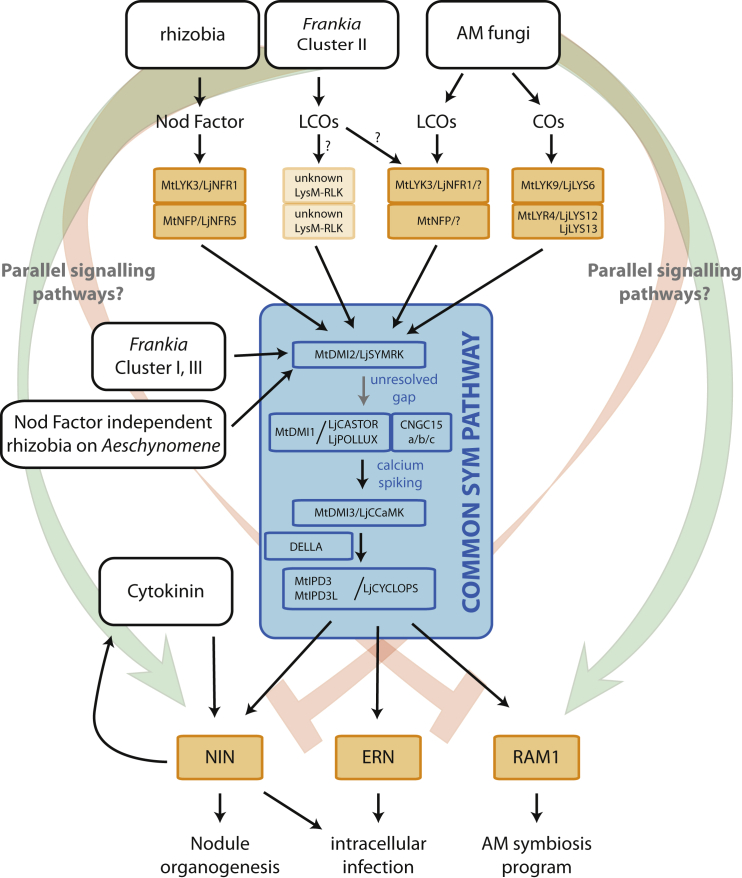
Schematic Representation of the Common SYM Pathway. Lipochitooligosaccharides (LCOs) of rhizobia (Nod factors), Frankia cluster II, and arbuscular mycorrhizal (AM) fungi (Myc factors), as well as chitin oligomers (COs) of AM fungi, are perceived by different heterodimeric complexes of LysM-RLKs. These complexes interact also with the leucine-rich repeat-type SYMBIOSIS RECEPTOR KINASE (LjSYMRK/MtDMI2), thereby activating the common SYM pathway. In the case of LCO-independent Frankia clusters I and III as well as Aeschynomene legumes, SYMRK is activated by an as-yet unknown mechanism. Nuclear Ca2+ oscillations are a hallmark of symbiotic signaling induced by rhizobia, Frankia, and AM fungi. Ca2+ oscillations are decoded by calcium-/calmodulin-dependent kinase (CCaMK), leading to activation of MtIPD3/LjCYCLOPS. Downstream of this transcription factor a symbiosis-specific transcriptional network is activated, which includes ERN1 and the NIN–cytokinin feed-forward loop, in the case of nodule formation in legumes, and RAM1 in the case of AM symbiosis. To allow such symbiosis-specific transcriptional activation, parallel pathways are predicted, which can include activating (green) or inhibiting (red) activity.
Figure 4
Figure 4
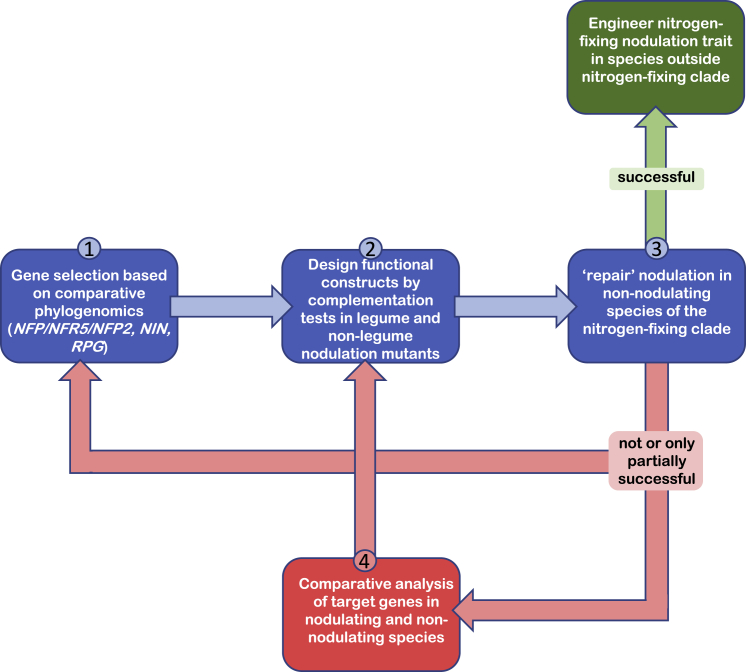
A Roadmap for Engineering the Nitrogen-Fixing Nodulation Trait Based on an Evolutionary Blueprint from Nodulating Legumes or Non-legumes. Step 1: Selection of engineering targets based on comparative phylogenomics using nodulating and non-nodulating species of the nitrogen-fixing clade. Currently, these studies have provided three potential targets: the LysM-RLK LCO receptor NFP/NFR5/NFP2, the transcription factor NIN, and the coiled-coil protein RPG. Step 2: Design constructs that can functionally complement legume and non-legume nodulation mutants. The nature of the gene constructs can depend on the selected target species for engineering. Step 3: Repair nodulation in non-nodulating species of the nitrogen-fixing clade. If this turns out not—or only partially—successful, then additional engineering targets should be found, focusing on genes that can be associated with the phenotype of the unsuccessful complementation attempt (step 1). Alternatively, it can be determined whether downstream targets of, e.g., NIN, are conserved (step 4). In case nodulation can be successfully repaired, the obtained knowledge can guide an engineering strategy for species outside the nitrogen-fixing clade.

References

    1. Akasaka-Kennedy Y., Tomita K.-O., Ezura H. Efficient plant regeneration and Agrobacterium-mediated transformation via somatic embryogenesis in melon (Cucumis melo L.) Plant Sci. 2004;166:763–769.
    1. Andrews M., James E.K., Sprent J.I., Boddey R.M., Gross E., dos Reis F.B. Nitrogen fixation in legumes and actinorhizal plants in natural ecosystems: values obtained using 15N natural abundance. Plant Ecol. Divers. 2011;4:131–140.
    1. Antolín-Llovera M., Ried M.K., Parniske M. Cleavage of the SYMBIOSIS RECEPTOR- LIKE KINASE ectodomain promotes complex formation with NOD FACTOR RECEPTOR 5. Curr. Biol. 2014;24:422–427. - PubMed
    1. Arrighi J.-F., Cartieaux F. In: de Bruijn F.J., editor. Vol. 1. John Wiley & Sons, Inc.; Hoboken, New Jersey: 2015. Out of water of a new model legume: the Nod-independent Aeschynomene evenia; pp. 447–454. (Biological Nitrogen Fixation).
    1. Arrighi J.-F., Godfroy O., de Billy F., Saurat O., Jauneau A., Gough C. The RPG gene of Medicago truncatula controls Rhizobium-directed polar growth during infection. Proc. Natl. Acad. Sci. U S A. 2008;105:9817–9822. - PMC - PubMed

Publication types

LinkOut - more resources