


Effect of Coronal Alignment on 10-Year Survivorship of a Single Contemporary Total Knee Arthroplasty
- PMID: 33406614
- PMCID: PMC7795414
- DOI: 10.3390/jcm10010142
Effect of Coronal Alignment on 10-Year Survivorship of a Single Contemporary Total Knee Arthroplasty
Abstract
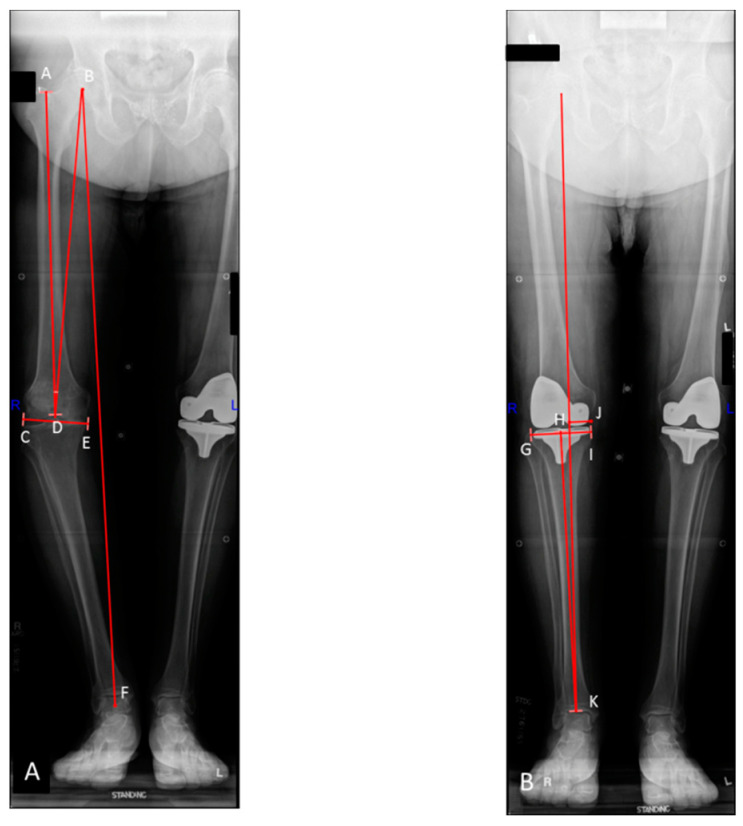
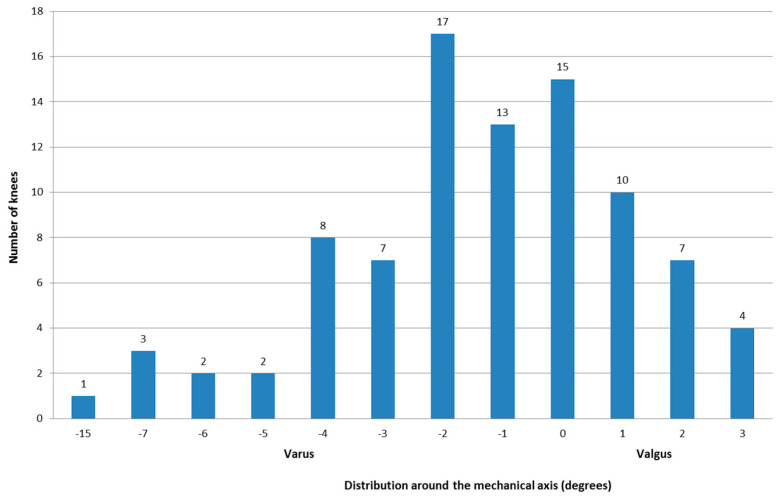
Debate remains regarding the utility of mechanical axis alignment as a predictor of durability after total knee arthroplasty (TKA). Our study aimed to assess the effects of coronal alignment on implant durability, clinical outcomes, and radiographic results with a single fixed-bearing TKA design. All patients undergoing primary cemented TKA of a single design (Stryker Triathlon) from 2005-2007 with >10 years of follow-up and available pre-operative and post-operative hip-knee-ankle radiographs were included (n = 89). Radiographs were measured to determine coronal alignment and assessed for loosening. Mean preoperative mechanical axis alignment was -6° ± 6.7° (varus, range, -16°-23°), while mean post-operative alignment was -1° ± 2.7° (varus, range, -3°-15°). The aligned group was defined as knees with a post-operative mechanical axis of 0° ± 3° (n = 73) and the outlier group as those outside this range (n = 16). No patients underwent revision. Ten-year survivorship free from any reoperation was 99% and 100% in the aligned and outlier groups, respectively (p = 0.64). Knee Society scores improved significantly in both groups (p < 0.001) and did not differ at final follow-up (p = 0.15). No knees demonstrated radiographic evidence of loosening. Post-operative mechanical axis alignment within 3° of neutral was not associated with improved implant durability, clinical outcomes, or radiographic results at 10 years following primary TKA.
Keywords: coronal alignment; mechanical axis; survivorship; total knee arthroplasty.
Conflict of interest statement
Tibbo has nothing to disclose. Limberg has nothing to disclose. Perry has nothing to disclose. Pagnano reports royalties from DePuy Synthes, royalties from Stryker, personal fees from Turbett Surgical all outside the submitted work. Stuart is a consultant and receives royalites from Arthrex, research support from Stryker, research support from USA Hockey Foundation all outside the submitted work. Hanssen has nothing to disclose. Abdel is a consultant and receives royalties from Stryker outside the submitted work and is on the American Academy of Orthopedic Surgeons (AAOS) Board of Directors.
Figures
References
-
- Abdel M.P., Ollivier M., Parratte S., Trousdale R.T., Berry D.J., Pagnano M.W. Effect of Postoperative Mechanical Axis Alignment on Survival and Functional Outcomes of Modern Total Knee Arthroplasties with Cement: A Concise Follow-up at 20 Years. J. Bone Jt. Surg. Am. 2018;100:472–478. doi: 10.2106/JBJS.16.01587. - DOI - PubMed
-
- Young S.W., Walker M.L., Bayan A., Briant-Evans T., Pavlou P., Farrington B. The Chitranjan S. Ranawat Award: No Difference in 2-year Functional Outcomes Using Kinematic versus Mechanical Alignment in TKA: A Randomized Controlled Clinical Trial. Clin. Orthop. Relat. Res. 2017;475:9–20. doi: 10.1007/s11999-016-4844-x. - DOI - PMC - PubMed
LinkOut - more resources
Full Text Sources
Other Literature Sources
