


Application of systems dynamics and group model building to identify barriers and facilitators to acute care delivery in a resource limited setting
- PMID: 33407458
- PMCID: PMC7787401
- DOI: 10.1186/s12913-020-06014-7
Application of systems dynamics and group model building to identify barriers and facilitators to acute care delivery in a resource limited setting
Abstract
Background: Group model building (GMB) is a method to facilitate shared understanding of structures and relationships that determine system behaviors. This project aimed to determine the feasibility of GMB in a resource-limited setting and to use GMB to describe key barriers and facilitators to effective acute care delivery at a tertiary care hospital in Malawi.
Methods: Over 1 week, trained facilitators led three GMB sessions with two groups of healthcare providers to facilitate shared understanding of structures and relationships that determine system behaviors. One group aimed to identify factors that impact patient flow in the paediatric special care ward. The other aimed to identify factors impacting delivery of high-quality care in the paediatric accident and emergency room. Synthesized causal maps of factors influencing patient care were generated, revised, and qualitatively analyzed.
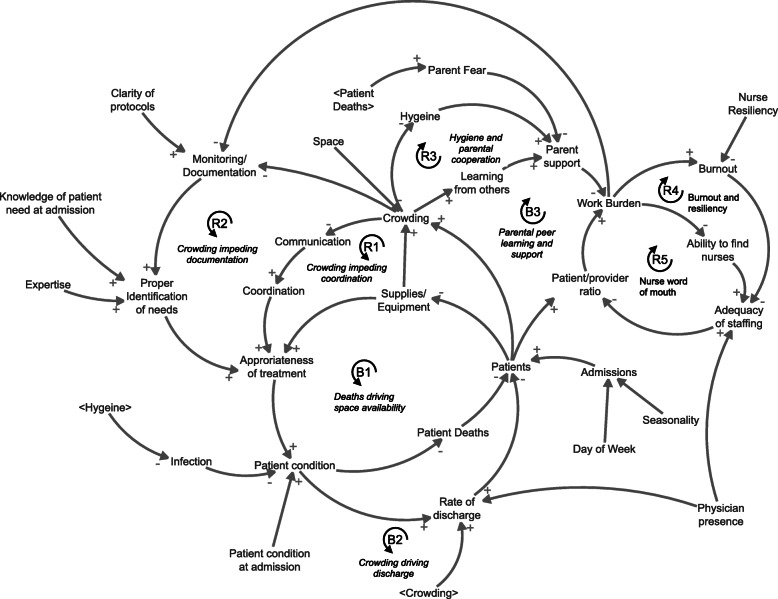
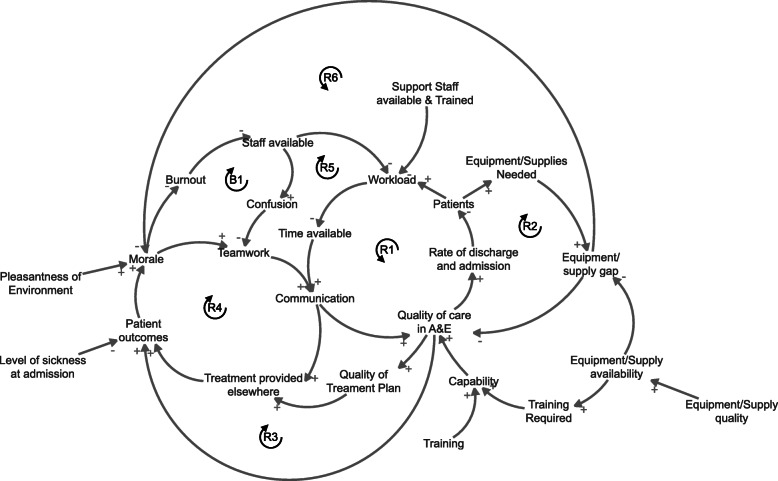
Results: Causal maps identified patient condition as the central modifier of acute care delivery. Severe illness and high volume of patients were identified as creating system strain in several domains: (1) physical space, (2) resource needs and utilization, (3) staff capabilities and (4) quality improvement. Stress in these domains results in worsening patient condition and perpetuating negative reinforcing feedback loops. Balancing factors inherent to the current system included (1) parental engagement, (2) provider resilience, (3) ease of communication and (4) patient death. Perceived strengths of the GMB process were representation of diverse stakeholder viewpoints and complex system synthesis in a visual causal pathway, the process inclusivity, development of shared understanding, new idea generation and momentum building. Challenges identified included time required for completion and potential for participant selection bias.
Conclusions: GMB facilitated creation of a shared mental model, as a first step in optimizing acute care delivery in a paediatric facility in this resource-limited setting.
Keywords: Group model building; Paediatric critical care; Paediatric emergency care; Systems dynamics.
Conflict of interest statement
The authors declare that they have no competing interests.
Figures
References
MeSH terms
Grants and funding
LinkOut - more resources
Full Text Sources
Other Literature Sources
Medical
