


KASP: a genotyping method to rapid identification of resistance in Plasmodium falciparum
- PMID: 33407529
- PMCID: PMC7789257
- DOI: 10.1186/s12936-020-03544-7
KASP: a genotyping method to rapid identification of resistance in Plasmodium falciparum
Abstract
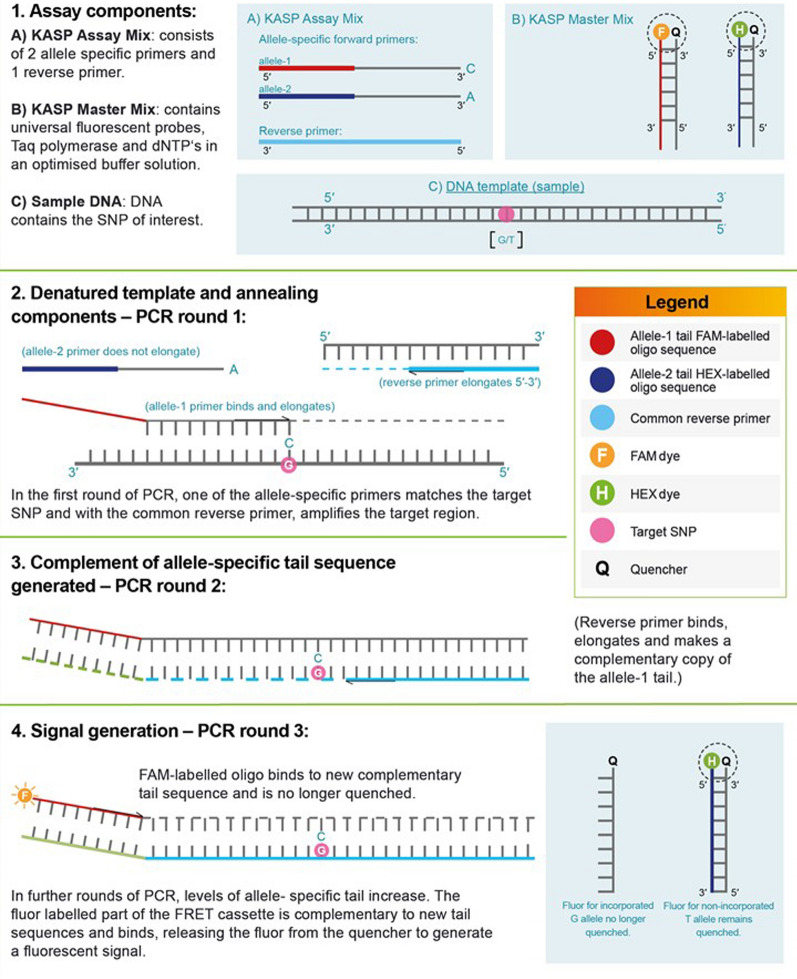
Background: The emergence and spread of anti-malarial resistance continues to hinder malaria control. Plasmodium falciparum, the species that causes most human malaria cases and most deaths, has shown resistance to almost all known anti-malarials. This anti-malarial resistance arises from the development and subsequent expansion of Single Nucleotide Polymorphisms (SNPs) in specific parasite genes. A quick and cheap tool for the detection of drug resistance can be crucial and very useful for use in hospitals and in malaria control programmes. It has been demonstrated in different contexts that genotyping by Kompetitive Allele Specific PCR (KASP), is a simple, fast and economical method that allows a high-precision biallelic characterization of SNPs, hence its possible utility in the study of resistance in P. falciparum.
Methods: Three SNPs involved in most cases of resistance to the most widespread anti-malarial treatments have been analysed by PCR plus sequencing and by KASP (C580Y of the Kelch13 gene, Y86N of the Pfmdr1 gene and M133I of the Pfcytb gene). A total of 113 P. falciparum positive samples and 24 negative samples, previously analysed by PCR and sequencing, were selected for this assay. Likewise, the samples were genotyped for the MSP-1 and MSP-2 genes, and the Multiplicity of Infection (MOI) and parasitaemia were measured to observe their possible influence on the KASP method.
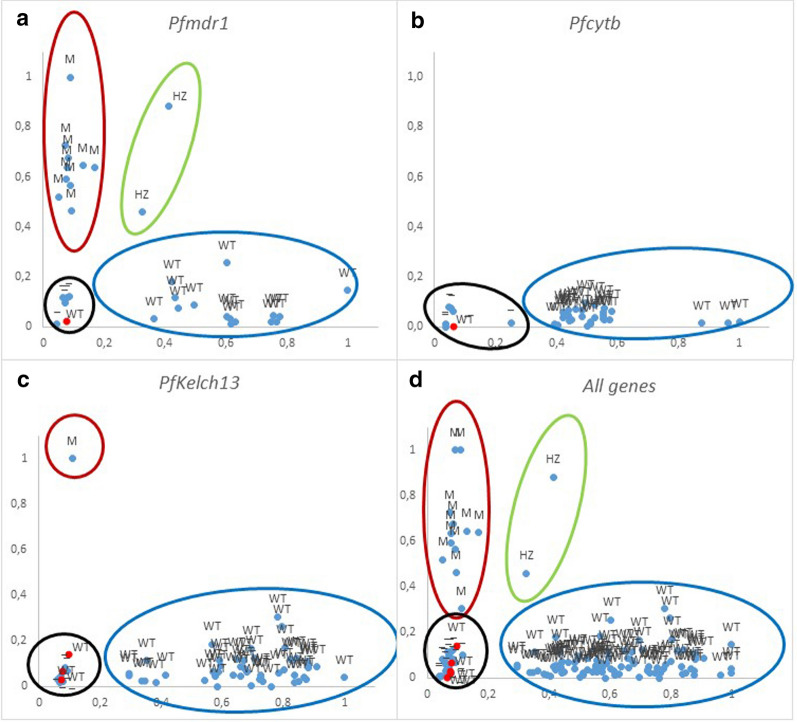
Results: The KASP results showed the same expected mutations and wild type genotypes as the reference method, with few exceptions that correlated with very low parasitaemia samples. In addition, two cases of heterozygotes that had not been detected by sequencing were found. No correlation was found between the MOI or parasitaemia and the KASP values of the sample. The reproducibility of the technique shows no oscillations between repetitions in any of the three SNPs analysed.
Conclusions: The KASP assays developed in this study were efficient and versatile for the determination of the Plasmodium genotypes related to resistance. The method is simple, fast, reproducible with low cost in personnel, material and equipment and scalable, being able to core KASP arrays, including numerous SNPs, to complete the main pattern of mutations associated to P. falciparum resistance.
Keywords: Cytb; K13; KASP; MDR; Plasmodium falciparum; Resistance; SNPs.
Conflict of interest statement
The authors declare that they have no competing interests.
Figures
References
-
- WHO. World malaria report 2019. Geneva: World Health Organization; 2019.
-
- WHO. Artemisinin resistance and artemisinin-based combination therapy efficacy. Geneva: World Health Organization; 2018.
MeSH terms
Substances
Grants and funding
LinkOut - more resources
Full Text Sources
Other Literature Sources
Research Materials
