Review
. 2021 Jan 6;40(1):11.
doi: 10.1186/s13046-020-01798-2.

Noncoding RNAs regulate alternative splicing in Cancer

Affiliations
Review

Noncoding RNAs regulate alternative splicing in Cancer

Yunze Liu et al. J Exp Clin Cancer Res. .

Abstract

AS (alternative splicing) is a fundamental process by which a gene can generate multiple distinct mRNA transcripts to increase protein diversity. Defects in AS influence the occurrence and development of many diseases, including cancers, and are frequently found to participate in various aspects of cancer biology, such as promoting invasion, metastasis, apoptosis resistance and drug resistance. NcRNAs (noncoding RNAs) are an abundant class of RNAs that do not encode proteins. NcRNAs include miRNAs (microRNAs), lncRNAs (long noncoding RNAs), circRNAs (circular RNAs) and snRNAs (small nuclear RNAs) and have been proven to act as regulatory molecules that mediate cancer processes through AS. NcRNAs can directly or indirectly influence a plethora of molecular targets to regulate cis-acting elements, trans-acting factors, or pre-mRNA transcription at multiple levels, affecting the AS process and generating alternatively spliced isoforms. Consequently, ncRNA-mediated AS outcomes affect multiple cellular signaling pathways that promote or suppress cancer progression. In this review, we summarize the current mechanisms by which ncRNAs regulate AS in cancers and discuss their potential clinical applications as biomarkers and therapeutic targets.

Keywords: Alternative splicing; Cancer; Noncoding RNA; circRNA; lncRNA; miRNA; snRNA.


Conflict of interest statement

The authors declare that they have no competing interests.

Figures
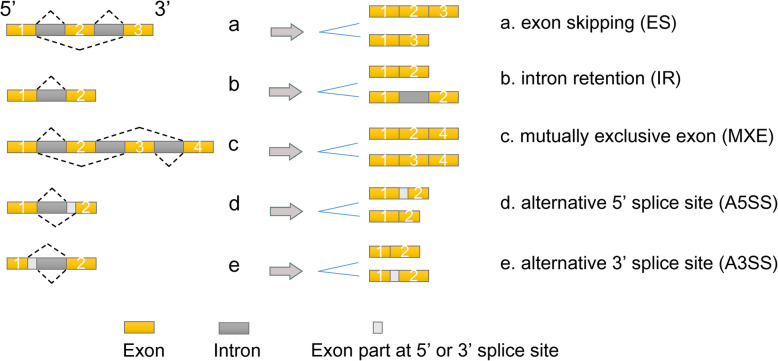
Fig. 1
Fig. 1
Different types of AS. a. ES (exon skipping); b. IR (intron retention); c. MXE (mutually exclusive exon); d. A5SS (alternative 5′ splice site); and e. A3SS (alternative 3′ splice site)
Fig. 2
Fig. 2
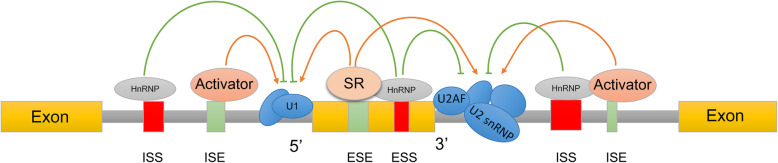
A schematic representation of AS regulated by cis-acting elements and trans-acting factors. The cis-acting elements ESEs and ESSs represent exonic splicing enhancers and silencers, respectively. ISEs and ISSs represent intronic splicing enhancers and silencers, respectively. SR proteins, hnRNPs, or other trans-acting factors bind to cis-acting elements for positive or negative AS regulation by affecting the recruitment or recognition of spliceosome components to splice sites; for example, U1 binds to the 5′ splice site, while U2AF and U2 bind to the 3′ splice site
Fig. 3
Fig. 3
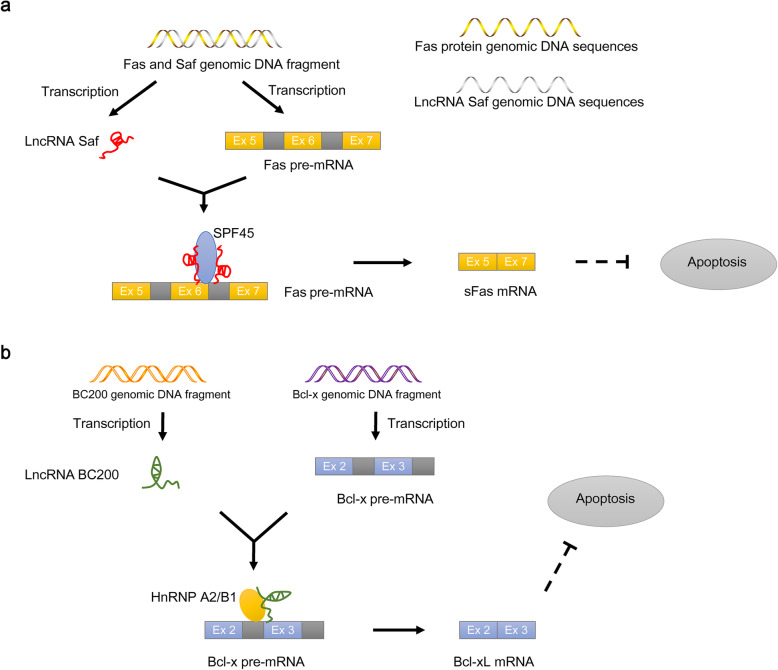
NcRNAs regulate AS through cis-acting elements. a One example of a cis-NAT: the lncRNA Saf binds specifically to the Ex 6 (exon 6) region of the Fas pre-mRNA and recruits SPF45, resulting in the expression of the sFas isoform, which consequently inhibits apoptosis. b One example of a trans-NAT: the lncRNA BC200 binds to Bcl-x pre-mRNA Ex 3 (exon 3) and recruits hnRNPA1/B2 to form the BC200-Bcl-x-hnRNPA2/B1 complex. This complex contributes to Bcl-xL expression and apoptosis resistance in breast tumor cells
Fig. 4
Fig. 4
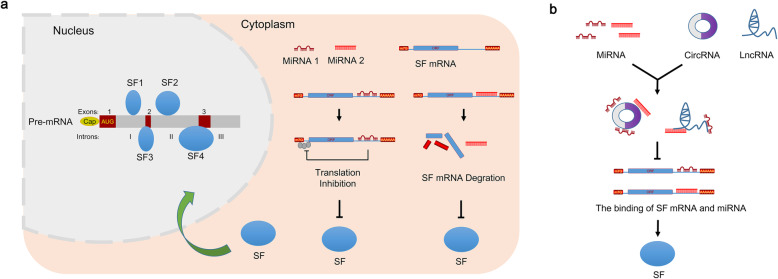
NcRNAs regulate AS through the posttranscriptional regulation of SFs. a MiRNAs silence SFs by directly binding to the SF mRNA. b CircRNAs and lncRNAs can sponge miRNA functions by directly binding to block their function with SF mRNAs, promoting SF expression
Fig. 5
Fig. 5
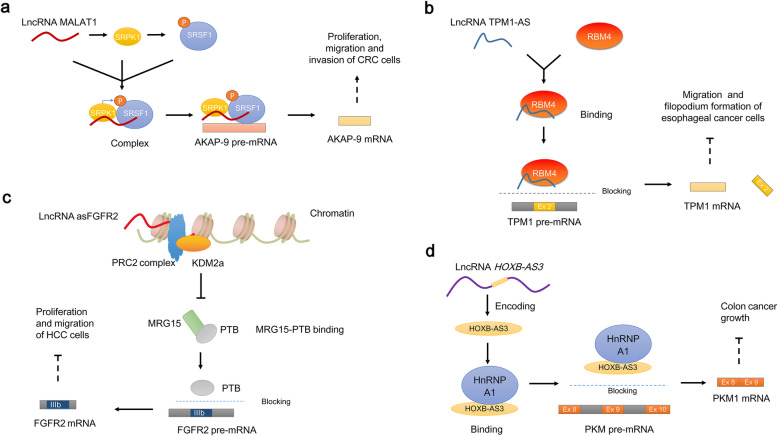
NcRNAs regulate AS through the posttranslational regulation of SFs. a Posttranslational chemical modifications. The lncRNA MALAT1 contributes to SRSF1 phosphorylation by stimulating both the expression and activity of SRPK1, thereby promoting SRSF1-mediated AS of the AKAP-9 pre-mRNA and enhancing the expression of the AKAP-9 isoform, which exacerbates CRC. b Decoy SFs. For example, the lncRNA TPM1-AS can directly block the binding between the SF RBM4 and TPM1 pre-mRNA and regulate AS, inhibiting the progression of cancer. c Chromatin remodeling. The lncRNA asFGFR2 recruits PRC2 and KDM2a to chromatin to form a chromatin environment that disrupts the binding of MRG15-PTB. This disruption alters the location of the SF PTB, promoting FGFR2 mRNA with exon IIIb inclusion and consequently repressing HCC progression. d Encoding functional peptides. The lncRNA HOXB-AS3 encodes the peptide HOXB-AS3, which targets hnRNPA1 and blocks it from binding to PKM pre-mRNA flanking exon 9, decreasing the expression of the PKM2 isoform and consequently repressing the growth of colon cancer
Fig. 6
Fig. 6
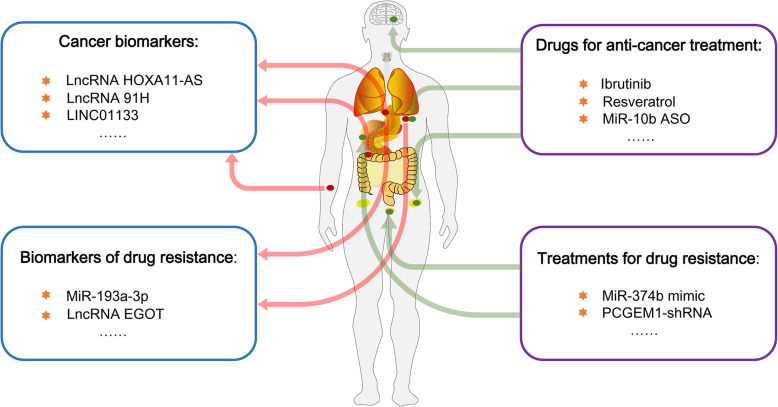
A schematic representation: the diagnostic and therapeutic value of ncRNA-regulated AS in cancer. Multiple ncRNAs can act as diagnostic biomarkers and promising targets for pharmaceutical development in various types of cancers due to their participation in AS events

References

    1. Keren H, Lev-Maor G, Ast G. Alternative splicing and evolution: diversification, exon definition and function. Nat Rev Genet. 2010;11(5):345–355. doi: 10.1038/nrg2776. - DOI - PubMed
    1. Yang X, Coulombe-Huntington J, Kang S, Sheynkman GM, Hao T, Richardson A, et al. Widespread expansion of protein interaction capabilities by alternative splicing. Cell. 2016;164(4):805–817. doi: 10.1016/j.cell.2016.01.029. - DOI - PMC - PubMed
    1. Frampton GM, Ali SM, Rosenzweig M, Chmielecki J, Lu X, Bauer TM, et al. Activation of MET via diverse exon 14 splicing alterations occurs in multiple tumor types and confers clinical sensitivity to MET inhibitors. Cancer Discov. 2015;5(8):850–859. doi: 10.1158/2159-8290.CD-15-0285. - DOI - PubMed
    1. Climente-Gonzalez H, Porta-Pardo E, Godzik A, Eyras E. The functional impact of alternative splicing in Cancer. Cell Rep. 2017;20(9):2215–2226. doi: 10.1016/j.celrep.2017.08.012. - DOI - PubMed
    1. Urbanski LM, Leclair N, Anczukow O. Alternative-splicing defects in cancer: splicing regulators and their downstream targets, guiding the way to novel cancer therapeutics. Wiley Interdiscip Rev RNA. 2018;9(4):e1476. doi: 10.1002/wrna.1476. - DOI - PMC - PubMed

Substances