Review
. 2021 Jan 6;15(1):6.
doi: 10.1186/s13037-020-00281-3.

Current challenges and controversies in the management of scapular fractures: a review

Affiliations
Review

Current challenges and controversies in the management of scapular fractures: a review

Robinson Esteves Pires et al. Patient Saf Surg. .

Abstract

Fractures of the scapula are rare and usually associated with high-energy trauma. The unfavorable scapular anatomy, combined with the complexity of the approaches for fracture fixation, make the treatment challenging, even for experienced surgeons. Furthermore, the literature is controversial regarding surgical indications and rationale for treatment. The present review article was designed to address and discuss critical aspects of decision-making for the management of scapular fractures, including surgical indications and patient safety considerations.

Keywords: Complications; Floating shoulder; Non-operative treatment; Patient safety; Scapular fractures; Surgical decision-making.


Conflict of interest statement

The authors declare that they have no competing interests related with this article.

Figures
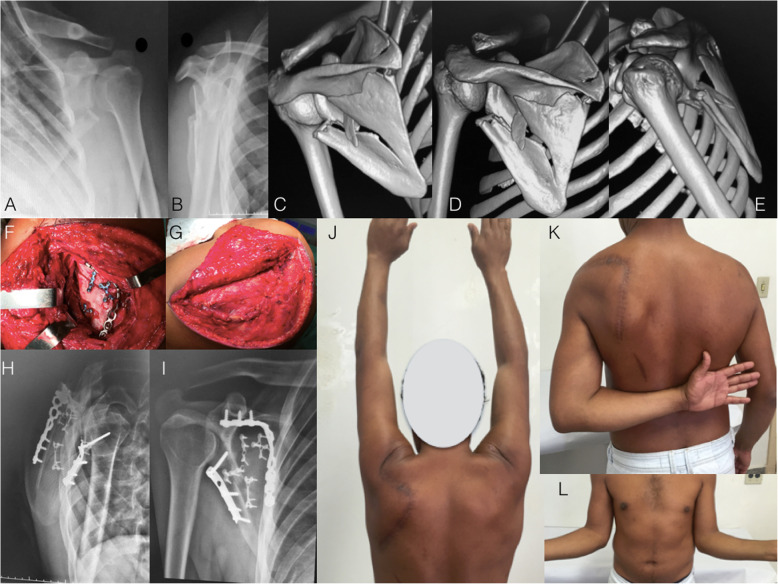
Fig. 1
Fig. 1
a and b: Radiographs of the left shoulder of a 34-year-old male patient who suffered a motorcycle accident and presented a severely displaced and comminuted infraspinous fracture of the scapula body. c, d, and e: Computed tomography with three-dimensional reconstruction. Observe the angulation of the scapula body and the degree of glenoid medialization. f: Perioperative photography depicting the classic Judet approach. Observe the extensile detachment of the infraspinatus muscle. g: Perioperative photography showing the closure and infraspinatus muscle. h and i: Radiographs after three months showing the fracture healing after fixation with one-third tubular plate at the lateral pillar and a twisted reconstruction plate at the medial pillar of the scapula. Fragment-specific fixation using 2.0-mm minifragment plates was also performed. j, k, and l: Postoperative photographs showing complete range of motion recovery after three months of surgery
Fig. 2
Fig. 2
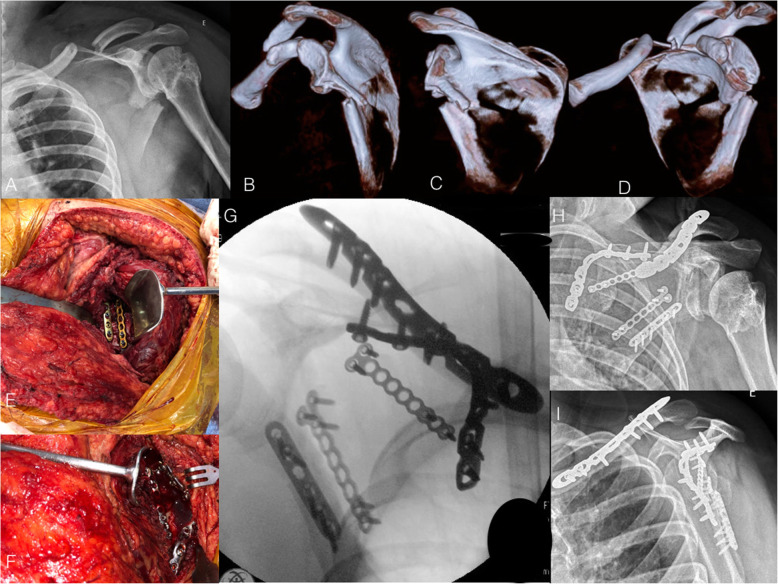
a: Radiograph of the right shoulder in anteroposterior view of a 24-year-old male patient who suffered a car accident and presented a severely displaced midshaft clavicle fracture in combination with an infraglenoid fracture of the scapula body. Observe that the patient presented a sequelae of previous proximal humeral and glenoid fractures, with no residual shoulder instability. b, c, and d: 3-D CT reconstruction showing the medialization of the glenoid and the angulation of the scapular body. e and f: Perioperative photographs depicting the modified Judet approach. Observe the fixation of the lateral pillar of the scapula with two plates at the interval between the infraspinatus and teres minor muscles (e). The medial pillar of the scapula was reduced and fixed with a twisted reconstruction locking plate. Observe the minimal detachment of the infraspinatus muscle (f). g: Perioperative fluoroscopy image showing scapula and clavicle fractures reduction and fixation. h and i: Radiographs in anteroposterior and lateral views showing fracture healing after three months
Fig. 3
Fig. 3
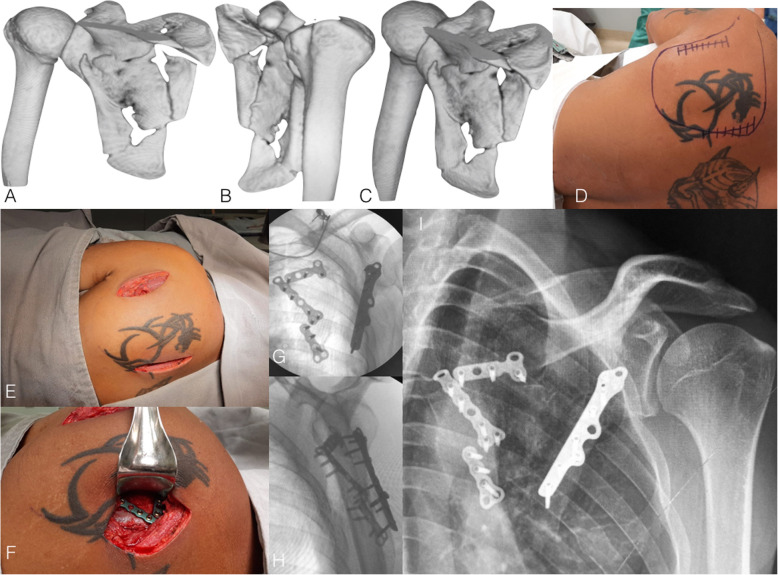
a, b, and c: 3-D CT reconstruction showing a comminuted infraglenoid fracture of the scapular body in a 35-year-old male patient. Observe the angulation of the inferior part of the scapular body and the medialization of the glenoid. d: Preoperative photography depicting the landmarks for minimally invasive approach. e and f: Perioperative photographs showing the lateral (between infraspinatus and teres minor muscles) and medial approaches (partial detachment of the infraspinatus). g and h: Postoperative fluoroscopy images in anteroposterior and lateral views showing fracture reduction and fixation using 2.7 minifragment plates (medial pillar) and the unconventional use of a 2.7 fibular plate (lateral pillar)
Fig. 4
Fig. 4
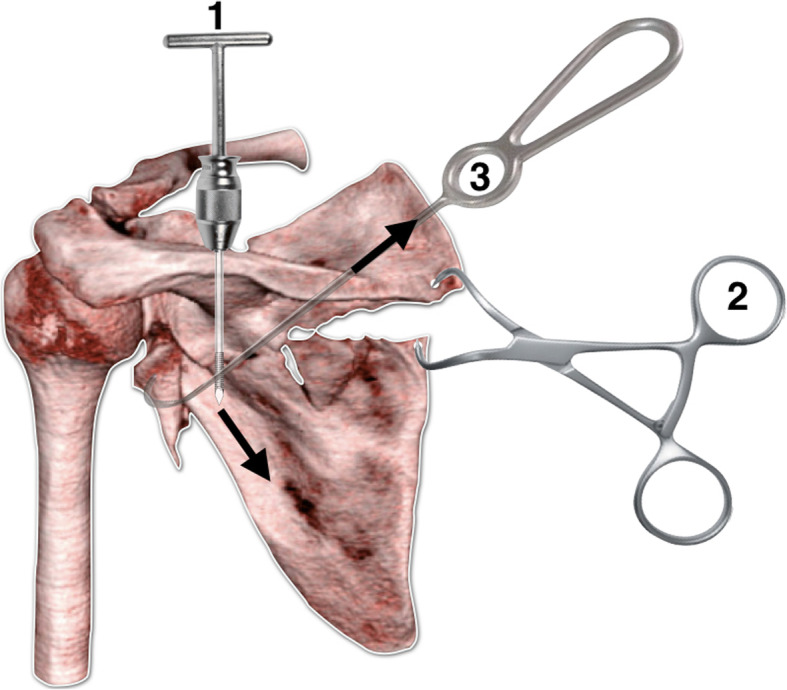
Illustration simulating the sequence of reduction of a displaced fracture of the glenoid and body of the scapula. The reduction starts with the placement of a Schanz screw in the body of the scapula and a traction in the caudal direction is performed to correct the length of the lateral pillar. Then, two holes are performed with a 2.5-mm drill bit on each side of the medial pillar of the scapula and a pointed clamp is used for medial column reduction. Following, a bone hook is used to pull the glenoid fragment in order to achieve reduction. Provisional K-wires or miniplates may be used for reduction maintenance
Fig. 5
Fig. 5
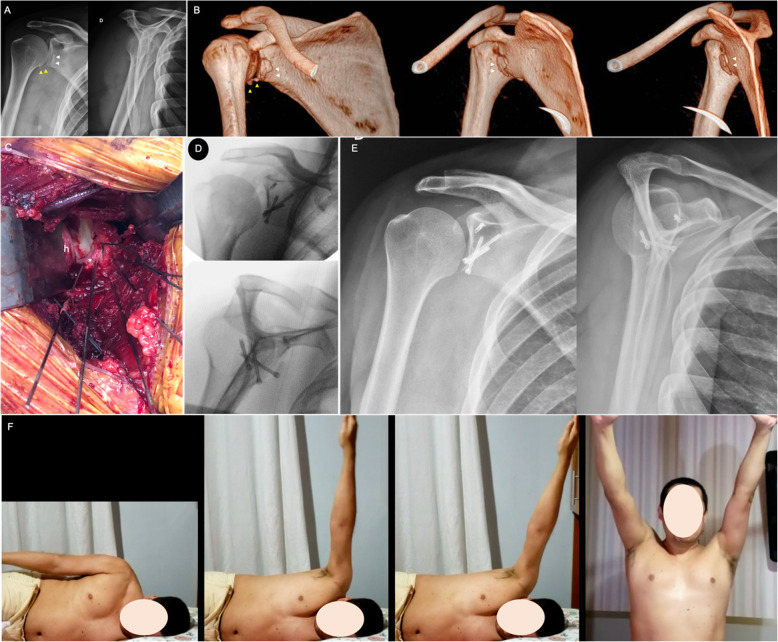
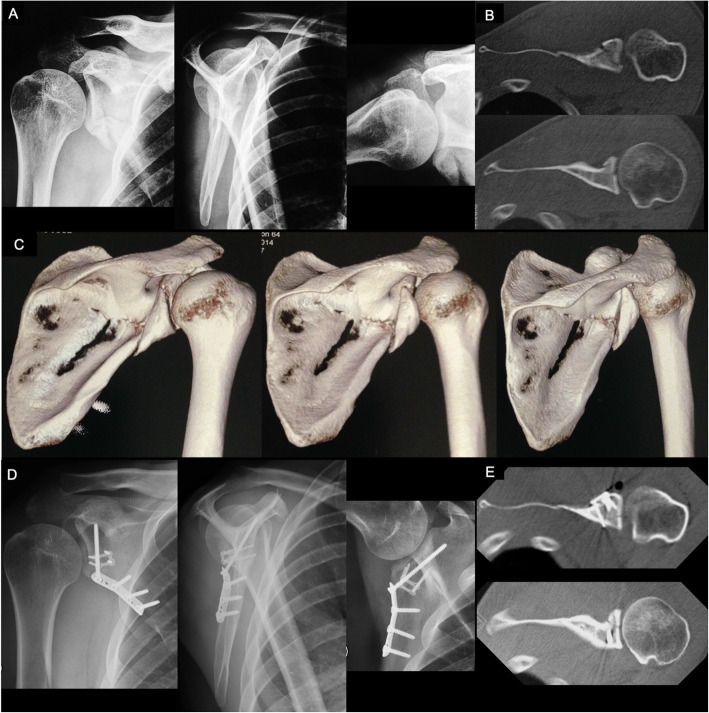
a: Preoperative true AP and lateral scapular radiographic views of the right shoulder of a 40-years-old male patient, showing a step-off on the anteroinferior rim of the glenoid (white arrowheads). Patient reported on a fall from stairs 48 h before. Also note the small bone fragments in the inferior portion of the capsule (yellow arrowheads); b: Preoperative 3-D CT reconstructions showing the displaced anteroinferior glenoid rim fracture (white arrowheads) and small bone fragments in the inferior portion of the capsule (yellow arrowheads); c: Intraoperative image showing the anteroinferior rim fracture anatomically reduced and provisionally fixed with multiple threaded K-wires. Observe the number 2 ethibond® sutures attached to the anterior labrum for posterior repair. * – anteroinferior glenoid rim fragment, h – humerus head; d: Intraoperative true AP and lateral scapular fluoroscopic views of the right shoulder showing final fixation with three 2.4-mm headless screws. Labrum was repaired using a bone anchor and unabsorbable sutures; e: Postoperative true anteroposterior and lateral scapular radiographic views of the right shoulder demonstrating the anatomic reduction of the anterior glenoid rim; f Pictures done during the rehabilitation protocol, demonstrating a satisfactory range of motion of the operated shoulder
Fig. 6
Fig. 6
a: Preoperative true AP, lateral scapular, and axillary radiographic views of the right shoulder of a 25-years-old male patient, showing a displaced inferior glenoid fragment extending to the lateral pillar of the scapular neck and body. Patient reported on a fall from stairs 48 h before. Also note the small bone fragments in the inferior portion of the capsule (yellow arrowheads); b: Preoperative CT axial cuts of the right shoulder demonstrating the displaced inferior glenoid fracture; c: Preoperative 3-D CT reconstructions showing the displaced inferior glenoid fracture extending to the lateral pillar of the scapular neck and body; d: Postoperative true AP, lateral scapular, and axillary radiographic views of the right shoulder demonstrating the anatomic reduction of the inferior glenoid fracture and buttressing with a one-third tubular plate. Observe the 2.3-mm reduction plate used to maintain the reduction during surgery. Note the long 3.5-mm screw inserted through the plate directed to the coracoid process; e: Postoperative CT axial cuts of the right shoulder demonstrating the anatomic reduction of the inferior glenoid fracture
Fig. 7
Fig. 7
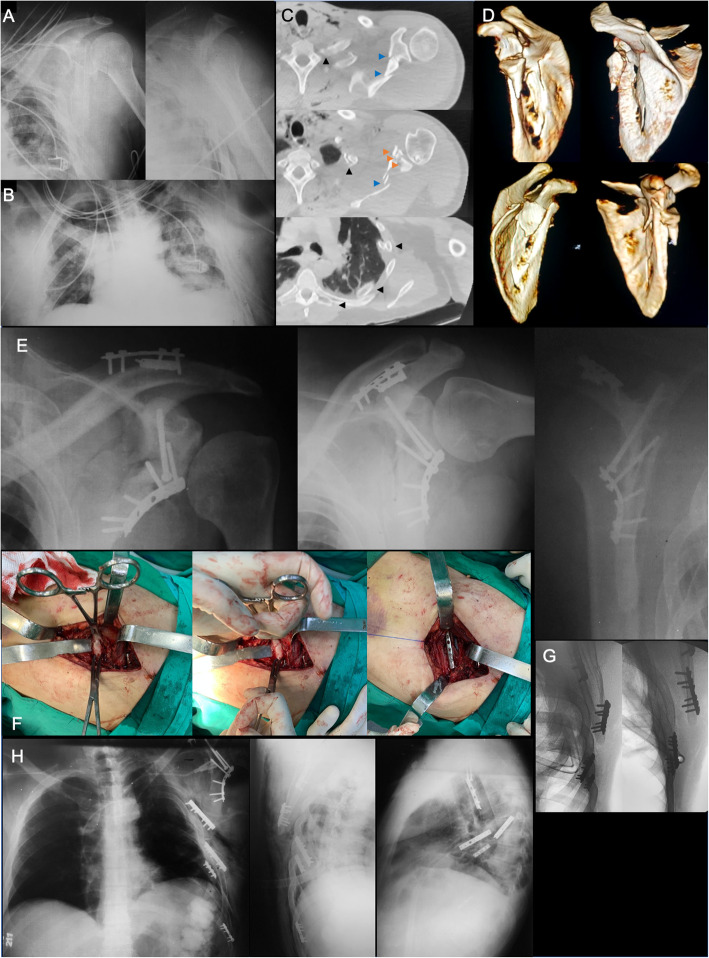
a: Preoperative AP and lateral scapular radiographic views of the left shoulder of a 42-years-old male polytraumatized patient done in the Intensive Care Unit (ICU), showing a comminuted displaced complex scapula fracture; b: Anteroposterior (AP) radiograph of the thorax done in the ICU, demonstrating a drain tube in the left hemithorax due to a traumatic haemopneumothorax; c: Preoperative CT axial cuts of the left shoulder and hemithorax, demonstrating the comminuted displaced complex scapula fracture, involving fragmentation of the glenoid fossa (orange arrowheads) and the scapular body (blue arrowheads). Note the multiple contiguous displaced rib fractures (black arrowheads), extending from the 3rd to the 9th left rib; d: Preoperative 3-D CT reconstructions showing comminuted displaced complex scapula fracture, involving fragmentation of the glenoid fossa and the scapular body. Observe the angled fracture of the spine of the scapular; e: Immediate postoperative true AP, AP, and lateral scapular views of the left shoulder demonstrating the fixation of the most proximal fractures of the scapula. Note the anatomic reduction of the glenoid fossa fracture. Patient was operated on in two steps, apart 5 days from each other; f: Intraoperative images of the 2nd operative procedure performed for the management of some rib fractures and the inferior angle of the scapular body. Observe the sequential reduction and fixation of the 6th left rib with a 2.0-mm straight non-locked plate; g: Intraoperative fluoroscopic images demonstrating the final fixation of the 6th, 7th, and 9th rib fractures, and the inferior angle of the scapular body; h, Postoperative AP, oblique, and lateral radiographs of the thorax, demonstrating the adequate reduction of both the complex left scapular and the multiple left rib fractures. Postoperative in-hospital and after discharge management protocols are the same as previously described for glenoid cavity fractures
Fig. 8
Fig. 8
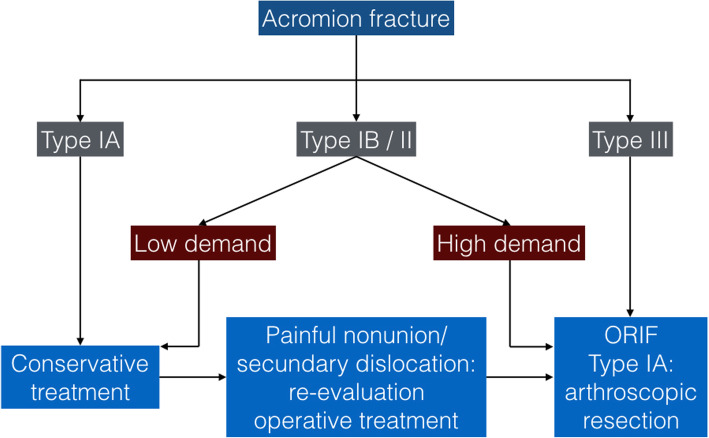
Proposed treatment algorithm for acromion fractures by Hess et al. [18] The classification is based on the original system described by Kuhn et al. [19]
Fig. 9
Fig. 9
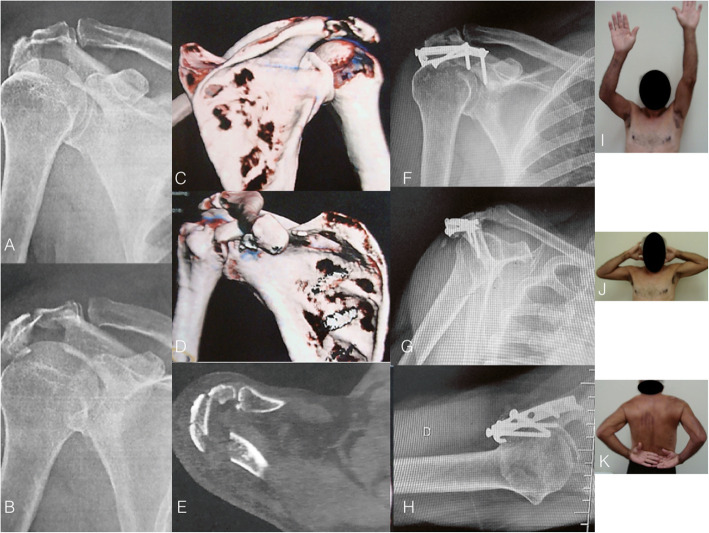
a and b: Radiographs of the shoulder showing a Kuhn et al. [18] type-II multifragmentary fracture of the acromion extending to the most lateral part of the scapular spine. c, d, and e: Observe the amount of comminution on the CT scan. There is no obvious reduction of the subacromial space. f, g, and h: Fracture fixation was performed with a superiorly placed non-locked one-third tubular plate. i, j, and k: Observe the functional range of motion of the operated shoulder after fracture healing at 24 months postoperatively
Fig. 10
Fig. 10
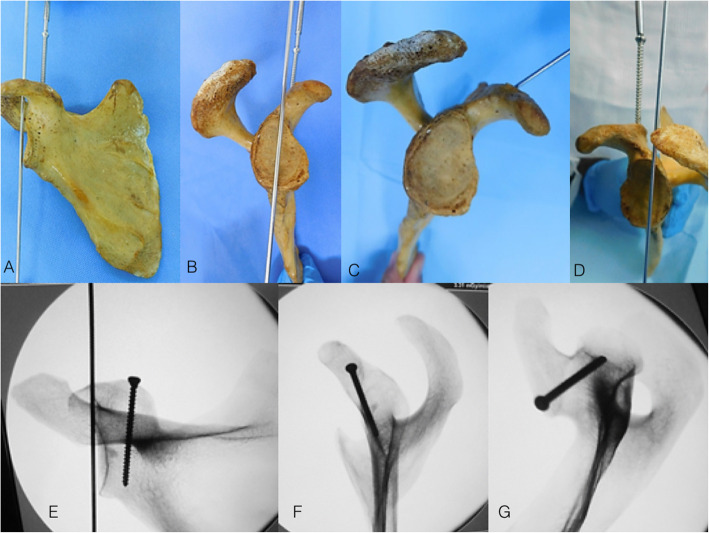
a, b, c, and d: Photographs of a scapular specimens showing the placement of K-wire parallel to the glenoid fossa, guiding the screw placement into the coracoid process. Observe that the screw must be positioned parallel to the longest axis of the glenoid. e, f, and g: Fluoroscopy images showing the coracoid fixation
Fig. 11
Fig. 11
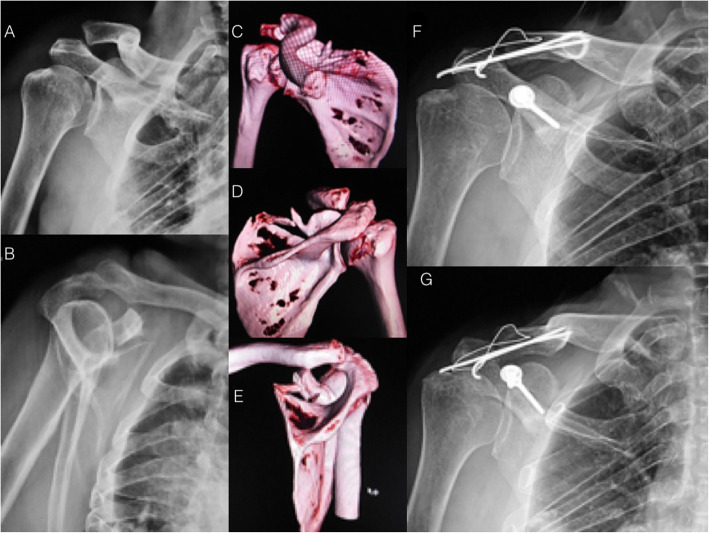
Radiographs (a and b) and 3D-CT reconstruction (c, d, and e) showing the fractures of the coracoid process and scapular spine associated with acromioclavicular dislocation. f and g: Postoperative radiographs showing the coracoid process fracture fixation with two 3.5 mm cortical screws and the acromioclavicular fixation with a static tension band

References

    1. Rowe CR. Fractures of the scapula. Surg Clin North Am. 1963;43:1565–1571. doi: 10.1016/S0039-6109(16)37145-6. - DOI - PubMed
    1. Vidović D, Benčić I, Ćuti T, Bakota B, Bekić M, Dobrić I, Sabalić S, Blažević D. Surgical treatment of scapular fractures: results and complications. Injury. 2020;S0020-1383(20):30772–30775. doi: 10.1016/j.injury.2020.09.031. - DOI - PubMed
    1. Kaya HA, Eroglu O, Günal N, ÇoSskun F, Deniz T. The relation between scapula fracture and the severity of trauma in blunt thoracic trauma. Turk J Med Sci. 2018;48:1228–1233. doi: 10.3906/sag-1802-149. - DOI - PubMed
    1. Voleti P, Namdari S, Mehta S. Fractures of the scapula: diagnosis, indications, and operative technique. Univ Penn Orthop J. 2013;23:57–61.
    1. Armitage BM, Wijdicks CA, Tarkin IS, Schroder LK, Marek DJ, Zlowodzki M, Cole PA. Mapping of scapular fractures with three-dimensional computed tomography. J Bone Joint Surg Am. 2009;91(9):2222–2228. doi: 10.2106/JBJS.H.00881. - DOI - PubMed

LinkOut - more resources