. 2021 Jan 6;23(1):1.
doi: 10.1186/s13058-020-01379-3.

Acquired mutations and transcriptional remodeling in long-term estrogen-deprived locoregional breast cancer recurrences

Affiliations

Acquired mutations and transcriptional remodeling in long-term estrogen-deprived locoregional breast cancer recurrences

Nolan Priedigkeit et al. Breast Cancer Res. .

Abstract

Background: Endocrine therapy resistance is a hallmark of advanced estrogen receptor (ER)-positive breast cancer. In this study, we aimed to determine acquired genomic changes in endocrine-resistant disease.

Methods: We performed DNA/RNA hybrid-capture sequencing on 12 locoregional recurrences after long-term estrogen deprivation and identified acquired genomic changes versus each tumor's matched primary.

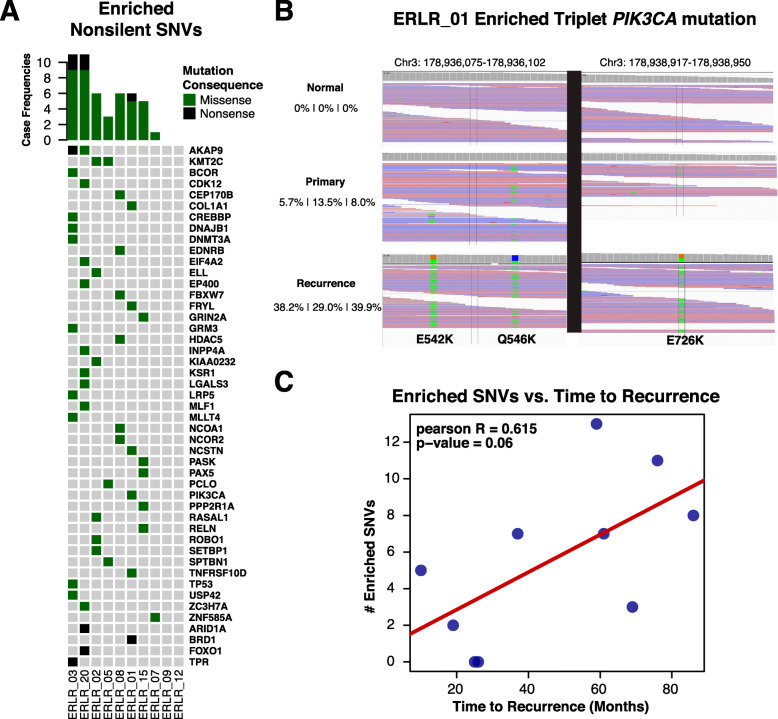
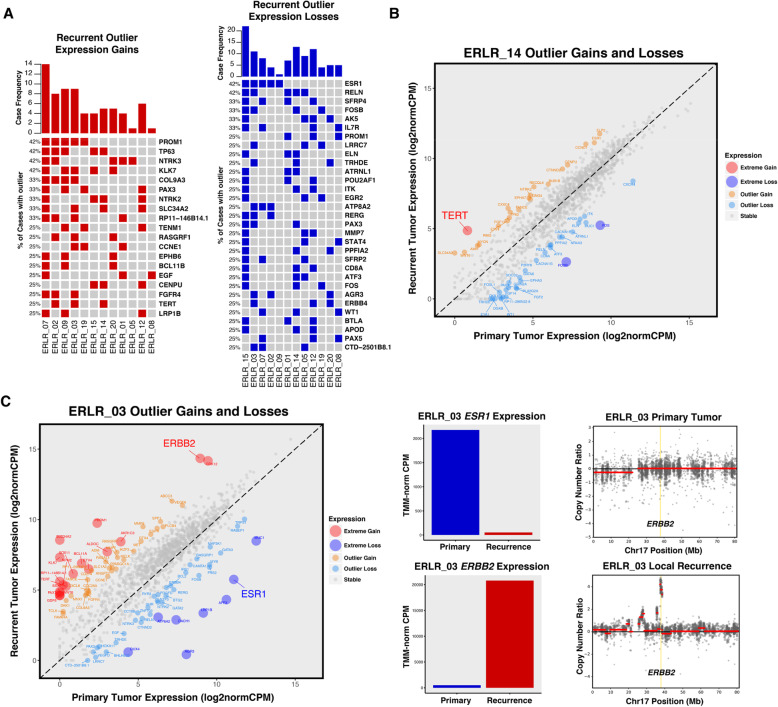
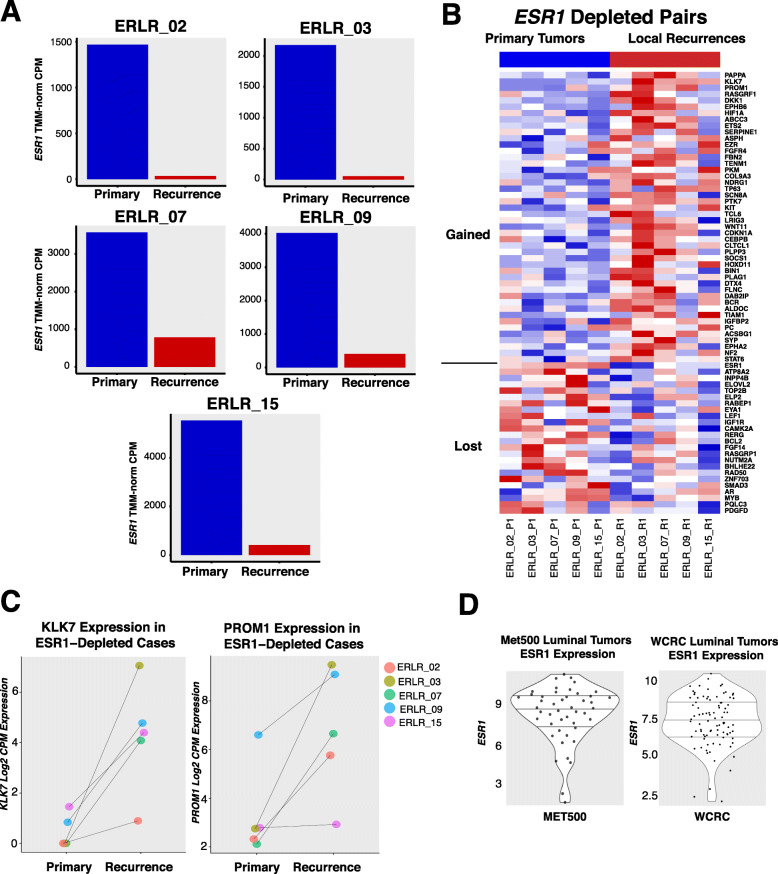
Results: Despite being up to 7 years removed from the primary lesion, most recurrences harbored similar intrinsic transcriptional and copy number profiles. Only two genes, AKAP9 and KMT2C, were found to have single nucleotide variant (SNV) enrichments in more than one recurrence. Enriched mutations in single cases included SNVs within transcriptional regulators such as ARID1A, TP53, FOXO1, BRD1, NCOA1, and NCOR2 with one local recurrence gaining three PIK3CA mutations. In contrast to DNA-level changes, we discovered recurrent outlier mRNA expression alterations were common-including outlier gains in TP63 (n = 5 cases [42%]), NTRK3 (n = 5 [42%]), NTRK2 (n = 4 [33%]), PAX3 (n = 4 [33%]), FGFR4 (n = 3 [25%]), and TERT (n = 3 [25%]). Recurrent losses involved ESR1 (n = 5 [42%]), RELN (n = 5 [42%]), SFRP4 (n = 4 [33%]), and FOSB (n = 4 [33%]). ESR1-depleted recurrences harbored shared transcriptional remodeling events including upregulation of PROM1 and other basal cancer markers.

Conclusions: Taken together, this study defines acquired genomic changes in long-term, estrogen-deprived disease; highlights the importance of longitudinal RNA profiling; and identifies a common ESR1-depleted endocrine-resistant breast cancer subtype with basal-like transcriptional reprogramming.

Keywords: ARID1A; Breast cancer; Cancer genomics; Copy number alterations; DNA-seq; ESR1; Endocrine therapy; Estrogen receptor; Exome capture; FFPE; Locoregional recurrence; NTRK; RNA-seq; Targeted sequencing; Therapy resistance; Tumor profiling.


Conflict of interest statement

Illumina provided free reagents for the study but had no role in the study design, data analysis, or conclusions. AVL is on the Scientific Advisory Board and a stockholder in Ocean Genomics. CD reports personal fees from Novartis, Roche, MSD Oncology, and Daiichi Sankyo and grants from Myriad Genetics and is a shareholder of Sividon Diagnostics/Myriad. In addition, Dr. Denkert has a patent EP18209672 pending, a patent EP20150702464 pending, and a patent Software (VMscope digital pathology) pending. JUB has received Honoraria from Amgen, AstraZeneca, Pfizer, Novartis, SonoScape, MSD Oncology, and Roche and has served a consulting role for Pfizer, Amgen, Novartis, AstraZeneca, and Roche.

Figures
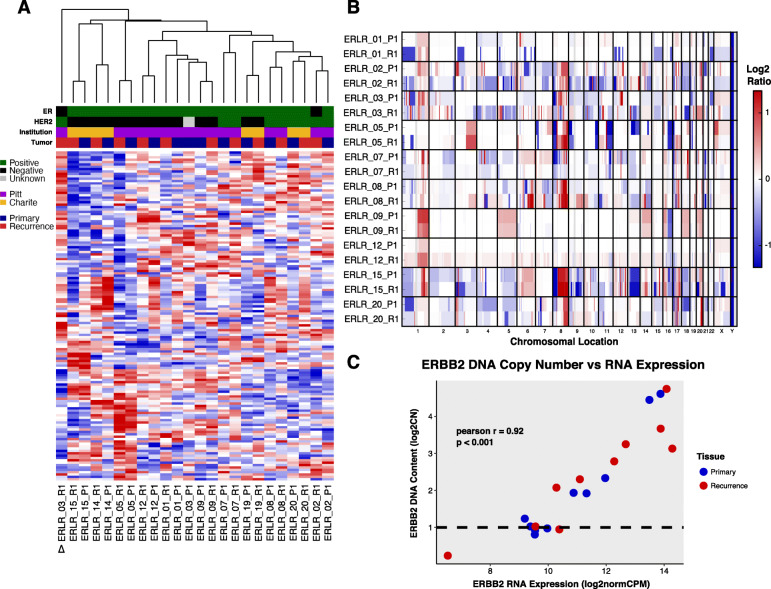
Fig. 1
Fig. 1
Transcriptional and CNA profiles of ER-positive local recurrences. a Unsupervised hierarchical clustering and heatmap (red = high relative expression, blue = low relative expression) on normalized gene expression values from patient-matched pairs (P1 = primary, R1 = recurrence). Clinical ER and HER2 status (black = negative, green = positive, gray = unknown), tissue source site (purple = Pitt, yellow = Charite), and tumor type (blue = primary, red = recurrence) are indicated. Delta symbol shows distinct clustering of ERLR_03_R1 away from its matched primary, ERLR_03_P1. b Heatmap of copy number ratios from patient-matched pairs. Redder regions indicate regions of copy number gain and bluer regions indicate regions of loss. c Correlation between ERBB2 DNA copy number calls and normalized expression values
Fig. 2
Fig. 2
SNV enrichments in ER-positive local recurrences. a OncoPrint of non-silent, enriched single nucleotide variants in patient-matched cases. Missense variants are indicated with a green box and nonsense variants with black. b Triplet mutation enrichment of PIK3CA mutations in case ERLR_01. Collapsed IGV alignments are shown, along with allele frequencies, for the normal, primary, and recurrence. c Frequency of enriched, non-silent single nucleotide variants versus time to recurrence along with Pearson R and calculated p value
Fig. 3
Fig. 3
Outlier expression gains and losses in ER-positive local recurrences. a OncoPrint of outlier expression gains (red) and outlier expression losses (blue) in ER-positive local recurrences. Genes are sorted by frequency of outlier changes across pairs. b Extreme expression gain of TERT in case ERLR_14; 2 other cases showed similar TERT enrichments in recurrent tumors. c Extreme expression gain and loss of ERBB2 and ESR1, respectively. TMM-normalized CPM values of primary (blue) and recurrent (red) tumor. ERBB2 expression gain is driven by recurrence-specific DNA-level amplification of ERBB2 locus
Fig. 4
Fig. 4
ESR1-depleted recurrences. a TMM-normalized expression of patient-matched local recurrences; primary tumor expression in blue, recurrent tumor expression in red. b Heatmap of differentially expressed genes (nominal p value < 0.05, red = high relative expression, blue = low relative expression) in ESR1-depleted recurrences versus matched primary tumors. Genes are sorted by p value and segregated by log2 fold-change values; log2 fold change > 0 on top, log2 fold change < 0 on bottom. c Ladder plots showing log2normCPM expression values for both KLK7 and PROM1, two of the most significantly upregulated genes in local recurrences with the largest average log2 fold changes. d ESR1 expression in metastatic, endocrine-resistant luminal tumors—MET500 (n = 47) and WCRC (n = 89) cohorts

References

    1. Early Breast Cancer Trialists’ Collaborative Group (EBCTCG) et al. Relevance of breast cancer hormone receptors and other factors to the efficacy of adjuvant tamoxifen: patient-level meta-analysis of randomised trials. Lancet. 2011;378:771–784. doi: 10.1016/S0140-6736(11)60993-8. - DOI - PMC - PubMed
    1. Davies C, et al. Long-term effects of continuing adjuvant tamoxifen to 10 years versus stopping at 5 years after diagnosis of oestrogen receptor-positive breast cancer: ATLAS, a randomised trial. Lancet. 2013;381:805–816. doi: 10.1016/S0140-6736(12)61963-1. - DOI - PMC - PubMed
    1. Goss PE, et al. Extending aromatase-inhibitor adjuvant therapy to 10 years. N Engl J Med. 2016;375:209–219. doi: 10.1056/NEJMoa1604700. - DOI - PMC - PubMed
    1. Jacobson JA, et al. Ten-year results of a comparison of conservation with mastectomy in the treatment of stage I and II breast cancer. N Engl J Med. 1995;332:907–911. doi: 10.1056/NEJM199504063321402. - DOI - PubMed
    1. Robinson DR, et al. Activating ESR1 mutations in hormone-resistant metastatic breast cancer. Nat Genet. 2013;45:1446–1451. doi: 10.1038/ng.2823. - DOI - PMC - PubMed

Publication types